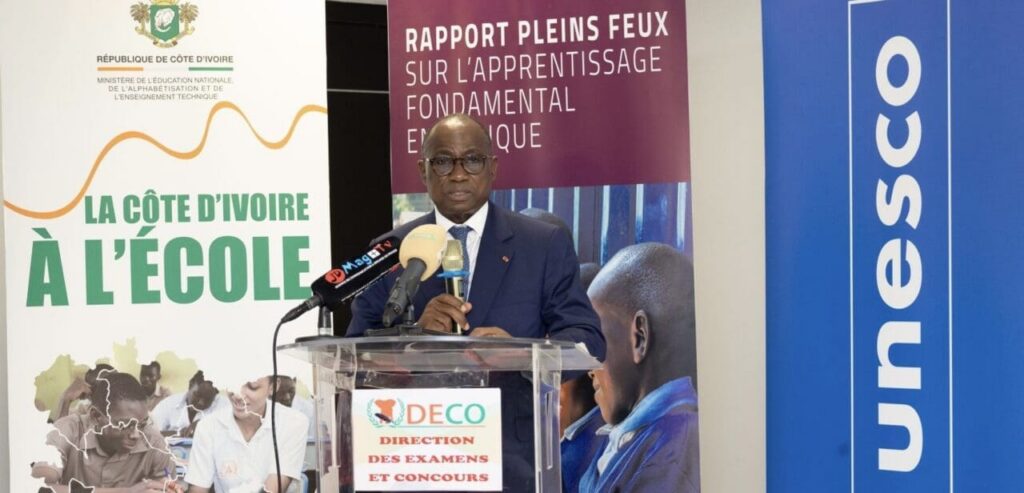
In April 2026, Abidjan unveiled Pleins Feux, a groundbreaking initiative designed to supercharge Côte d’Ivoire’s education system. Backed by international partners and aligned with President Alassane Ouattara’s vision, this project targets the core of the country’s educational challenges: strengthening governance and amplifying the impact of public policies to elevate learning standards sustainably.
With a population surpassing 30 million and a youthful demographic, Côte d’Ivoire faces mounting pressure on its education infrastructure, particularly in rural areas where access remains uneven. Education has emerged as a cornerstone of the President’s agenda, echoing the United Nations’ Sustainable Development Goal 4 (SDG 4) and the 2030 Agenda. Over the past decade, Ivorian authorities have relentlessly pursued reforms to democratize access and elevate teaching quality.

scaling up teacher recruitment and school infrastructure
Since 2011, Côte d’Ivoire has significantly expanded its teaching workforce, hiring over 69,000 primary school teachers and more than 30,000 secondary educators. Recent efforts have prioritized science disciplines, with 1,800 additional math and physics teachers deployed to meet labor market demands and fuel the country’s economic transformation ambitions.
Investments in school infrastructure have also accelerated, particularly in rural zones, to shrink distances, reduce dropout rates, and bring education closer to students. New facilities across the nation have broadened educational coverage, while the CAFOP de Boundiali in northern Côte d’Ivoire exemplifies this push. The center’s entrance exams in 2026 drew nearly 68,000 applicants for just 7,000 spots, underscoring a structured push to fortify teacher training and renewal.
prioritizing school climate and inclusion
Enhancing teaching conditions has become a pivotal lever in education policy. Between 2011 and 2025, starting salaries in primary schools surged by over 30%, while secondary teachers saw increases up to 15%. These adjustments bolster the profession’s appeal and stabilize teaching teams. Concurrently, efforts to modernize school environments have gained traction, including the adoption of tailored learning materials for students with disabilities—a leap toward a more inclusive education system.
Preventive measures, such as campaigns targeting school-related pregnancies, further safeguard educational trajectories by reducing dropout risks and encouraging students to stay in school.
Pleins Feux: a governance-driven transformation
Unveiled in Abidjan on April 12, 2026, Pleins Feux is a governance-focused project designed to refine the management and execution of educational policies. Unlike infrastructure or staffing initiatives, it zeroes in on enhancing the decision-making and oversight capabilities of educators and policymakers.
Developed in partnership with UNESCO, the African Union, and the Global Education Monitoring Report (GEM), the program reflects two years of collaborative work in Côte d’Ivoire, Ghana, and Ethiopia. Its goal is to equip decision-makers and educational supervisors with the tools to drive tangible improvements in learning outcomes nationwide.
The initiative arrives as international partners commend Côte d’Ivoire’s progress in foundational learning. In response, the Ivorian government continues to diversify its alliances—leveraging international, regional, and private sector partnerships—to sustain and accelerate the transformation of its education system.