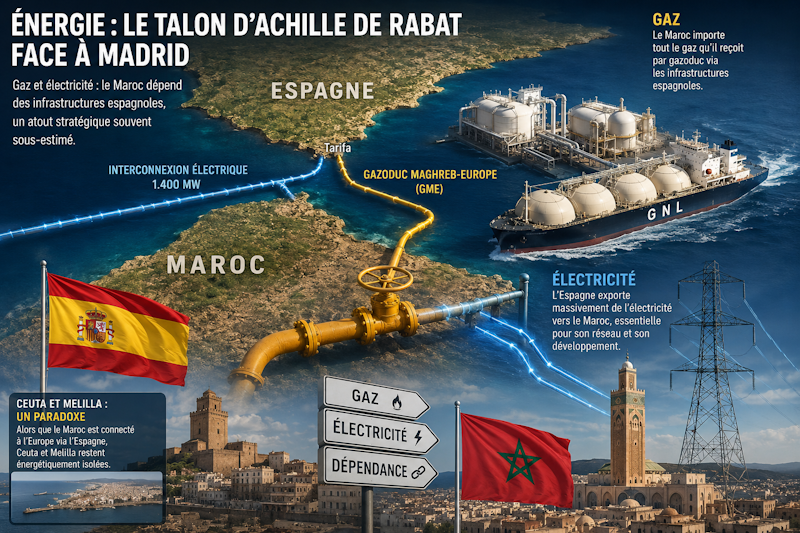

The escalating tensions between Madrid and Rabat often focus on migration flows, territorial disputes, or security cooperation. Yet beneath these headline-grabbing issues lies a quieter but no less critical vulnerability: Morocco’s heavy reliance on Spanish energy infrastructure.
Despite its assertive stance on Ceuta and Melilla, the kingdom remains largely dependent on neighboring Spain for both natural gas and electricity supply. This dependency creates a paradox in bilateral relations, where Rabat’s geopolitical ambitions clash with its energy reliance on Madrid.
The current energy landscape highlights how Spain holds unexpected leverage in this standoff. From gas pipelines to electrical interconnections, Spanish networks have become indispensable to Morocco’s energy security.
Gas pipeline reversal shifts power dynamics
The rupture of Morocco-Algeria relations in 2021 fundamentally altered the energy equation. When Algeria terminated the Maghreb-Europe Gas Pipeline (GME) agreement, cutting off Algerian gas transit through Morocco, the infrastructure took on a new role.
Rather than carrying Algerian gas to Spain, the GME reversed direction, becoming a conduit through which Spain now supplies gas to Morocco. Official 2025 data reveals the scale of this energy flow: Morocco imported approximately 10.3 TWh of gas via the GME, accounting for nearly a quarter of Spain’s total gas exports that year and translating to nearly €400 million in energy costs.
This transformation turned a once-symmetrical relationship into a clear dependency. What was once a transit corridor for Algerian gas has become a lifeline for Morocco’s energy needs through Spanish-controlled infrastructure.
Rabat’s push for energy diversification
Moroccan authorities recognize this vulnerability. The country’s energy strategy now prioritizes reducing reliance on Spanish networks through several key initiatives:
- Nador West Med LNG terminal: When completed, this facility will allow direct maritime gas imports, bypassing Spanish regasification terminals and injecting gas directly into the Maghreb-Europe pipeline.
- Nigeria-Morocco gas pipeline: This ambitious project aims to connect West African gas reserves to Moroccan markets, potentially reshaping regional energy dynamics.
However, these solutions require substantial investment and years to implement. Until then, Spain’s energy networks remain Morocco’s primary source for both gas and electricity.
Electricity interconnections: Spain’s silent advantage
Morocco’s energy dependency extends beyond gas. Two high-capacity submarine cables link the Spanish and Moroccan electrical grids, with a combined capacity of 1,400 MW.
In 2025, Spain exported 3,743 GWh of electricity to Morocco, a 47.5% increase from the previous year and the highest level since 2017. The energy flow overwhelmingly favors Spain, with nearly three-quarters of the interconnection’s capacity used for exports to Morocco.
This electrical interconnection serves multiple purposes. It provides Morocco with additional capacity during peak demand periods while supporting the country’s expanding renewable energy infrastructure. Madrid and Rabat are now considering adding a third submarine cable to further enhance these exchanges.
The Ceuta and Melilla paradox
The energy relationship reveals another striking contrast. While Morocco benefits from direct connection to the European electrical grid via Spain, the Spanish cities of Ceuta and Melilla have historically operated as energy islands.
Ceuta is set to break this isolation in 2026 with a new €300 million submarine cable linking the city to mainland Spain. However, Melilla’s geographical distance makes similar integration unlikely.
This disparity underscores a remarkable reality: Morocco’s mainland is connected to Europe’s energy network through Spain, while parts of Spanish territory remain reliant on isolated systems.
Energy interdependence: a new dimension in geopolitical calculus
The traditional view of these energy ties focused solely on economic considerations. Yet recent geopolitical tensions in the Mediterranean have transformed these networks into strategic assets.
While Spain has no apparent interest in weaponizing its energy exports, the structural dependency creates a potential diplomatic lever. This vulnerability introduces a new variable into the Madrid-Rabat relationship, where Rabat’s traditional advantages may be counterbalanced by Madrid’s energy influence.
Previous analyses often highlighted Morocco’s strengths in migration control, counterterrorism cooperation, and territorial claims. Energy now emerges as an equally significant factor, giving Spain unexpected strategic weight in the bilateral equation.
Madrid’s strategic position in energy relations
Rabat’s efforts to diversify energy sources—through LNG terminals and the Nigeria-Morocco pipeline—demonstrate clear recognition of this vulnerability. Yet these alternatives remain years away from operational capacity.
In the interim, Spain holds a unique position: its infrastructure serves as both the primary entry point for Morocco’s piped gas imports and the gateway connecting Morocco’s electrical grid to Europe’s continental network.As tensions persist around Ceuta and Melilla and geopolitical competition intensifies in the western Mediterranean, this energy reality may become an increasingly important factor in the balance of power between the two kingdoms. Morocco possesses significant leverage in many areas, but Spain’s energy networks represent a counterbalance that is both substantial and often overlooked.



More Stories
Burkina Faso’s shrinking public payroll: a household burden as schools reopen
Simporé’s televised admission: can Burkina Faso’s army still hold the line?
Gabon’s ghost worker purge: can 11 billion CFA francs in savings really reach the people?