
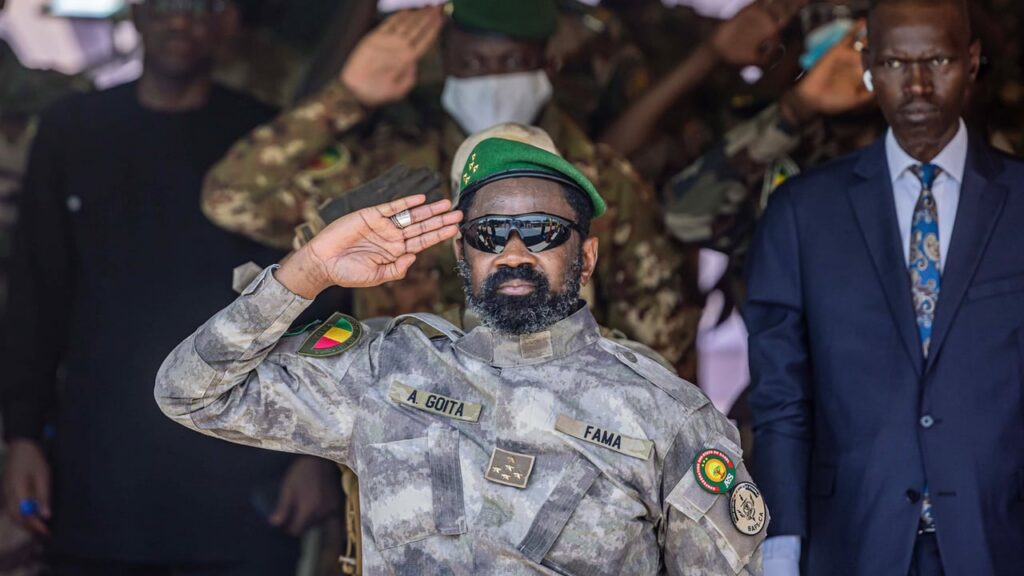

In the heart of Bamako, where the Niger River weaves through the daily rhythm of life, Mali’s leader, Assimi Goïta, stands at the crossroads of power and fragility. His grip on authority has tightened in recent months, yet the foundations beneath him remain shaky—both politically and security-wise.
The nation’s interim president, Assimi Goïta, has emerged as the defining figure in a country where instability has become its most persistent challenge. Since assuming leadership, his decisions have shaped Mali’s trajectory, yet the shadow of uncertainty looms large over his government’s ability to sustain control.
From military commander to interim president
Assimi Goïta’s rise to prominence began long before his current role. A career officer in Mali’s armed forces, his reputation was forged in the crucible of conflict. His pivotal role in the 2020 coup that ousted Ibrahim Boubacar Keïta marked the first turning point in his political ascent. Later, when he orchestrated another transition in 2021, he cemented his position as Mali’s de facto leader.
Initially, Goïta presented himself as a stabilising force—a military man tasked with restoring order in a nation grappling with jihadist insurgencies and political turmoil. Yet, as time has passed, the challenges have only multiplied, testing the resilience of his leadership.
A fragile mandate under pressure
The fragility of Assimi Goïta’s rule is not merely a matter of perception—it is etched into Mali’s current realities. The country remains embroiled in a relentless security crisis, with armed groups tightening their hold on vast swathes of territory. The loss of key military figures, including Defence Minister Sadio Camara, has further exposed vulnerabilities within the government’s security apparatus.
The funeral of Sadio Camara in late April 2026 became a stark reminder of the stakes at play. In Bamako, the ceremony was not just a farewell to a fallen leader but a moment of reckoning for a nation at war with itself. The presence of Assimi Goïta at the event underscored his central role in Mali’s struggle to regain stability.
The spectre of past transitions
Mali’s political landscape is littered with the remnants of past transitions, each leaving behind unfulfilled promises and lingering disillusionment. The legacy of Ibrahim Boubacar Keïta, Mali’s former president, serves as a cautionary tale. His ousting in 2020 was followed by a period of cautious optimism, yet the transition that followed has struggled to deliver tangible progress.
Under Goïta’s leadership, the interim government has sought to chart a new course, but the path forward remains fraught with obstacles. The growing influence of armed factions, including the Jama’at Nusrat al-Islam wal Muslimin (JNIM), has eroded trust in the state’s ability to protect its citizens. Meanwhile, international partnerships—once seen as lifelines—have become sources of contention, complicating efforts to restore security.
The interim government faces a daunting task: balancing the demands of a weary population with the harsh realities of a conflict that shows no signs of abating. For Goïta, the challenge is not just about maintaining power—it is about proving that Mali can still find a way forward, despite the odds stacked against it.
What lies ahead for Mali’s leader?
The coming months will be decisive for Assimi Goïta and the future of Mali. With the country’s stability hanging in the balance, the choices he makes today will shape Mali’s destiny for years to come. Can his leadership bridge the divides that threaten to tear the nation apart? Or will the cycle of instability continue, leaving Mali trapped in a state of perpetual crisis?
The answers to these questions remain uncertain, but one thing is clear: the path forward for Mali—and for Assimi Goïta—will be anything but straightforward.

More Stories
Ivorian president alassane ouattara concludes Kenya diplomatic mission
Kaliningrad trapped between NATO’s tightening grip
Bénin: live streaming of presidential inauguration free on all mobile networks