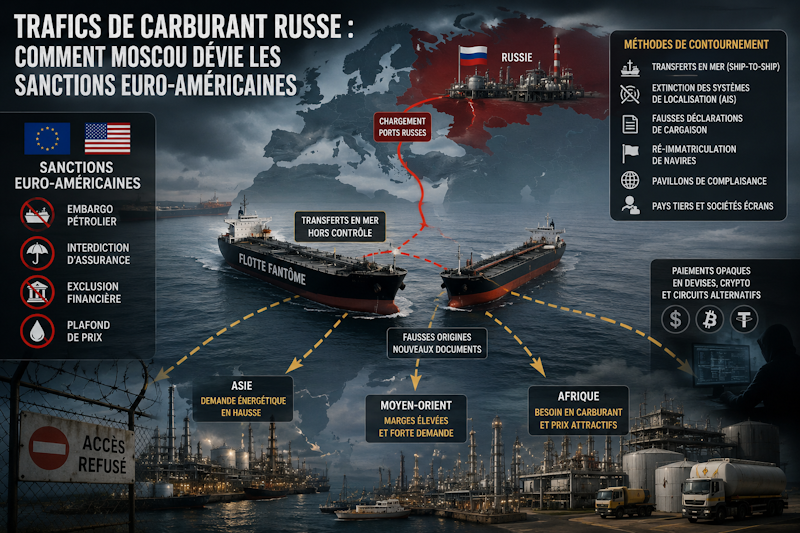
Investigations by multiple sources reveal a growing role for Morocco in facilitating the covert transportation of Russian oil products to markets closed off by Western sanctions since the 2022 invasion of Ukraine. The North African kingdom has emerged as a critical hub in this shadow trade network.
Geneva-based trader orchestrates complex supply chains
The key player in this operation appears to be Alvari SA, a discreet trading firm headquartered in Geneva. According to detailed reports, this company has orchestrated multimillion-dollar shipments of Russian oil derivatives to Morocco since 2025, establishing the country as North Africa’s largest importer of Russian fuel. Three tankers—Tranquil Sea, Duke II, and Eldia—have been identified as part of this network, transporting diesel and other refined products from Baltic Sea terminals to Morocco‘s ports of Jorf Lasfar and Mohammedia.
The Tranquil Sea case exemplifies the sophisticated methods used to obscure these transactions. British sanctions lists included the vessel by October 2025 while it was en route to Morocco, followed shortly after by similar measures from the European Union and Switzerland. Ukrainian defense authorities previously accused the tanker of serving as a platform for spying on NATO military and aerial operations, with Finnish authorities boarding the ship on suspicion of damaging an undersea cable.
When confronted by investigators, Alvari SA‘s legal representatives denied any direct or indirect involvement in the chartering or operation of these vessels, though documentation strongly suggests otherwise.
False origins and financial networks
To disguise the true provenance of these shipments, investigators uncovered a scheme involving the Chamber of Commerce and Industry of Cyprus. This organization issued falsified certificates of origin declaring Turkmenistan as the source country, despite clear evidence pointing to Russian ports. The deception involved ship-to-ship transfers in international waters near Gibraltar under the guise of routine Off Port Limits (OPL) operations—typically reserved for minor logistical tasks rather than high-risk fuel transfers.
The financial underpinnings of this trade reveal equally complex layers. Transactions between Morocco‘s Attijariwafa Bank—controlled by the royal holding company Al Mada—and the offshore branch of the Popular Bank in Tangier were conducted in US dollars. Industry insiders report that Moroccan distributors secured a discount of approximately $7 per metric ton compared to European benchmarks, representing a significant saving considering that non-Russian fuel currently trades $15 above these indices. Notably, these savings were not passed on to consumers at the pump.
Diplomatic timing added another layer to this puzzle. As the Tranquil Sea approached Morocco‘s shores, Foreign Minister Nasser Bourita traveled to Moscow for talks with his Russian counterpart Sergey Lavrov. This diplomatic maneuver coincided with a critical UN Security Council vote on Western Sahara, where Russia ultimately abstained—a decision aligning with Morocco‘s interests.
escalating concerns from european refiners
Across the Strait of Gibraltar, Spanish oil industry officials have raised alarms about potential triangulation schemes. Data from Kpler indicates that Morocco imported 645,000 tons of Russian diesel in 2025, with purchases accelerating in early 2026 to 489,000 tons—comprising 45% of the kingdom’s total fuel imports. This represents a dramatic shift, as Morocco had not exported any diesel to Spain prior to the 2022 sanctions against Russia.
The timing of these shipments correlates with geopolitical tensions in the Middle East. Following the March 2026 US-Israeli strikes on Iran and subsequent closure of the Strait of Hormuz, Spanish strategic reserves data shows 76,000 tons of diesel arriving from Morocco between March and April—after nearly a year of negligible flows. Multiple shipments were documented at ports including Tarragona, Barcelona, and Bilbao between April and June 2026.
Spanish refiners, represented by the Spanish Fuel Industry Association (AICE), have expressed concerns about unfair competition. Industry representatives emphasize the need to combat fraudulent practices that distort hydrocarbon markets, particularly when imports may originate from sanctioned sources.
circuit of deception: what investigators can—and cannot—prove
When examined collectively, these investigations paint a clear picture of a sophisticated smuggling route: Russian oil products, relabeled en route, passing through Morocco before potentially reaching European markets. While both investigations stop short of providing definitive proof that every shipment follows this exact path, they present compelling circumstantial evidence drawn from maritime tracking data, customs documents, and industry testimonies. The inherent complexity of tracing refined products once they enter the global commercial network makes absolute verification extremely challenging.