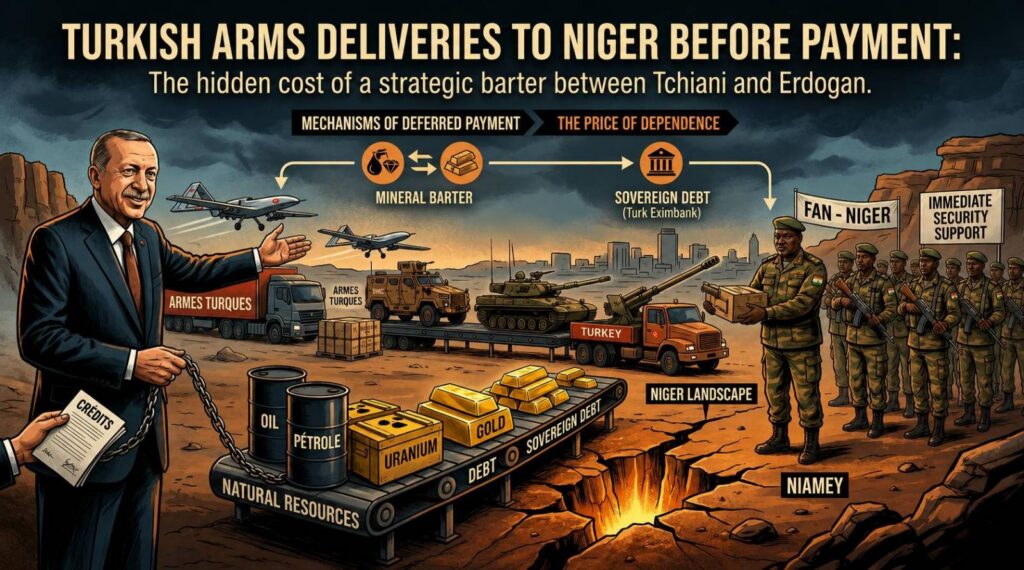
During a high-level diplomatic mission to Ankara, General Abdourahamane Tchiani disclosed a significant development: President Recep Tayyip Erdogan has authorized the transfer of military hardware to Niger prior to any financial settlement. While the administration in Niamey frames this as an act of international solidarity, this departure from the rigorous standards of the global arms trade reveals a complex partnership that may impact Nigerien sovereignty.
In the specialized world of defense procurement, the concept of “unconditional credit” is largely a myth. Defense manufacturers typically mandate substantial deposits before any equipment leaves the factory. The declaration made on June 4, 2026, by the head of the Nigerien transition masks a multifaceted economic and geopolitical reality where no asset is truly free of charge.
The financial undercurrents of deferred settlement
Global commerce operates on a fundamental principle: every delivery necessitates a payment. To manage the immediate financial limitations facing Niamey, several compensatory frameworks are being utilized behind the scenes:
- Resource bartering (The “Arms-for-Minerals” strategy): Niger possesses some of West Africa’s most significant reserves of uranium, crude oil, and gold. By facilitating early equipment deliveries, Ankara secures strategic exploration rights and exclusive mining concessions for its national corporations.
- Indebtedness through sovereign credit lines: This military hardware does not constitute a donation. The costs are tied to loans issued by entities like Turk Eximbank. Consequently, Niger is transforming its urgent security requirements into a long-term financial obligation to Ankara.
The consequences of strategic dependence
For General Tchiani, this partnership is a critical necessity for the Nigerien Armed Forces (FAN) following the exit of Western military units. However, this short-term pragmatic choice places a significant lien on the nation’s future autonomy.
The burden of over-indebtedness: By integrating Bayraktar TB2 drones, tactical armored vehicles, and advanced transmission systems through credit, Niamey grants Turkey a degree of influence over its future economic and extractive policies.
Potential strategic concessions
- Privileged access to Nigerien petroleum and uranium deposits.
- The establishment of Turkish logistical hubs or military facilities.
- Consistent diplomatic alignment with Ankara within the Sahel region.
Erdogan’s regional objectives: Anchoring Turkish influence
For Recep Tayyip Erdogan, providing financial leeway to military administrations in the Sahel is a highly profitable geopolitical investment designed to achieve three primary goals:
- The definitive displacement of Western powers from the region.
- Counterbalancing Russian influence by establishing Turkey as the essential technological and security provider.
- Securing long-term markets for the Turkish defense industry, a cornerstone of modern Turkish national power.
Immediate political gains versus long-term economic risks
General Tchiani has secured a domestic political victory by acquiring weaponry without immediate depletion of the national treasury. Yet, the perception of independence is challenged by the reality of material and technological reliance. Between its security arrangements with Moscow and the technological debt owed to Ankara, Niger has not moved away from foreign influence; it has merely shifted its creditors at a price that the Nigerien people have yet to fully calculate.