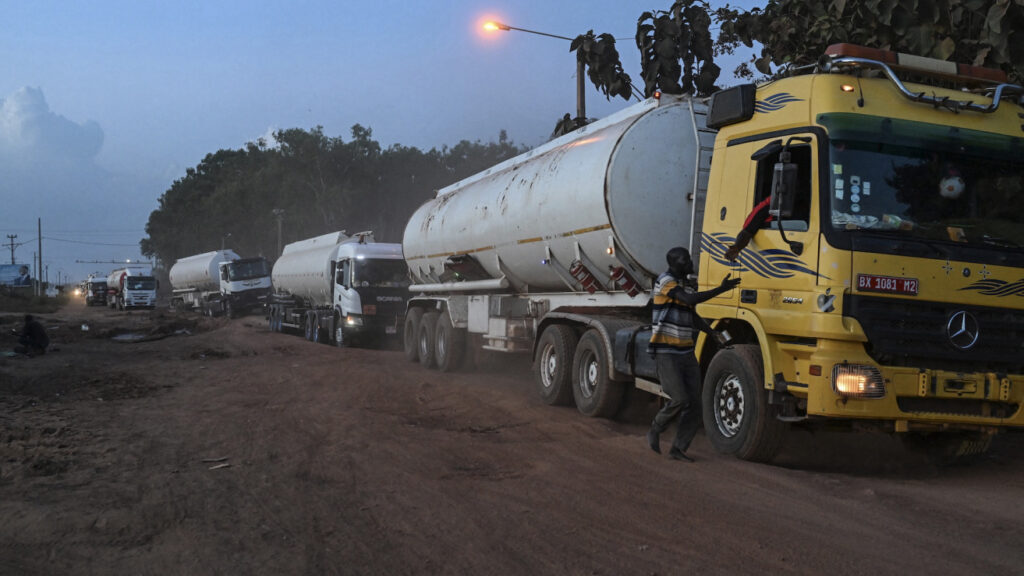
JNIM’s strategic blockade paralyses west African trade corridors
Recent coordinated assaults in Mali, carried out by the Jama’at Nusrat al-Islam wal Muslimin (JNIM) and the Front de Libération de l’Azawad (FLA), have escalated into a deliberate blockade that now threatens regional commerce. The attacks, which struck Kati, Mopti, Sévaré, Gao, and Bamako on April 25, left a trail of destruction and claimed the life of Mali’s Defence Minister, Sadio Camara.
In response, Malian authorities launched a counteroffensive targeting insurgent positions, resulting in multiple arrests, including civilians, active-duty soldiers, and former military personnel. Despite these efforts, the JNIM swiftly imposed a crippling blockade on Bamako, focusing on western transit routes.
The closure of the Kita–Bamako road has left hundreds stranded, cutting off critical supplies of food and water. This siege has also severed commercial flows, halting traffic on the Kayes–Bamako axis and extending to the previously secure Conakry–Bamako route, where transport convoys are now under constant threat.
Economic fallout across west Africa
The blockade has far-reaching consequences, disrupting supply chains that connect landlocked Sahelian nations to coastal ports. These trade corridors—vital lifelines for economies across the region—are now under siege, with the Dakar–Bamako route bearing the brunt of the disruption.
In 2024, Mali was Senegal’s top export destination, accounting for 26.5% of all Senegalese shipments, valued at 802.8 billion FCFA (1.42 billion USD). By the first nine months of 2025, exports to Mali had reached 662 billion FCFA (1.17 billion USD). However, JNIM’s attacks have severely hampered this trade. From September to November 2025, Dakar’s port faced daily blockages of around 120 containers bound for Mali, costing Senegal an estimated 15 billion FCFA (26.54 million USD) per month. By late November 2025, over 2,000 containers were stranded in Dakar, and by February 2026, 4,000 empty containers remained stuck in Bamako, as drivers avoided the perilous return journey.
This crisis has crippled Mali’s access to essential goods, including petroleum products, refined fuels, cement, and food supplies. Thousands of drivers, traders, and logistics operators face mounting hardships, while other corridors—such as those linking ports in Côte d’Ivoire, Ghana, Togo, and Bénin to the Sahel—risk similar disruptions.
The Abidjan–Bamako route, a key artery for Mali’s oil and food imports, has also come under attack. In 2025, Mali remained Côte d’Ivoire’s largest client within the West African Economic and Monetary Union (UEMOA), with approximately 1.47 million tonnes of goods transported via this corridor by the end of the year. However, recent JNIM offensives in the Sikasso region have jeopardised this vital link.
Regional spillover and policy responses
The blockade’s impact extends beyond Mali. Côte d’Ivoire, a major supplier to Burkina Faso—particularly in fuel, electricity, and fertiliser—relies heavily on transit routes through Ghana and Senegal. The February 14 attack in Titao, northern Burkina Faso, which killed seven Ghanaian tomato traders, underscores the growing insecurity along this network.
To mitigate the crisis, Malian authorities have implemented stricter fuel convoy escorts, allowing only 200 to 300 tanker trucks to enter weekly—a stark decline from the 1,200 permitted before the attacks. A new customs protocol with local petroleum groups aims to streamline trade, while fuel rationing has been introduced to curb black-market activity. Efforts are also underway to redirect commercial flows away from overburdened ports in Dakar and Abidjan.
Despite reports of a potential truce between Bamako and jihadist factions ahead of Eid al-Adha—exchanging prisoner releases—the Malian government has denied such an arrangement, and attacks have persisted.
Call for unified action
The blockade underscores the urgent need for coordinated regional strategies to protect transborder trade arteries. Organisations like the Economic Community of West African States (ECOWAS), the Alliance of Sahel States (AES), the Entente Council, the Mano River Union, and UEMOA must collaborate to prevent further expansion of this threat.
Counterterrorism efforts could serve as a catalyst for renewed cooperation between Sahelian and coastal states, ensuring the resilience of west Africa’s trade networks in the face of escalating insurgent activity.