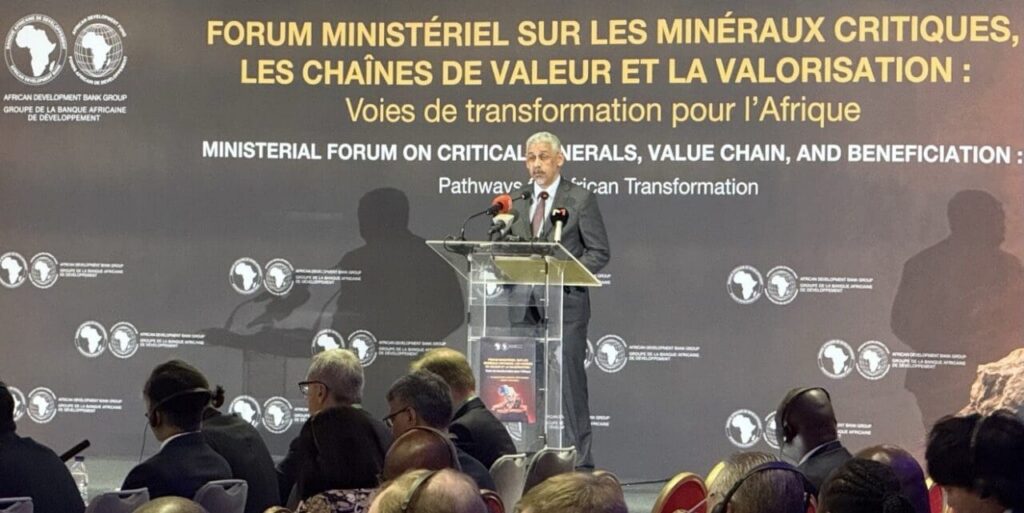
The future of Africa’s economic independence may lie beneath its soil. This week, leaders from mineral-rich African nations and international partners convened in Abidjan to chart a bold new course: transforming the continent’s vast reserves of critical minerals into engines of sustainable development, industrialization, and shared prosperity.
On July 10, ministers responsible for Mines, Energy, Industry, Green Economy, and Natural Resources—alongside representatives from the African Union Commission, the African Continental Free Trade Area (AfCFTA) secretariat, the United Nations Economic Commission for Africa, regional development banks, financial institutions, and global investors—gathered to redefine Africa’s role in the global resource economy.
Abidjan’s historic mineral pact: turning soil into sovereignty
The gathering wasn’t just another policy talk—it was a strategic declaration. The message was clear: Africa must move beyond exporting raw minerals and instead build local value chains that capture the full economic potential of its underground wealth. The aim? To ensure that every gram of cobalt, lithium, or rare earth lifted from African soil translates into jobs, infrastructure, and lasting growth for local communities.
A paradigm shift led by Africa’s financial institutions
Sidi Ould Tah, President of the African Development Bank (AfDB), opened the conference with a call to action: a complete overhaul of how Africa manages its natural wealth. “This is not just about extracting more—it’s about extracting smarter. We must prioritize local processing, build resilient infrastructure, and reform our development financing architecture,” he stated.
He pointed to a stark reality: Africa hosts over 100 development finance institutions, yet their combined balance sheets represent only 1% of the global total. “We need to consolidate these institutions, recapitalize them, and align their strategies with our industrialization goals,” he emphasized.
The AfDB head stressed that Africa’s mineral wealth—estimated at $29.5 trillion—must serve as the backbone of its economic transformation, not just a source of foreign revenue.
Côte d’Ivoire leads with a bold 15-year mining vision
Mamadou Sangafowa-Coulibaly, Côte d’Ivoire’s Minister of Mines, Petroleum, and Energy, made a compelling case for regional collaboration. “No single country can unlock this potential alone. We must create regional value chains that connect extraction, processing, and manufacturing,” he said.
Highlighting Côte d’Ivoire’s untapped mineral potential—where nearly three-quarters of the national territory may hold critical minerals—he outlined a 2026–2040 strategy valued at 38 trillion West African CFA francs. “This plan is 88% funded by the private sector,” he noted, signaling strong investor confidence in the country’s resource-driven growth model.
The minister also tied the nation’s mineral strategy to its broader ambition: achieving upper-middle-income status by 2030 under President Alassane Ouattara’s vision.
Why Africa’s minerals are the world’s next big deal
Africa holds an astonishing 30% of the world’s reserves of transition energy minerals—including cobalt, lithium, graphite, rare earths, platinum-group metals, copper, manganese, and nickel. Yet, despite their estimated value of $29.5 trillion—more than eight times the continent’s annual GDP and nearly 20% of global reserves—over $8.6 trillion remains untapped.
Meanwhile, global demand is skyrocketing. By 2040, platinum group metals demand could surge over 1,000%, lithium by 842%, and copper by 88% compared to 2023 levels. This isn’t just a market shift—it’s a once-in-a-century opportunity for Africa to redefine its place in the global economy.
From raw export to industrial powerhouse: the path forward
The stakes are higher than ever. The global electric vehicle and battery supply chain alone could grow from $7 trillion in 2030 to $59 trillion by 2050. Africa, with its mineral endowment, is uniquely positioned to capture a significant share—but only if it shifts from exporting ore to producing batteries, vehicles, and green technologies.
The leaders in Abidjan made it clear: the era of unprocessed mineral exports is over. The new era is about industrialization, job creation, and sustainable wealth—rooted in Africa’s soil and built by African hands.