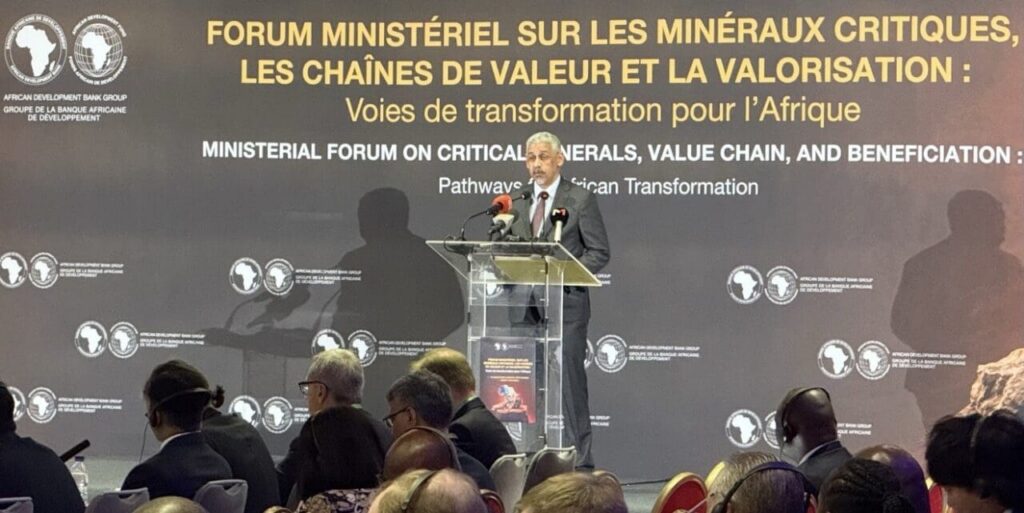
In a landmark gathering in Abidjan, African nations rich in critical minerals, alongside their development partners, declared a unified vision: to transform the continent’s strategic resources into a powerful catalyst for economic, industrial, and social advancement. Central to the discussions were strategies for fostering local value creation, securing essential development financing, and building robust regional value chains capable of meeting burgeoning global demand.
On Friday, July 10, the Ivorian capital hosted a ministerial conference where African countries endowed with critical minerals and various international development partners converged. The primary aim was to fundamentally redefine Africa’s position within the global economy of strategic resources.
Abidjan convenes a transformative African mining compact
The high-level meeting brought together African ministers overseeing Mines, Energy, Industry, Green Economy, and Natural Resources. They were joined by representatives from the African Union Commission, the secretariat of the African Continental Free Trade Area (AfCFTA), the United Nations Economic Commission for Africa, regional development banks, diverse financial institutions, and international investors.
The stated objective was unequivocal: to ensure Africa can fully harness its vast reserves of critical minerals, leveraging them for inclusive and sustainable development across the continent.
A new paradigm for Africa’s resource governance
During the opening remarks, Sidi Ould Tah, President of the African Development Bank (AfDB), issued a powerful call for a comprehensive overhaul in how Africa manages its natural resources.
“The core purpose of this conference is to instigate a paradigm shift and forge a new partnership for the African continent, enabling it to better manage its resources and ensure direct benefits for its populace,” he articulated.
He emphasized that prioritizing the local processing of raw materials is crucial for generating greater added value within the continent. Furthermore, he advocated for significant reforms in development financing.
“We estimate that Africa is home to over 100 development finance institutions, yet their combined balance sheet represents merely 1% of the global DFI total. It is imperative that we consolidate and recapitalize these institutions,” he underscored.
For the AfDB President, the development of resilient infrastructure and the establishment of local industries are key pillars for maximizing the profitability of Africa’s mineral resources.
Côte d’Ivoire champions its subsurface wealth
Mamadou Sangafowa-Coulibaly, Côte d’Ivoire’s Minister of Mines, Petroleum and Energy, who was present at the conference, stressed the critical need for enhanced continental solidarity.
“The challenge lies in transforming these resources into enduring wealth and shared prosperity. While our individual national trajectories may differ, it will be difficult for any nation to achieve its goals in isolation. We must collaborate to forge regional value chains,” he asserted.
The minister also highlighted Côte d’Ivoire’s significant mining potential, revealing that nearly three-quarters of the national territory is believed to harbor critical minerals.
This immense wealth forms a cornerstone of President Alassane Ouattara’s vision, which aims to elevate the country to upper-middle-income nation status by 2030.
To realize this ambitious goal, Abidjan is banking on an integrated mineral and energy resources policy spanning 2026-2040. This extensive program, valued at 38 trillion CFA francs, is projected to be 88% financed by the private sector.
Colossal potential amidst surging global demand
The stakes are undeniably high. Africa possesses approximately 30% of the world’s most strategic mineral reserves vital for the energy transition, including cobalt, lithium, graphite, rare earths, platinum group metals, copper, manganese, and nickel.
The estimated value of the continent’s mineral resources reaches nearly 29.5 trillion dollars, representing more than eight times Africa’s annual GDP and close to 20% of global resources. Of this, an estimated 8.6 trillion dollars in reserves remain untapped.
Simultaneously, global demand for these minerals is projected to experience spectacular growth by 2040. Requirements for platinum group metals are expected to soar by over 1,000%, lithium by 842%, and copper by 88% compared to their 2023 levels.
Seizing an unprecedented historical opportunity
This dynamic unfolds within a profound global industrial transformation driven by the energy transition. The electric vehicle and battery value chain alone could expand from 7 trillion dollars in 2030 to a staggering 59 trillion dollars by 2050.
Confronted with this historic opportunity, African leaders gathered in Abidjan expressed a firm commitment to abandon the traditional model of raw material export. Their collective ambition is to leverage critical minerals as a powerful engine for industrialization, job creation, and sustainable prosperity across the entire continent.