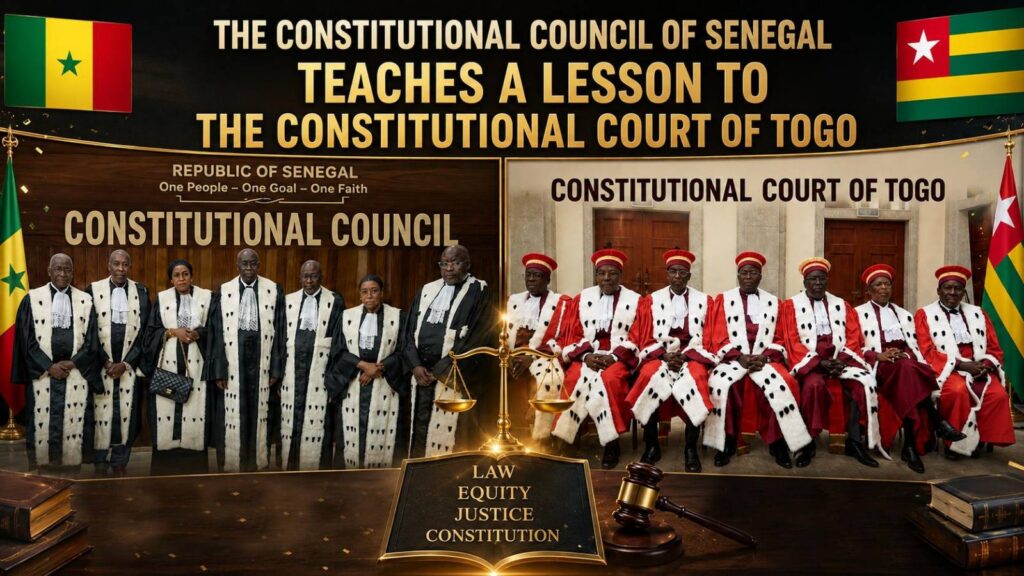
In the current African political landscape, Dakar and Lomé stand out as two contrasting models of constitutional governance. Recent judicial decisions in both capitals have further underscored the fundamental differences in how these nations interpret the role of their highest legal institutions.
Dakar: where constitutional limits prevail
In Senegal, the Constitutional Council has reaffirmed a steadfast commitment to upholding the supremacy of constitutional law, regardless of political circumstances. The body’s latest ruling, which struck down a constitutional amendment proposed by the administration of Prime Minister Ousmane Sonko despite parliamentary backing, sends a clear message: electoral victories do not grant carte blanche to reshape the nation’s foundational laws. This judicial intervention demonstrates that in Senegal, constitutional provisions serve as an unassailable bulwark against political excesses.
The decision carries significant implications. By rejecting a reform that would have expanded executive power, the Council preserved the integrity of Senegal’s democratic framework. Such judicial assertiveness reinforces public trust in institutions, as citizens witness the Constitution’s primacy over partisan interests. This predictability in legal interpretation is equally critical for international investors and development partners who prioritize stable, rule-based governance environments.
Lomé: constitutional reform under scrutiny
Togo’s Constitutional Court, by contrast, has faced criticism for validating sweeping changes to the country’s fundamental charter amid substantial political and civil society opposition. Analysts argue the reform process lacked sufficient national debate and inclusive consultation, raising concerns that the new provisions primarily reflect political power calculations rather than broad societal consensus.
Such controversies are not merely academic. When constitutional amendments appear designed to serve immediate political objectives rather than long-term institutional stability, they risk undermining the very legitimacy of the state. A constitution that evolves solely through power dynamics ceases to function as a social contract and instead becomes a tool for consolidating authority. This pattern, if unchecked, can erode public confidence in judicial institutions and encourage recourse to regional courts as primary arbiters of constitutional disputes.
Institutional independence as the cornerstone of democracy
The divergent paths of Senegal and Togo highlight a fundamental truth about democratic governance: the strength of a nation’s constitutional system depends less on the elegance of its legal text than on the independence and courage of its judicial guardians. When constitutional courts demonstrate the willingness to challenge even popularly elected governments, they protect not just legal principles but the stability of the entire political system.
In Togo, the intervention of the ECOWAS Court of Justice in several human rights cases has exposed limitations in the national judiciary’s capacity to serve as an effective check on executive power. While regional judicial mechanisms provide essential recourse for citizens denied justice domestically, their involvement often signals systemic weaknesses in domestic constitutional protections.
The dangers of constitutional engineering
Beyond the immediate legal implications, the process of constitutional reform reveals much about a nation’s democratic health. In mature democracies, such changes undergo rigorous public debate and multi-stakeholder consultation precisely because constitutions govern not just the present but future political transitions. When reforms appear driven primarily by short-term political calculations, they establish dangerous precedents where each new government feels entitled to reshape institutional arrangements to its advantage.
This approach fosters chronic instability and concentrates power in ways that erode democratic accountability. A constitution that no longer commands broad consensus becomes itself a source of perpetual conflict rather than a framework for peaceful governance.
Lessons from comparative governance
Togo’s government has sought inspiration from constitutional models abroad, including parliamentary systems in India. While comparative study can offer valuable insights, sustainable democratic development must ultimately draw from domestic experiences and realities. Africa’s constitutional evolution offers numerous examples where judicial independence has proven more critical to democratic consolidation than imported institutional designs.
Senegal’s Constitutional Council stands as a testament to this principle. Its credibility derives not from rhetorical commitments to the rule of law, but from tangible actions where it has courageously constrained executive power. Such judicial assertiveness serves as a powerful antidote to political instability while enhancing the country’s international standing and economic attractiveness.
The contrast between Dakar and Lomé ultimately reveals two fundamentally different conceptions of constitutional governance. In Senegal, the Constitution functions as an inviolable limit on power. In Togo, critics contend it increasingly serves as a malleable instrument for political adaptation. The measure of a robust democracy, however, lies not in the frequency of constitutional amendments but in the capacity of its institutions to protect citizens from all forms of arbitrary power—whether executive, legislative or judicial.