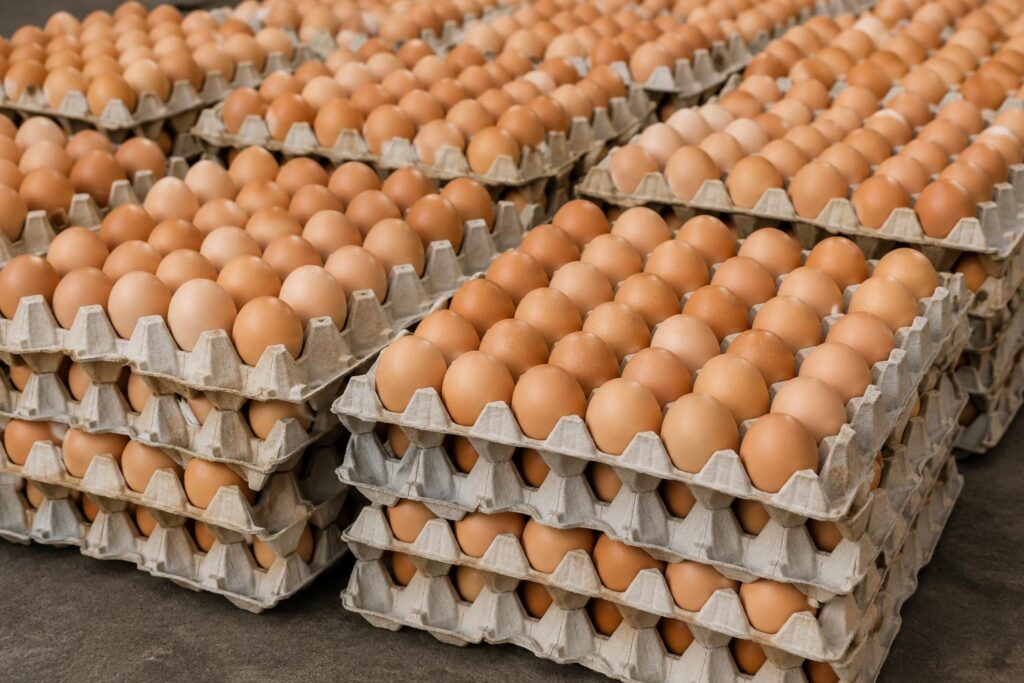
The decision sent shockwaves through Burkina Faso’s poultry sector. Following a joint announcement by the Ministry of Trade and the Ministry of Animal Resources, the government has imposed a ceiling on the price of a single egg at 100 F CFA for consumers. Wholesalers are restricted to 2 600 F CFA per tray, while retailers face a cap of 2 750 F CFA. While framed as a move to safeguard household purchasing power, the policy instead tightens the noose around local entrepreneurs and threatens the survival of an already vulnerable industry.
Controlling prices without addressing cost realities
The government claims it can lock in the price of a finished product while ignoring the soaring costs of its raw materials. This is an unsolvable puzzle for poultry farmers. The backbone of egg production lies in animal feed — locally known as provende — composed of maize, soybean meal, cottonseed cake, and mineral supplements. Over recent months, these inputs have surged in price, driven by inflation, transport expenses, and supply chain disruptions.
By setting an arbitrary price cap on eggs without offsetting the rising cost of provende, the authorities are forcing producers into a lose-lose scenario. Selling below cost is unsustainable. Operating at zero margin is only a temporary reprieve. The policy effectively guarantees financial distress for the very sector it claims to protect.
Entrepreneurial freedom under threat
The foundation of private enterprise rests on two pillars: the free interplay of supply and demand, and the ability of business owners to price their goods according to operational realities. When the State intervenes to dictate internal pricing policies, it ceases to regulate — it suffocates.
Why would any investor risk millions of F CFA to build poultry infrastructure, secure bank loans, or hire local workers, if the government reserves the right to cap profits based on arbitrary figures that disregard real costs? Such a move discourages risk-taking and innovation, stifling the growth of Burkina Faso’s agri-food economy.
Unintended consequences: shortages and black markets
History shows that artificial price controls often backfire spectacularly. Without urgent adjustments, the poultry sector faces several immediate threats:
- Collapse of small-scale producers: Vulnerable local farmers, lacking the buffers of large industrial outfits, may be forced to close operations, eliminating thousands of jobs.
- Reduced output: To cut losses, breeders may downsize flocks or curtail production cycles.
- Emergence of shadow markets: With official supply dwindling, eggs will re-emerge on unregulated markets — not at 100 F CFA, but at inflated prices that hurt consumers even more.
A smarter path to affordable eggs
Ensuring access to nutritious food is a legitimate goal, but it must not come at the expense of those who produce it. If the government truly seeks to make eggs affordable for all Burkinabè, the solution lies upstream: subsidize feed production, exempt aviculture inputs from taxes, or expand credit access for poultry farmers.
Capping egg prices while ignoring the skyrocketing cost of provende is economic folly. It sends a dangerous signal to the business community: that entrepreneurial freedom remains hostage to decrees out of touch with market realities. To rescue the poultry sector and secure Burkina Faso’s food sovereignty, prices must be freed — and producers must be supported.