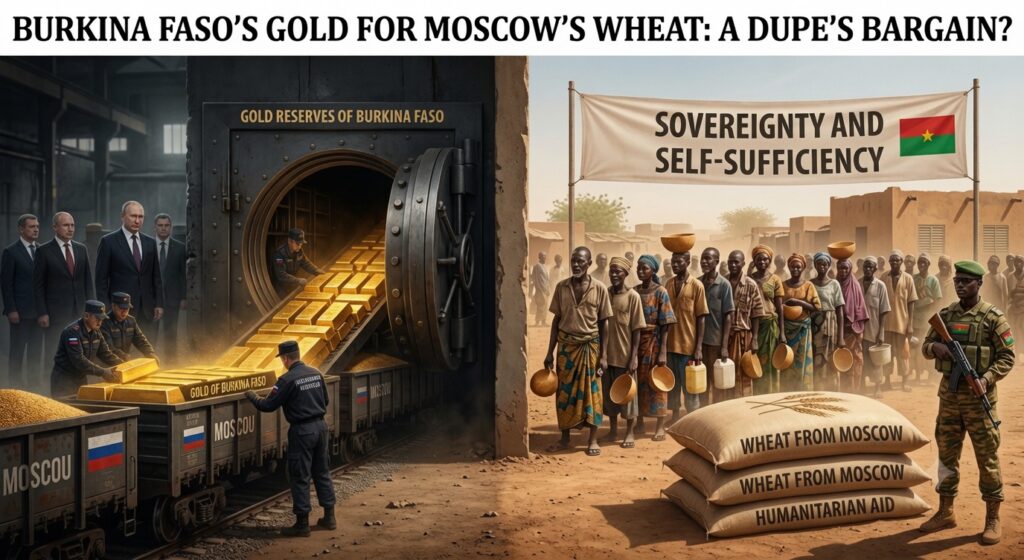
The stark contrast between rhetoric and reality in Burkina Faso has reached unprecedented levels. While authorities loudly proclaim a return to sovereignty, their actions reveal a humiliating reliance on foreign aid. By banning local initiatives and NGOs from assisting the nation’s most vulnerable citizens under the guise of controlling humanitarian aid, the transitional government is demonstrating an unusually harsh political stance. Yet this cruelty becomes even more cynical when the same authorities turn to Moscow, begging for sacks of wheat to feed their population.
Recent discussions between Burkina Faso’s foreign minister and his Russian counterpart have exposed the true nature of this lopsided “cooperation.” With a diplomacy that combines iron fist and velvet glove, the Kremlin’s envoy celebrated Ouagadougou’s decision to transfer and store the country’s gold reserves directly in Moscow’s central bank. This announcement carries the unmistakable scent of economic surrender. For a regime that built its legitimacy on breaking from neo-colonialism and promising total independence, entrusting the nation’s treasure to Russia resembles nothing less than a fool’s bargain.
When Sovereignty Becomes a Mirage
The inconsistency in this policy becomes glaring when considering the official discourse that has dominated for months, emphasizing self-sufficiency and economic sovereignty. While these goals are understandable, they lose all credibility when basic food needs cannot be met without external assistance. A sovereignty that depends on foreign grain shipments remains incomplete, as it fails to guarantee either production autonomy or food security for citizens.
The math behind this partnership is brutally straightforward: Burkina Faso is mortgaging its sovereign wealth—its gold—to secure political protection and, above all, emergency food aid. Receiving Russian wheat shipments to feed a population ravaged by security crises is no diplomatic triumph. It’s the very emblem of failure. How can a nation claim pride when its nutritional survival hinges on the goodwill of an external patron who holds the keys to its financial vault?
The Paradox of National Priorities
Burkina Faso stands among West Africa’s top gold producers—a resource that should theoretically fund agricultural policies, storage infrastructure, irrigation systems, and sustainable support for local producers. Yet when the country continues to depend on foreign food aid, many observers question how national wealth is being mobilized and whether it truly improves living conditions.
The most infuriating aspect remains the government’s internal mismanagement of this crisis. While it’s unfortunate that a state struggles to feed its people amid asymmetric conflict, actively sabotaging national solidarity by threatening or prohibiting Burkinabè from helping each other represents an extreme form of social control. By monopolizing aid distribution, the Traoré administration appears determined to ensure every grain of rice or wheat received by the hungry is perceived as a gift from the regime—not an act of human compassion.
The Political Risks of Aid Centralization
In many crisis contexts, humanitarian organizations, local associations, and citizen initiatives play a crucial complementary role to the state, particularly in areas where administration is weak or severely constrained by security threats. Restricting their operational capacity slows assistance to vulnerable populations and increases dependence on state-controlled mechanisms—feeding suspicions of political manipulation of aid.
Another paradox lies in the disconnect between the sacrifices demanded of the population and the actual results delivered. Burkinabè are regularly called upon to make sacrifices in the name of national sovereignty, counter-terrorism, and state rebuilding. Yet these sacrifices grow increasingly meaningless as daily hardships persist, insecurity remains rampant, and the country continues to beg for external assistance to meet fundamental needs like food. True sovereignty is measured not just by declarations, but by a state’s ability to protect and sustainably nourish its people.
While Burkina Faso’s gold flows toward Russian vaults to secure political survival at the top, the people at the bottom are left with nothing but hollow sovereignty and very real hunger. Through this arrangement, Captain Traoré hasn’t liberated Burkina Faso—he’s merely renegotiated its dependence on a new guardian, at a bargain-basement price.
The fundamental question isn’t about which partner Burkina Faso chooses, but whether these alliances genuinely strengthen the country’s autonomy and improve the lives of Burkinabè. Sovereignty cannot be judged solely by diplomatic rhetoric; it must be measured by tangible outcomes—security, prosperity, and dignity for all citizens. When these outcomes fail to materialize, the gap between political promises and daily reality becomes impossible to ignore.