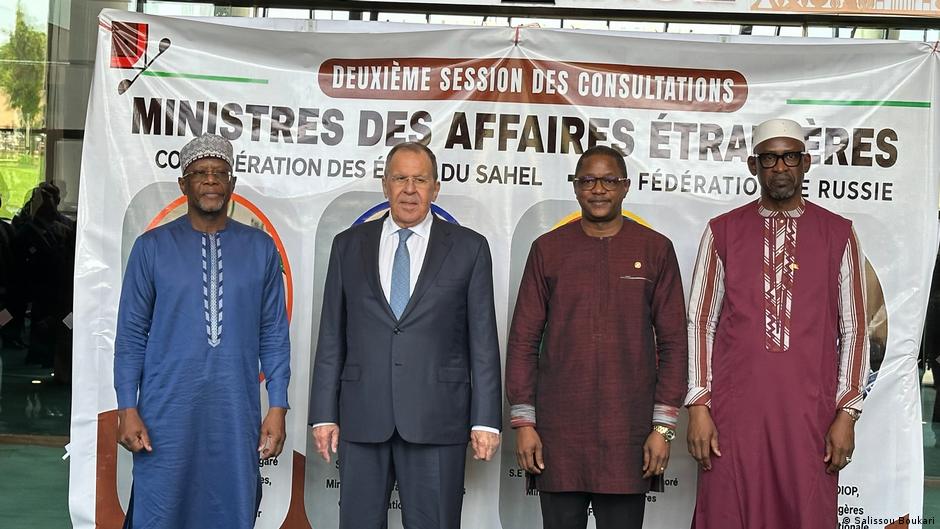
Niamey hosts crucial talks as Russia and Sahel states deepen security ties
In a significant diplomatic move, Russian Foreign Minister Sergueï Lavrov arrived in Niamey this Wednesday for discussions with his counterparts from the Alliance of Sahel States (AES). The primary objective of this high-level meeting was to further solidify the collaborative framework between Russia and the three member nations of the AES: Mali, Burkina Faso, and Niger.
Over recent years, the military governments presiding in Bamako, Ouagadougou, and Niamey have increasingly gravitated towards Moscow, often at the expense of their long-standing Western allies, particularly France. Russia has consequently assumed a more prominent role in the diplomatic strategies of the AES countries, who advocate for diversifying their international partnerships and upholding their national sovereignty. Notably, Moscow has emerged as a crucial partner in regional security endeavors.
Daouda Emile Ouédraogo, a political analyst and coordinator for the US-based NGO Stand for Life and Liberty, observes that “from a security standpoint, the AES countries are receiving military training, arms and equipment shipments, intelligence sharing, and collaborative efforts against jihadist factions.”
Sahel states eye joint force with russian backing
The nations comprising the AES are also counting on Russian assistance for the establishment of a unified armed force, designed to confront the persistent security threats plaguing the region. During the inaugural consultation session between AES and Russian foreign ministers, held in Moscow in April 2025, Russia had previously affirmed its commitment to this initiative, pledging support through military training, equipment provision, and technical aid.
However, some observers have raised questions regarding the tangible efficacy of this military collaboration, particularly following the jihadist attacks on April 25 in Mali. These assaults tragically claimed the life of Defense Minister Sadio Camara, widely regarded as one of Moscow’s staunchest allies within the military leadership. Further underscoring the challenges Russia faces in the region is the withdrawal of Africa Corps personnel from the city of Kidal.
What are the benefits for local populations?
Beyond military aspects, certain analysts contend that while strengthening military cooperation is ostensibly aimed at combating armed groups, it also serves to entrench the power of existing military regimes. This raises a critical question: are the local populations truly experiencing concrete benefits from this deepening engagement with Russia?
Political analyst Daouda Emile Ouédraogo points out that “for the populations, we aren’t seeing increased investments in mining, energy, or infrastructure. It’s a continuation of past patterns; Western countries were criticized for exploiting natural and mineral resources, and the same dynamics persist today.”
The expert further notes that “while security has improved in some areas, many citizens find the concrete results limited when confronted with daily struggles like ongoing insecurity, inflation, unemployment, and poverty.”
Russia also extends political backing to these military governments on the global stage, aligning its positions with theirs in international forums such as the United Nations. This strategic coordination allows Moscow to amplify its global influence while simultaneously helping the military rulers overcome their international isolation.