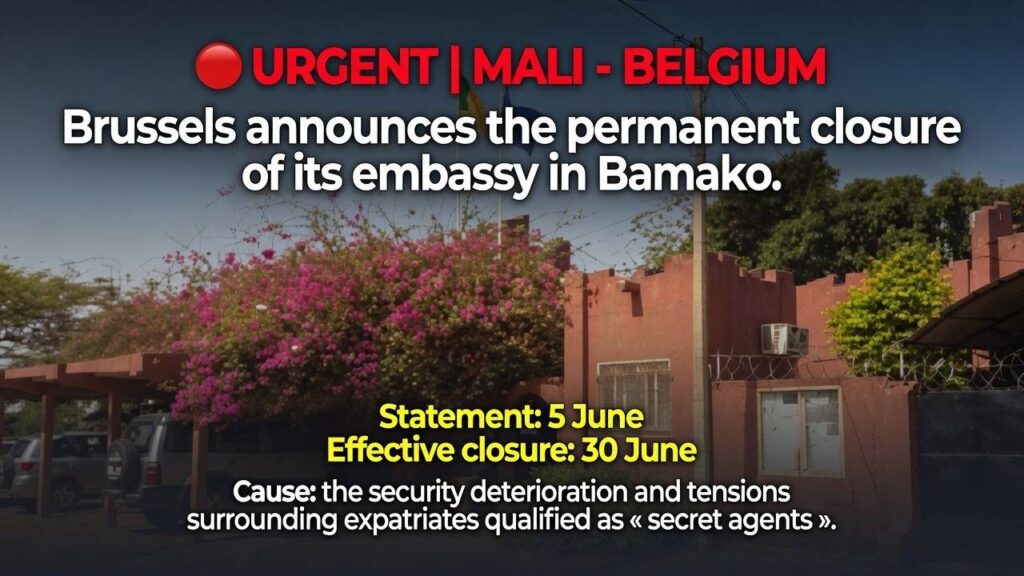
Following several decades of bilateral partnership, Brussels officially announced this Friday, June 5, the definitive closure of its diplomatic mission in Bamako. This decision, set to take full effect on June 30, represents a historic breaking point in relations. The move comes as a direct response to the persistent deterioration of the security situation across the Sahel and follows a series of arrests involving Western expatriates, who have been frequently labeled as secret agents by Mali’s transitional government. This development deals a significant blow to Mali, further deepening its international isolation.
The end of a long-standing partnership
The announcement sent shockwaves through the diplomatic circles of the Malian capital. In an official statement released on June 5, the Belgian Ministry of Foreign Affairs confirmed a move that many analysts had feared: the total withdrawal of Belgian diplomatic staff from Malian territory. The embassy building is scheduled to be handed over by June 30, signaling the conclusion of decades of humanitarian, cultural, and economic cooperation.
For Bamako, this withdrawal is far from trivial. Belgium has long been a key European partner for Mali, particularly in funding essential development initiatives in the central and northern regions. This voluntary exit aligns with a broader trend of Western nations disengaging from the country, leaving Mali increasingly reliant on a narrow circle of new strategic allies, most notably Russia.
Security challenges and the exit of international partners
At the heart of the decision made by Brussels is the untenable security environment. Since the departure of French forces under Operation Barkhane and the forced withdrawal of the United Nations mission (MINUSMA), the security vacuum has expanded. Armed terrorist groups have ramped up pressure on primary transit routes and around major urban centers.
For Belgium, the safety of its citizens and diplomatic personnel could no longer be assured beyond the June 30 deadline. Belgian authorities have concluded that the current military and political framework prevents the successful implementation of development assistance missions. Without a dependable security umbrella and faced with chronic instability, maintaining a full-scale embassy was deemed a disproportionate risk by Brussels.
The “secret agent” narrative and the targeting of expatriates
Beyond the jihadist threat, another pivotal factor accelerated the rupture announced on June 5: the pervasive atmosphere of suspicion in Bamako. Over the past several months, Malian authorities have adopted an increasingly hostile stance toward Westerners remaining in the country. Technical experts, humanitarian workers, and consultants have been subjected to arbitrary detentions.
The primary point of contention lies in the transitional government’s official narrative, which tends to categorize any European researcher or expert as a potential threat to stability or a member of foreign intelligence services. This systematic branding of civilians involved in development projects as “secret agents” has fueled a climate of fear. The prolonged detention of several European professionals, without transparent justification or adherence to standard consular protocols, ultimately convinced Belgium that its staff were no longer safe. This administrative and judicial hostility has made field operations virtually impossible.
What this means for the Malian people
On the ground, the impact of this closure is expected to be severe starting in early July. Because the Belgian embassy managed numerous direct aid programs—specifically in areas such as basic education, reproductive health, and access to clean drinking water—the freezing or redirection of these funds to other countries in the region will leave a void for vulnerable communities.
Furthermore, for Malian citizens, obtaining visas for business, medical treatment, or studies within the Schengen Area will become even more difficult. Applicants will now have to rely on the already overwhelmed representations of other European nations still present in the country or travel to neighboring states to complete their applications.
Increasing diplomatic isolation
The closure of the Belgian embassy, finalized on June 5 for a June 30 execution, is not an isolated incident but rather a symptom of a widening chasm between Bamako and the European Union. By choosing to break trust with traditional partners and increasing the arrest of expatriates under espionage pretexts, the Malian government is locking itself into a strategy of confrontation.
While this firm stance is praised by some local supporters of national sovereignty, it weakens Mali’s standing on the global stage. By severing ties with Brussels, Mali loses a moderate diplomatic voice within Europe, intensifying its isolation at a time when economic and security hurdles require pragmatic and global cooperation.