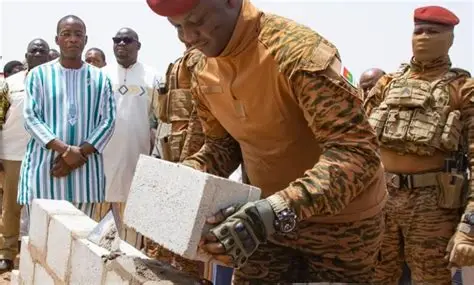
The captain Ibrahim Traoré has spent recent months unveiling industrial projects across Burkina Faso, from tomato processing plants to gold refining facilities. While state media showcases these developments as evidence of the nation’s economic ascent, the underlying reality tells a different story. Behind the polished broadcasts of RTB, the country grapples with escalating security threats and economic hardship that mere propaganda cannot conceal.
Symbolic gestures overshadow systemic challenges
In a familiar pattern for regimes seeking legitimacy, the transitional government has prioritized high-profile infrastructure projects. In Ouagadougou and Bobo-Dioulasso, the captain positions himself as a champion of economic self-reliance, emphasizing job creation and national sovereignty. Supporters applaud each ribbon-cutting ceremony as a triumph over foreign influence. Yet, to economic analysts, these events appear less like a coherent development strategy and more like an attempt to mask deeper structural issues.
Industrial ventures shrouded in ambiguity
Scrutiny of these so-called industrial flagship projects often uncovers troubling inconsistencies. Despite lavish inaugurations, critical details remain undisclosed: precise funding sources, long-term production viability, and actual operational capacity. Concerns also persist regarding the allocation of patriotic funds, with allegations of mismanagement and opacity surrounding procurement processes. As traditional private enterprises struggle under heavy taxation and relentless insecurity, newly established entities tied to influential circles raise serious questions about the fairness and transparency of market allocations.
A widening chasm between policy and daily life
The stark disparity between official narratives and ground-level realities has never been more evident. As government officials celebrate industrial milestones, Burkinabè citizens face mounting economic pressures.
Rising costs and shrinking resources
Inflation has driven staple food prices—rice, oil, and millet—to historic highs, placing an unbearable burden on vulnerable households. The humanitarian crisis deepens, with over two million internally displaced persons relying on sporadic aid convoys to survive. Entire communities remain trapped under terrorist blockades, cut off from basic supplies and economic activity.
Collapse of informal trade networks
The informal sector, the backbone of Burkina Faso’s economy, is in freefall. Frequent power outages disrupt daily life, while road insecurity paralyzes trade and commerce. These conditions stifle entrepreneurship and erode livelihoods, further destabilizing the nation’s economic fabric.
Media spectacle vs lived experience
The contrast is glaring: polished state broadcasts showcase gleaming machinery and a resolute leader, while ordinary citizens face impossible choices—educating their children, securing food, or surviving another day of conflict. The narrative of a ‘prospering Burkina Faso’ is, for now, a carefully constructed media illusion, designed to foster hope and silence dissent. Yet propaganda has its limits—especially when the fields lie fallow and the newly inaugurated plants exist only on television screens.
The captain’s gamble on perception carries significant risk. By prioritizing image over substance, he risks severing the vital connection between leadership and the people it serves. Industrialization remains a worthy ambition, but it cannot thrive on unstable foundations. Without verifiable financial transparency and genuine territorial security, these ceremonial announcements will remain mere illusions in the harsh Sahelian landscape.