Niger’s Banking Sector Faces Severe Credit Default Crisis
The latest economic outlook for West Africa’s financial bloc reveals a troubling divide. While the West African Economic and Monetary Union (WAEMU) has seen modest progress in its banking sector, Niger stands out as a major outlier, with non-performing loans surging to alarming levels. The country’s struggles are reshaping regional financial stability and exposing deeper economic fractures.
Niger’s Financial Weakness: A Regional Outlier
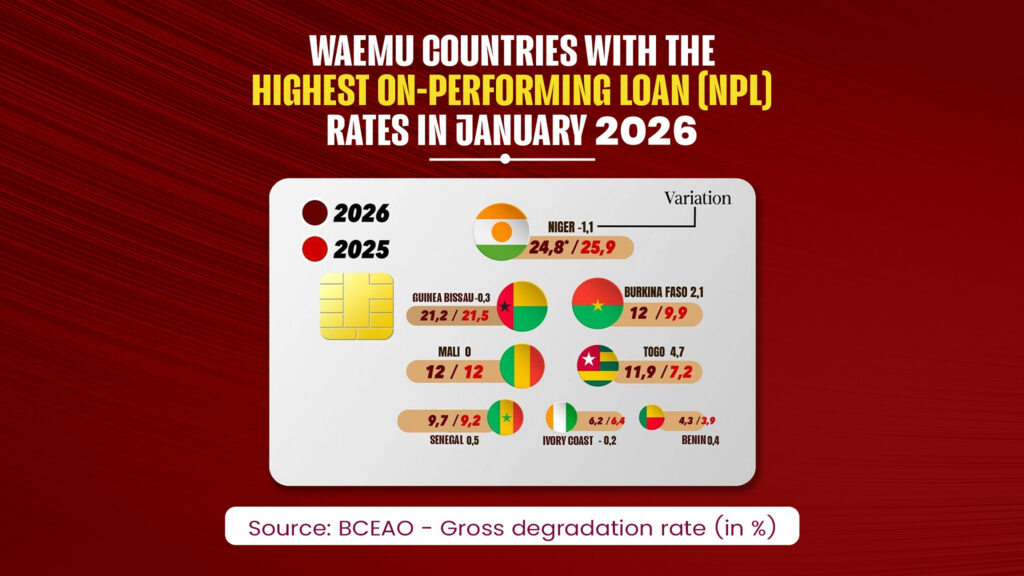
Despite efforts to strengthen the union’s banking system, Niger’s debt crisis remains unmatched. The latest data shows a 24.8% default rate on loans—the highest in WAEMU—and nearly a quarter of all credits issued in the country are now at risk of default.
Though this figure marks a slight improvement from the 25.9% recorded in 2025, it remains far above the regional average, highlighting persistent structural vulnerabilities. Experts link these risks to ongoing security threats and political instability, which continue to undermine investor and lender confidence.
A Divided Union: Coastal Economies vs. Sahelian Struggles
The January 2026 report underscores a clear economic split within WAEMU. While coastal nations show resilience, the Sahelian bloc—where Niger sits at the epicenter—grapple with escalating credit risks.
Sahelian Nations in the Red
- Mali and Burkina Faso share a troubling 12% default rate, with Burkina Faso’s non-performing loans rising sharply by 2.1 percentage points in just one year.
- Guinea-Bissau remains in critical territory with a 21.2% default rate, further straining regional stability.
Coastal Economies Show More Stability
In contrast, most coastal WAEMU members maintain healthier loan portfolios, though not without concerns:
- Benin leads the bloc with the lowest default rate at 4.3%.
- Ivory Coast and Senegal demonstrate moderate stability, with 6.2% and 9.7% default rates, respectively.
- Togo bucks the trend with a dramatic spike, jumping from 7.2% to 11.9%—a 4.7 percentage point increase.
Systemic Risks Threaten Regional Financial Health
The union’s total loan portfolio has surpassed 40.031 trillion FCFA, a historic milestone. However, this growth is overshadowed by a sharp rise in bad loans, which now total 3.631 trillion FCFA—a 59% coverage ratio that signals growing strain on banks’ ability to absorb losses.
Faced with escalating risks, financial institutions are tightening lending standards:
- Higher personal contributions and stricter collateral requirements for new loans.
- Reduced lending to small and medium-sized enterprises (SMEs) in favor of safer, lower-risk assets.
Early 2026: A Pivotal Moment for WAEMU Banking
While the union’s overall banking system has not yet reached a crisis point, Niger’s struggles and the spreading risks across the Sahel demand urgent attention. Analysts warn that unchecked deterioration could trigger liquidity shortages, threatening broader regional financial stability.