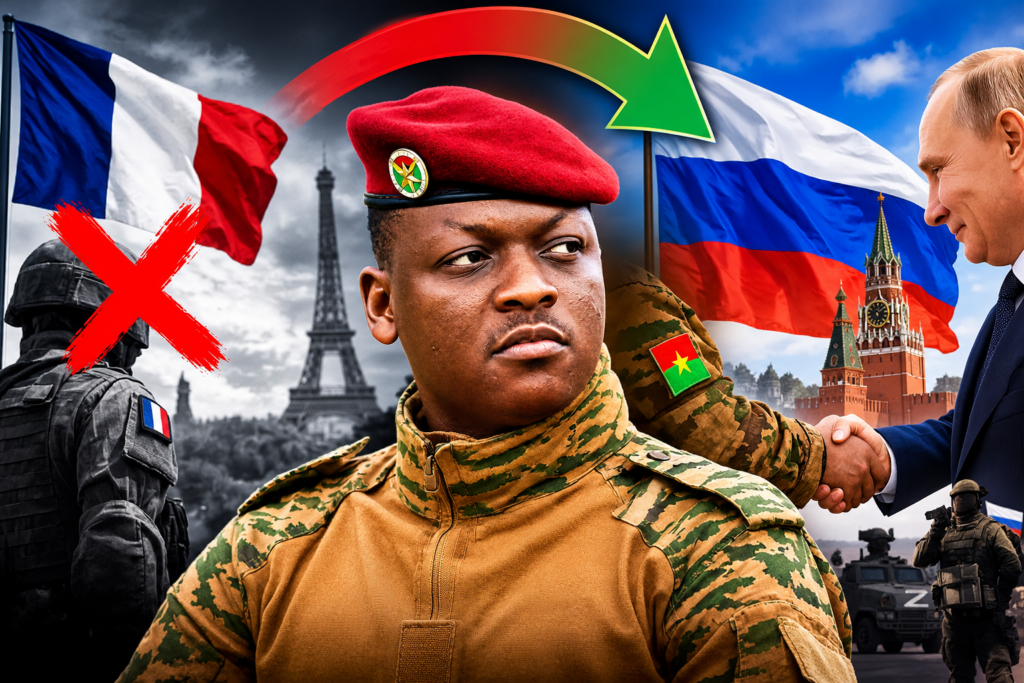
Captain Ibrahim Traoré, Burkina Faso’s transitional president, used a late-September interview on BF1 TV to close the door firmly on any normalisation of diplomatic ties with France, delivering unusually sharp criticism of Paris. The intervention marks more than a rhetorical flourish: it crystallises a political line the regime has pursued since seizing power in September 2022 a gradual break with the former French partner and a deliberate reorientation of Burkinabè diplomacy toward new allies, with Russia at the forefront.
From words to deeds: a rupture that has become structural
Since taking office, Traoré has repeatedly voiced hostility toward France, and relations between Ouagadougou and Paris have deteriorated sharply. The withdrawal of French forces, the departure of diplomats and the questioning of several forms of cooperation have all marked this break. In parallel, the Burkinabè authorities have deepened ties with Moscow and consolidated their alignment with Mali and Niger within the Alliance of Sahel States (AES).
Presented by the authorities as a reconquest of national sovereignty, this diplomatic reorientation deserves scrutiny beyond political rhetoric. A sovereign state is free to choose its partners but those choices must allow it to preserve its decision-making autonomy, strengthen national capacities and durably improve living conditions for its people.
The central question is therefore straightforward: has Burkina Faso genuinely freed itself from external influence, or has it simply swapped one historical partner for another whose interests do not necessarily coincide with its own?
Breaking with Paris does not, by itself, guarantee independence
Rejection of France has become a central element of Traoré’s political discourse. The stance resonates with part of the population, shaped by a long history of unbalanced relations with the former colonial power and by frustrations over the results of past cooperation.
Yet denouncing French influence is not, in itself, a complete sovereignty policy. Breaking with a partner does not automatically mean becoming independent of all external influence. True sovereignty is also measured by a country’s ability to define its own priorities, diversify its partnerships, negotiate balanced agreements and refuse pressure whatever its origin.
By presenting the rupture with Paris as major proof of national emancipation, the Burkinabè authorities risk reducing a complex issue to a rivalry between two foreign powers. France becomes the symbol of past dependency, while Russia is cast as the solution to that dependency.
That reading needs nuance. No foreign partner Western, Russian, Chinese or from any other region bases its foreign policy exclusively on defending a third country’s interests. States defend their own strategic, economic, military and diplomatic interests first.
Russia is no exception to that rule.
Russia: a strategic ally, not a disinterested partner
The rapprochement between Ouagadougou and Moscow is one of the most visible changes in Burkinabè foreign policy since Traoré came to power. Security cooperation occupies a prominent place in this new orientation, as Burkina Faso confronts persistent insecurity linked to armed terrorist groups.
For the Burkinabè authorities, diversifying military partners can be a way to strengthen national capacities and move away from cooperation deemed insufficient with France. That choice falls within Burkina Faso’s sovereign right.
The question, however, should not be whether Russia is preferable to France in principle, but rather what Burkina Faso concretely obtains from this new relationship.
What are each side’s commitments? What are the financial, military or economic counterparts? How long do the agreements last? What guarantees frame foreign partners’ interventions? And above all, to what extent does this cooperation durably strengthen the Burkinabè army’s own capacities?
These questions are essential. Military cooperation can provide operational support, equipment or technical expertise. But it does not automatically guarantee a lasting improvement in the security situation. Its effectiveness must be judged on verifiable results: protection of populations, securing of road corridors, return of displaced people and the ability of public services to function in areas affected by violence.
It would therefore be premature to treat the sole rapprochement with Moscow as proof of strategic success. Conversely, it would be equally excessive to conclude, without examining agreements and outcomes, that Russia dictates every decision of the Burkinabè authorities.
The real issue is whether this partnership increases Burkina Faso’s decision-making capacity or creates new forms of dependency.
Changing partners does not necessarily mean changing the dependency system
One paradox of Traoré’s policy lies in how sovereignty is framed in public debate. The authorities claim they want to free Burkina Faso from Western influence, but that ambition cannot be assessed solely through declarations against France or rapprochements with Moscow.
Sovereignty is not limited to the choice of military partners. It also concerns control over natural resources, budgetary policy, economic independence, industrial capacity, food security and the freedom to negotiate with foreign investors.
A country can break with a former partner power while remaining dependent on other actors for military equipment, technology, financing or certain commercial outlets. Such dependency is not necessarily synonymous with submission, since international relations often rest on interdependence. It becomes problematic, however, when alternative options are limited and the country struggles to defend its own priorities.
That is why Burkina Faso must be judged on its ability to genuinely diversify its relations, develop national skills and negotiate transparent partnerships.
If Russia becomes an indispensable partner in certain areas without the country having credible alternatives, the risk would be the emergence of a new dependency even if it is dressed in a different political discourse.
This is not to claim that Moscow controls Traoré’s decisions, as no evidence supports such a conclusion. It is rather to recall an obvious fact of international relations: a foreign partner, however politically close, pursues its own interests and cannot be considered disinterested by principle.
The AES: a sovereignty ambition that must also prove itself
The rapprochement between Burkina Faso, Mali and Niger within the Alliance of Sahel States fits this desire to redefine regional power balances. The three countries highlight their sovereignty, their intent to coordinate policies and their ambition to strengthen autonomy vis-à-vis external partners.
In principle, regional cooperation can be a significant lever. It can facilitate pooled defence resources, intelligence coordination, trade and the search for common solutions to Sahel challenges.
But a political alliance does not, by itself, guarantee effective collective action. It must demonstrate its ability to deliver concrete results for populations.
On security, the persistence of attacks, population displacements and difficulties in certain localities demand rigorous evaluation of adopted strategies. The situation cannot be assessed only through official statements or talk of territorial reconquest. It requires verifiable data, comparison over time and particular attention to the situation of civilians.
On the economic front, the ambition of regional integration must also translate into smoother trade, suitable infrastructure and mechanisms to support producers, traders and businesses.
Finally, the sovereignty claimed by the AES should also manifest in its members’ ability to maintain diversified relations with several partners, without turning their opposition to certain powers into the exclusive guiding principle of their diplomacy.
A sovereign alliance is not one that simply changes camps, but one that retains the freedom to choose, to negotiate and, if necessary, to say no to its own allies.
Political sovereignty cannot overshadow the results people expect
Beyond diplomatic questions, the debate on sovereignty must be re-centred on the daily lives of Burkinabè citizens.
For populations facing insecurity, displacement, economic hardship or limited access to certain public services, the essential question remains results.
The break with France may represent an assumed political choice. The rapprochement with Russia may also serve strategic objectives. But these decisions cannot exempt the authorities from accounting for their effectiveness.
Personal security, continuity of public services, access to healthcare and education, employment opportunities and protection of economic activities are all indicators by which a government’s action can be assessed.
It would therefore be insufficient to measure the success of Traoré’s policy by the number of hostile declarations toward Paris, symbols of diplomatic rupture or multiplying meetings with Russian officials.
Results must be examined on the ground, using reliable and independent indicators.
Sovereignty cannot be only a diplomatic posture. It must translate into an increased capacity of the state to protect its citizens, finance its priorities and meet its population’s needs.
The real test: Burkina Faso’s freedom of decision
By rejecting any normalisation with France, Traoré confirms his choice of a lasting political break with Paris. But this orientation raises a fundamental question about the very conception of sovereignty defended by his regime.
A truly independent country must be able to choose its partners without submitting to their demands, maintain relations with several powers and defend its interests without being captive to its alliances.
France has its interests. Russia has its own. Other powers pursue their own objectives too. No diplomatic rapprochement should therefore be assessed solely on the basis of ideological proximity between leaders.
Burkina Faso has the right to diversify its partnerships and redefine its strategic priorities. But it is up to its authorities to demonstrate that this reorientation produces measurable results and genuinely strengthens the country’s autonomy.
The question is not to systematically defend Paris against Moscow, nor to treat Russia as an adversary by principle. It is to know whether the choices made durably serve Burkina Faso’s interests.
Ultimately, sovereignty is not proclaimed only in speeches against the former colonial power: it is verified in the ability to decide freely, negotiate without constraint and deliver concrete results for one’s people.
And it is precisely on that ground that Traoré’s policy must be assessed beyond slogans, alliances and diplomatic declarations.
By Marguerite Ndongo — Journaliste / Rédacteur