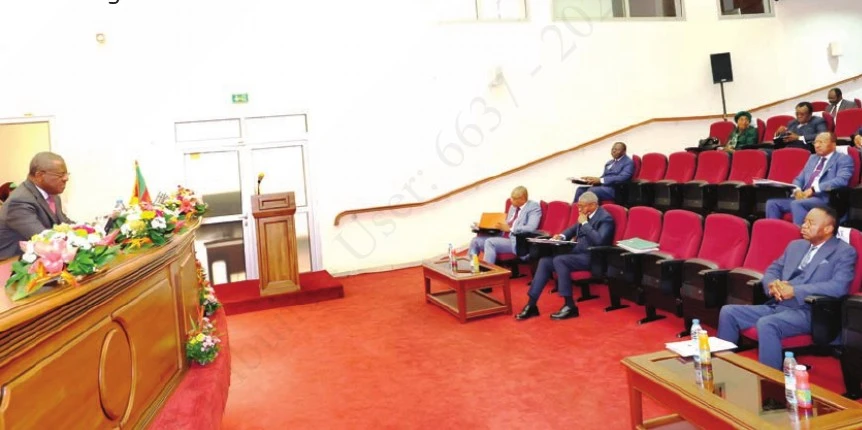
Three budget exercises scheduled in a single session. Prime Minister Joseph Dion Ngute chaired a Cabinet Council on Friday, June 26, 2026, dedicated to the budgets for 2027, 2028, and 2029. With projected growth at 3.5% in 2026, public debt to be kept under 50% of GDP, and a new program with the IMF in preparation, the decisions taken that day commit Cameroon for the next four years.
Key orientations adopted by the council
The minister delegate at the Ministry of Finance set the macroeconomic backdrop. The global economy remains fragile due to the repercussions of the 2026 Middle East conflict, which is expected to slow world growth from 3.4% in 2025 to 3.1% in 2026, before a slight recovery to 3.2% in 2027. Cameroon is projected to maintain growth of 3.5% in 2026 and 3.7% in 2027. Inflation continues to decline.
It is hard not to see IMF pressure behind the fiscal discipline on display: the policy for 2027-2029 will be based on concluding a new Economic and Financial Program with the Fund, with the explicit objective of keeping the public debt stock below 50% of GDP. Efforts will focus on mobilizing domestic non-oil revenues and rationalizing public spending.
The Minister of Economy, Planning and Regional Development presented projects included in the Priority Investment Program for 2027-2029. Digital infrastructure, roads, railways, energy, water, agriculture, and industry are among the targeted sectors. Accelerating the deployment of digital infrastructure is a priority, as is improving the electricity supply.
What this means for Cameroonians, concretely or not
On the social front, the priority is extending the general health insurance system to the most disadvantaged segments. The Special Fund for Women’s Economic Empowerment and Youth Employment will also be accelerated. These are announcements that often recur.
However, the Council adopted an Economic and Budgetary Programming Document for 2027-2029, which will be submitted to Parliament as part of the Budget Orientation Debate. This is a formal step, but it provides a binding framework for ministries.
The Prime Minister instructed the Minister of Finance to consolidate this document quickly, in close consultation with the Minister of Economy. Performance contracts for public projects are to be generalized.
The Council concluded at 12:10 pm.