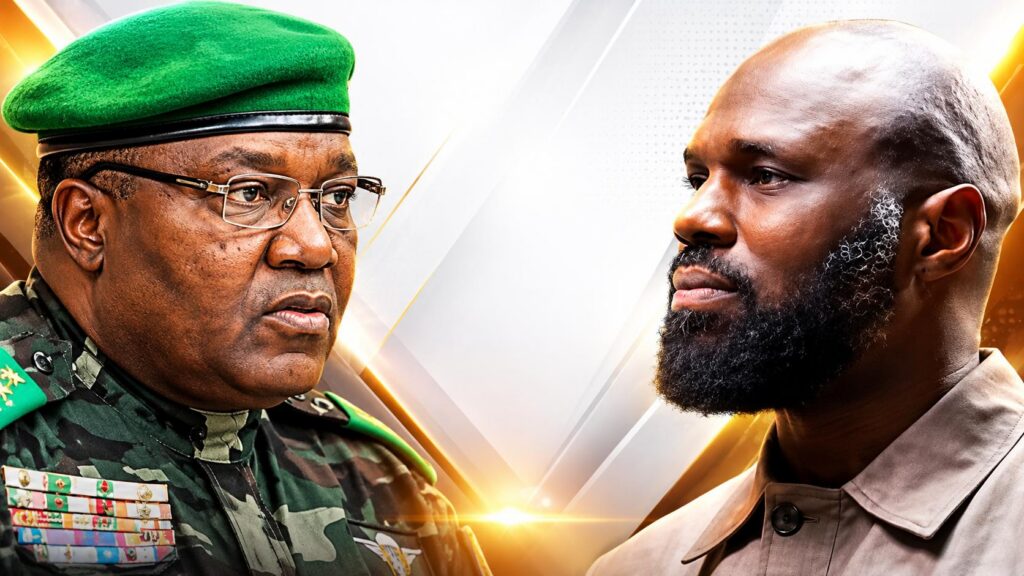
When Niger’s military government moved to strip several of its own citizens of their nationality, it simultaneously kept a Beninese activist wanted by Cotonou under its official wing. That contradiction now sits at the heart of one of West Africa’s most delicate diplomatic puzzles.
The question that won’t go away in Niamey
Kemi Seba, a Beninese-born pan-African activist, was arrested in South Africa in April 2026. Benin is seeking his extradition in connection with the failed coup attempt of 7 December 2025. Cotonou accuses him of backing the putschists and has issued arrest warrants against him. Seba rejects the charges.
His defence strategy increasingly points north — to Niger, where he holds a diplomatic passport and serves as a special adviser to General Abdourahamane Tiani, positions he obtained in 2024. That same diplomatic passport is reportedly how he entered South Africa in late 2025.
The central dilemma for Niamey could hardly be sharper: how does a government justify extending institutional protection to a foreign national wanted by a neighbouring state’s courts while, at the same time, temporarily revoking the citizenship of its own people?
Nigeriens stripped, a Beninese shielded
The contrast is hard to miss.
On 17 September 2026, Tiani signed a decree provisionally stripping five people of Nigerien nationality: former Prime Minister Ouhoumoudou Mahamadou and four other Nigeriens, including former associates of Mohamed Bazoum and a social media activist. The government accuses them of intelligence with foreign powers, undermining state security, spreading data likely to disturb public order, and activities capable of disrupting public peace and security.
These are provisional revocations under a 2024 ordinance. The national press agency reported that the latest decision brings the total number of people provisionally stripped of nationality to 25 since the mechanism was introduced.
Niamey frames the measures as necessary to defend fundamental interests and national security. But their growing use has fuelled controversy over the political use of citizenship. Human Rights Watch has said the mechanism raises serious concerns about human rights and procedural safeguards.
It is against this backdrop that the Kemi Seba case stands out. On one side, Nigeriens are provisionally denied their nationality in the name of protecting the state. On the other, a Beninese national with a long record of hostile rhetoric toward Western influence enjoys official status with Niger’s head of state and a diplomatic passport.
A pan-African figure turned political liability
Kemi Seba is no distant observer of regional tensions. A well-known pan-African militant who has built a following on attacks against France and Western influence in Africa, he has drawn closer to Sahel military governments in recent years. His ties with Niamey were formalised through his appointment as Tiani’s special adviser.
His relationship with Benin is openly hostile. After the December 2025 coup attempt, Beninese authorities issued arrest warrants against him, alleging that his statements and videos during the events amounted to support for those seeking to overthrow the government. Cotonou then launched an extradition procedure from South Africa.
For Niamey, the political difficulty remains unresolved: Seba is now directly tied to a case that touches Benin’s political stability, and the fact that he holds an official position with Niger’s president is something Cotonou cannot ignore.
A fragile rapprochement under strain
The affair lands at a particularly sensitive moment in relations between the two neighbours.
After years of tensions following the July 2023 coup in Niger, Niamey and Cotonou recently began rebuilding dialogue. On 2 June 2026, Beninese President Romuald Wadagni travelled to Niamey for talks with Tiani. Benin’s presidency presented the visit as a sign of warming relations and a willingness to revive bilateral cooperation.
That rapprochement matters strategically to both states. Niger and Benin share economic interests, communities living on both sides of the border, and common security challenges. Their cooperation is also important for trade and the movement of people and goods. Any deterioration in trust therefore has consequences well beyond diplomacy.
This is why the Kemi Seba file arrives at the wrong time. As the two countries try to turn the page on years of confrontation, Niger’s continued special relationship with a man sought by Beninese justice risks feeding misunderstandings.
Tiani’s political paradox
The issue for Niamey is not whether Kemi Seba is guilty or innocent — that is a matter for the courts. It is about the political message Niger’s government is sending.
Tiani says national sovereignty, the defence of Niger’s fundamental interests and the fight against external threats are at the core of his agenda. Under that logic, Nigeriens accused of undermining state security can face a measure as severe as provisional loss of nationality.
Yet at the same time, Niamey maintains an institutional closeness to Kemi Seba, a foreign national whose home country is now demanding his extradition. That difference in treatment inevitably raises a question of consistency.
Can sovereignty be invoked to punish Nigerien citizens severely while also serving as a shield for a foreign national wanted by a neighbouring state’s courts? That is precisely the question that may haunt relations between Niamey and Cotonou.
Reconciliation put to the test
Normalisation between Niger and Benin cannot rest solely on leaders’ meetings and statements of intent. It will also require gestures capable of restoring trust.
In the Kemi Seba case, Niamey finds itself in an awkward position. By granting the activist a diplomatic passport and an official role, Tiani’s government created an institutional link that goes far beyond a simple relationship with a foreign militant. That choice is now back in the spotlight just as Benin demands his handover.
Niger can defend its sovereign choices. Benin can pursue the legal procedures it deems necessary. South Africa remains sovereign in whatever decision it reaches at the end of the extradition process.
But politically, one reality is difficult to escape: the protection granted to Kemi Seba complicates the rapprochement between Niamey and Cotonou. The paradox is all the more striking because it comes as the Nigerien government simultaneously hardens its stance toward several of its own citizens.
Between the provisional revocation of nationality for Nigeriens accused of harming state interests and the diplomatic passport given to a Beninese man sought by Cotonou, Tiani’s government will sooner or later have to answer a question of political coherence.
If Niamey genuinely wants durable relations with Cotonou, it will need to show that the rapprochement goes beyond official ceremonies. Reconciliation is also built on trust — and in the Kemi Seba affair, that trust remains visibly fragile.


More Stories
Niger: after the september 23 attacks, can the security strategy still protect its own forces?
Sky Dragon 30 in Burkina Faso: can a $15 million missile stop a man on a motorcycle?
Can Niger’s junta stop the bleeding after the Abala-Filingué ambush?