The peace initiative between the Democratic Republic of Congo (DRC) and Rwanda has reached a “deadlock,” according to Jason K. Stearns, an associate professor at Simon Fraser University. Speaking during a Space event hosted by journalist Stanis Bujakera Tshiamala on Monday, Stearns highlighted that neither the Doha-Montreux nor the Washington processes have yielded any concrete results over the past year.
Regarding the Montreux Negotiations
Stearns observed “no significant shifts” since the Montreux discussions, where he believes “major disagreements” persist between the Congolese government and the AFC/M23 rebel coalition.
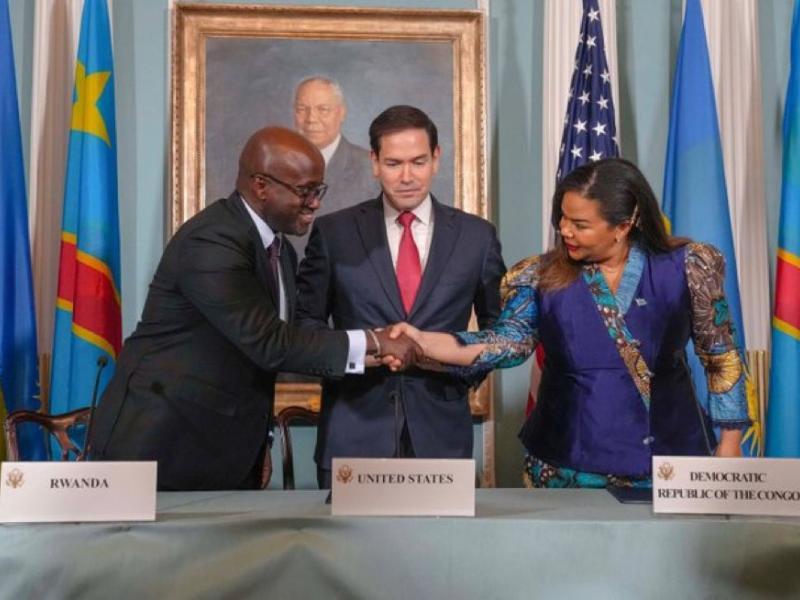
Concerning the accord signed by Kinshasa and Kigali under Washington’s mediation, he acknowledged that “many agreements” have been reached, but stressed that “implementation presents a real challenge.” He drew a parallel with American diplomacy in other areas, such as Iran, suggesting that while the Trump administration “invests heavily in diplomacy,” it risks settling for “grand declarations and MOUs” (framework agreements) “without substantial progress on implementation.” For Stearns, the crucial task is to “move beyond these framework agreements towards a genuine compromise,” a compromise that, in his view, “remains unclear.”
On the Nature of the Sought Compromise
Jason Stearns reiterated that the fundamental compromise between Kinshasa and Kigali remains consistent with all prior accords, including the comprehensive and inclusive agreement from the 2003 transition period: Rwandan troops withdrawing in exchange for a Congolese commitment to combat the FDLR. This “same deal,” he emphasized, has seen very little progress in its execution.
Regarding the M23, he noted a complete absence of compromise: “on the Congolese side, the focus remains on a military solution,” while the rebel movement asserts its intention to remain active “for another ten years.” The researcher’s conclusion: “we are very, very far from success.”
Analyzing the Lack of Progress
When questioned about the reasons for this stalemate, Jason Stearns first praised a unique contribution from the Trump administration compared to previous mediations (East African Community, then African Union via Angolan mediation): the application of genuine pressure, which he felt was absent from earlier attempts. He assessed that “sanctions on Rwanda are more aggressive than ever before,” even since the outbreak of the major Congolese wars in 1996.
However, he identified two critical shortcomings:
- A lack of coherence within the international community: Washington sanctions Rwanda without involving European partners, who are among Kigali’s primary financial backers. He illustrated this disparity by pointing out that Rwandan President Paul Kagame continues to sign agreements, notably with American basketball teams, which, in Stearns’ view, does not suggest a person truly under intense international pressure.
- The absence of a clear global strategy: According to American diplomats cited by Jason Stearns, Washington does not envision a military solution, a stance he agrees with. However, the compromise strategy that should underpin the pressure exerted on Kigali remains, in his opinion, undefined.
The Rejected Compromise Proposal at Montreux
The researcher also disclosed that American diplomats reportedly presented a “vague” compromise between the M23 and the DRC at Montreux, which was never made public. This proposal, based on Stearns’ understanding of the situation – noting he did not access the text himself – would have offered the rebel movement a form of “partial integration.” Both parties reportedly rejected this proposition.
Finally, Jason Stearns concluded that what is most lacking today is equivalent diplomatic pressure on Kinshasa. The DRC, he believes, has “thus far not really experienced diplomatic pressure from the United States,” unlike Rwanda.