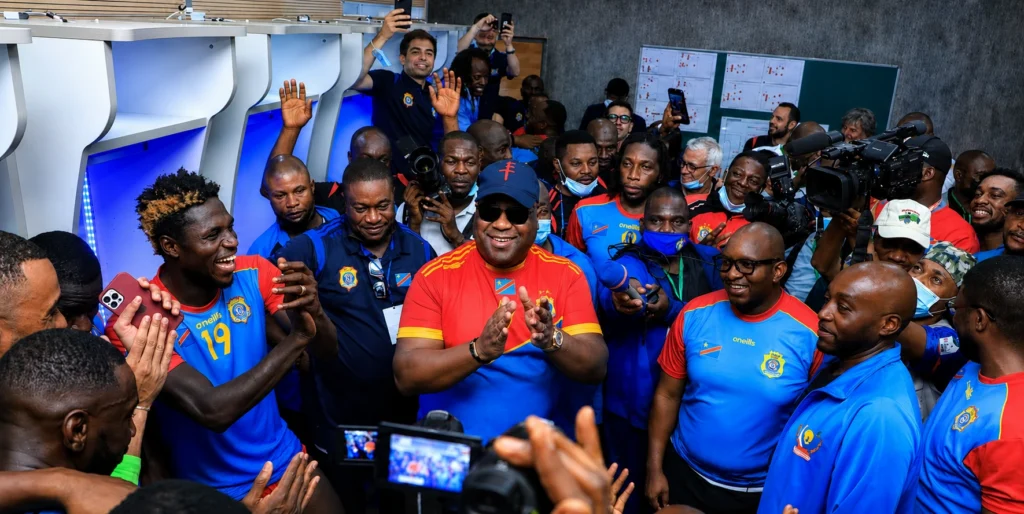
By leading the Léopards to the round of 32 in the World Cup, the République démocratique du Congo is doing more than celebrating a mere athletic achievement. This journey highlights a clear political objective: transforming football into a powerful engine for national unity and a symbol of a strengthening state. This strategy has been a cornerstone of President Félix Tshisekedi’s agenda for several years.

The scenes of jubilation are unforgettable. From the bustling streets of Kinshasa and Lubumbashi to the corners of Kisangani, Mbuji-Mayi, and the conflict-affected cities in the East, citizens gathered on June 28 to mark the historic qualification of the Léopards among the world’s elite teams. For a moment, the deep-seated political, regional, and communal divisions vanished, replaced by the sight of a single, unified flag.
In a nation often defined by its security struggles, this sporting saga tells a different tale—one of a people regaining self-assurance. While football cannot solve every problem, it serves as a powerful indicator of change. Behind the Léopards’ success lies a deeper ambition to rebuild national pride in a country that has endured decades of war, internal discord, and external pressures.
A vision shared by the president in his december address
This perspective is no coincidence. During his address to the Nation on December 9, Félix Tshisekedi dedicated a significant portion of his speech to sports. He praised the achievements of Congolese athletes and noted the Léopards’ qualification, stating that every win and every raised flag strengthens national identity and forms the intangible foundation of unity.
This sentiment encapsulates a specific political vision. For the Head of State, football is far more than popular entertainment; it is a vital component of social cohesion. It serves as a reminder that despite ongoing tensions, there is a shared Congolese destiny.
In that same speech, Félix Tshisekedi emphasized a central tenet: the République démocratique du Congo remains “one and indivisible.” Despite external aggression and attempts to fracture the territory by armed groups, every victory on the pitch acts as a symbolic demonstration of this restored integrity.
Sport as a pillar of national sovereignty
For several years, the government has launched numerous initiatives to place sports at the heart of its strategy. From hosting major continental events to overhauling sports governance and providing robust support for national teams, these actions reflect a core belief: a nation’s influence is also measured by its sporting triumphs.
The recent appointment of Véron Mosengo-Omba to lead FECOFA, alongside Amadou Diaby as first vice-president, is part of this momentum. Both leaders advocate for a modernized approach to football where high performance, professional standards, and international branding work in harmony. This new leadership is supporting a generation of players who are finally turning the massive potential of Congolese football into concrete results.
The immense popularity of “Fatshi béton”
Against a backdrop of security challenges in the East and significant structural reforms, this sporting success provides President Tshisekedi with a potent political symbol. This is not because he claims direct credit for the players’ skill or the coach’s tactics, but because he has consistently positioned sport as a tool for national healing.
As the team’s most prominent supporter, the Head of State has mirrored this athletic journey within a broader narrative of a République démocratique du Congo reclaiming its future. The popular moniker “Fatshi béton”—referring to Félix Tshisekedi with a term for unbreakable material—illustrates the connection he has built with the public, transcending traditional political boundaries.
A window into a new Democratic Republic of Congo
Leaders across the political and economic spectrum in the RDC frequently mention the need to change the country’s story. Long portrayed through the lens of conflict or resource extraction, the nation now seeks to be recognized for its stability, reforms, and regional influence. The Léopards today provide a prestigious platform for this ambition.
While football will not resolve security crises or the vast development needs facing the RDC, it underscores a fundamental truth: when an entire people rallies behind a single team, from Kinshasa to the most war-torn territories of the East, it is a nation asserting its existence and its unity.