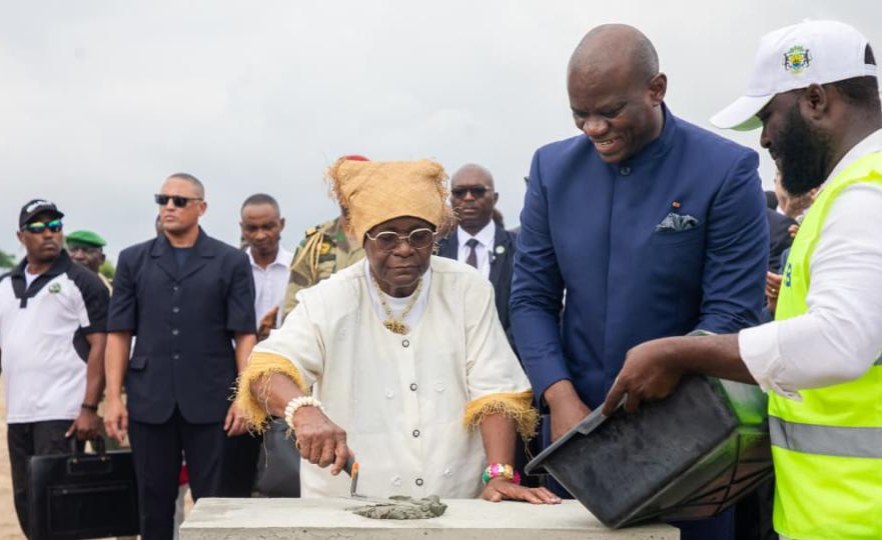
Gabon is taking a decisive step toward reshaping its economic future by initiating the construction of the Kobé-Kobé deep-water port, a cornerstone of its strategic plan to move beyond oil dependence. Under the leadership of President Brice Clotaire Oligui Nguema, this ambitious integrated project is set to redefine the nation’s growth trajectory by 2030.
Transforming Gabon into a regional logistics hub
The future deep-water port in Kobé-Kobé, located in the Estuaire Province, is designed to become one of West and Central Africa’s most advanced maritime facilities. With a draft depth of 14 to 16 meters, the terminal will accommodate ultra-large commercial vessels, positioning Gabon as a key player in the Gulf of Guinea’s competitive port landscape—challenging established hubs like Kribi in Cameroon or Pointe-Noire in Congo.
Its success, however, lies in its interconnected design. Unlike standalone infrastructure, Kobé-Kobé is engineered to serve as the maritime gateway to a broader national value chain, backed by three critical complementary projects:
- Belinga iron ore mine – One of the world’s largest untapped high-grade iron deposits, located in the Ogooué-Ivindo Province.
- Belinga–Kobé-Kobé railway corridor – A first-of-its-kind rail link designed to transport mined ore directly from the interior to the port.
- Booué hydroelectric dam – A newly commissioned facility poised to supply clean, reliable energy to mining and processing operations.
Shifting from raw exports to value-added industry
The coordinated rollout of these infrastructures marks a clear departure from Gabon’s traditional extractive economy. The government’s strategy prioritizes local metallurgical processing before export, ensuring that the nation retains greater value from its natural resources. A landmark partnership agreement signed between the Gabonese government and Africa Global Logistics in April 2026 solidified the project’s operational foundation.
Economic empowerment through large-scale job creation
The Socio-economic impact projections for the Kobé-Kobé complex are staggering, with estimates suggesting the creation of up to 160,000 direct and indirect jobs during the construction and operational phases. This presents a transformative opportunity for Gabon’s young workforce, particularly in technical disciplines such as civil engineering, port operations, energy engineering, railway maintenance, and metallurgy.
The project also seeks to catalyze growth in the local private sector by involving Gabonese SMEs in supply chains, logistics services, and ancillary industries—fostering a sustainable ecosystem of entrepreneurship and innovation.
A geopolitical milestone with long-term vision
Beyond its economic dimensions, the Kobé-Kobé initiative reflects a bold political commitment. Spearheaded under President Oligui Nguema’s administration, it embodies the vision of reclaiming national sovereignty through control of essential infrastructure. With oil reserves gradually depleting—a mainstay of state revenue—Gabon is proactively diversifying into sustainable mining and industrialization. If the project maintains its strict construction timeline, Kobé-Kobé will emerge by 2030 as the engine driving the country’s industrial emergence.