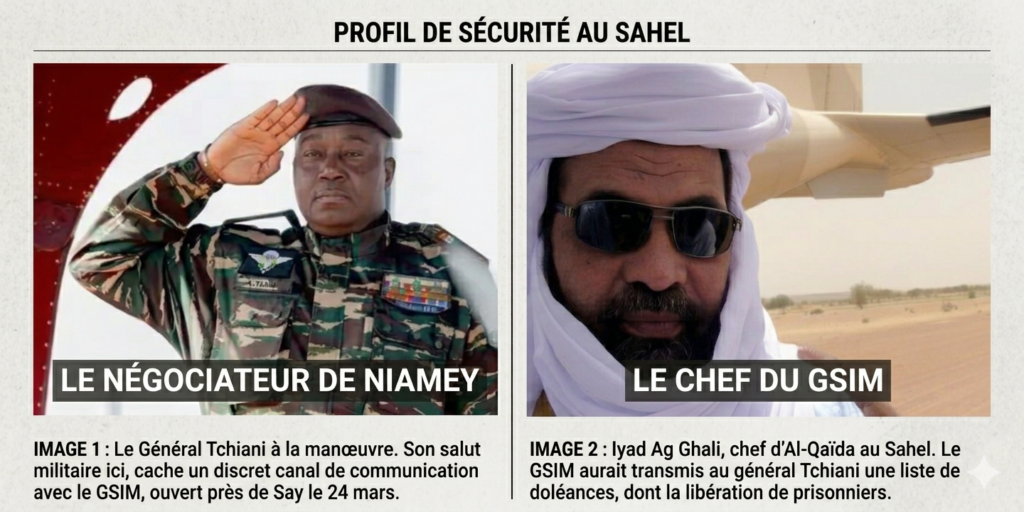
Confronted by a multifaceted terrorist threat and simmering discontent within his own military ranks, General Abdourahamane Tiani is reportedly embarking on a critical, last-ditch strategic maneuver. Niger’s transitional leader finds himself in a precarious position, attempting to balance covert negotiations with the Group for the Support of Islam and Muslims (GSIM) near Say with a robust reassertion of control over the military hierarchy, all in a bid to prevent the capital from succumbing to insecurity.
The Say Channel: a costly strategic pragmatism
A confidential meeting held on March 24 in the vicinity of Say signals a significant strategic shift. By dispatching a four-member delegation to the GSIM, General Tiani appears to be moving away from a stance of “absolute firmness” in favor of a pragmatic approach focused on national survival.
An analysis of the circumstances reveals two primary strategic pillars underpinning this decision:
- Prioritizing the adversary: Faced with the Islamic State in the Greater Sahara (EIGS), whose extreme radicalism was dramatically evidenced by the attack on Diori-Hamani Airport last January, the military leadership aims to “neutralize” the GSIM through dialogue. The strategic objective is to transform an exhausting three-way conflict into a more manageable bilateral front.
- The looming specter of a Bamako-style blockade: Niger’s authorities are observing the situation in Mali with growing apprehension, where the GSIM has attempted to encircle and isolate the capital. By engaging in discussions about the demands of the Katiba Hanifa — including the release of prisoners and the payment of an annual tithe — Niamey hopes to secure a vital logistical reprieve.
Disquiet beneath the epaulets: the ticking time bomb of unpaid wages
However, even the most astute high-level strategy can falter without a cohesive and motivated military force. The recent dismissal of the head of the Security and Intelligence Battalion (BSR) in Tahoua, following grievances over soldiers’ pay (reporting 800 F CFA received instead of the expected 1,200), exposes a deep-seated structural vulnerability.
This elite unit, once a cornerstone of cooperation with US special forces before their mandated departure in 2024, now serves as a poignant symbol of an army grappling with budget cuts and internal logistical challenges. Colonel Mamane Sani Kiaou, the army’s chief of staff, reportedly had to intervene personally to quell the unrest, underscoring that the internal threat is potentially as formidable as the jihadist insurgency.
The security void and the geopolitical realignment
The intensification of these clandestine negotiations unfolds against a backdrop of profound shifts in international alliances. Following the withdrawal of French and American troops, Niger has pivoted towards the Alliance of Sahel States (AES) and cultivated new partnerships with nations such as Russia and Turkey.
Yet, despite the arrival of military advisors and new equipment, including surveillance drones, the operational landscape remains fraught with difficulty. The absence of high-precision aerial intelligence sharing, previously provided by Base 101 in Niamey and Agadez, now compels the transitional government to forge a new “field diplomacy” with groups it was actively combating just yesterday.
The paradox of continuity: Mohamed Bazoum’s enduring shadow
A profound irony lies in the inadvertent mirroring of the former regime’s strategic approach. While the coup d’état of July 26, 2023, was officially justified by the “security failures” attributed to Mohamed Bazoum, General Tiani now finds himself compelled to employ similar tactics: negotiation as an integral component of counter-insurgency efforts.
However, where Bazoum openly acknowledged dialogue for hostage releases (such as that of nun Suellen Tennyson), the current military leadership must operate in secrecy. This clandestine approach stems from fears that public acknowledgment of such dialogue could be perceived by its more radical supporters — and its AES allies — as a sign of weakness in the face of Al-Qaeda.
The Niamey government currently stands at a critical juncture. Engaging in negotiations with the GSIM to isolate the EIGS represents a rational, yet politically precarious, calculation. By agreeing to discuss terms like “tithes” or “zone withdrawals,” the transitional authorities risk inadvertently legitimizing these armed groups in the long term. For General Tiani, the greater challenge is no longer seizing power, but rather maintaining the cohesion of an army that is scrutinizing its finances while the adversary continues to expand its territorial influence.