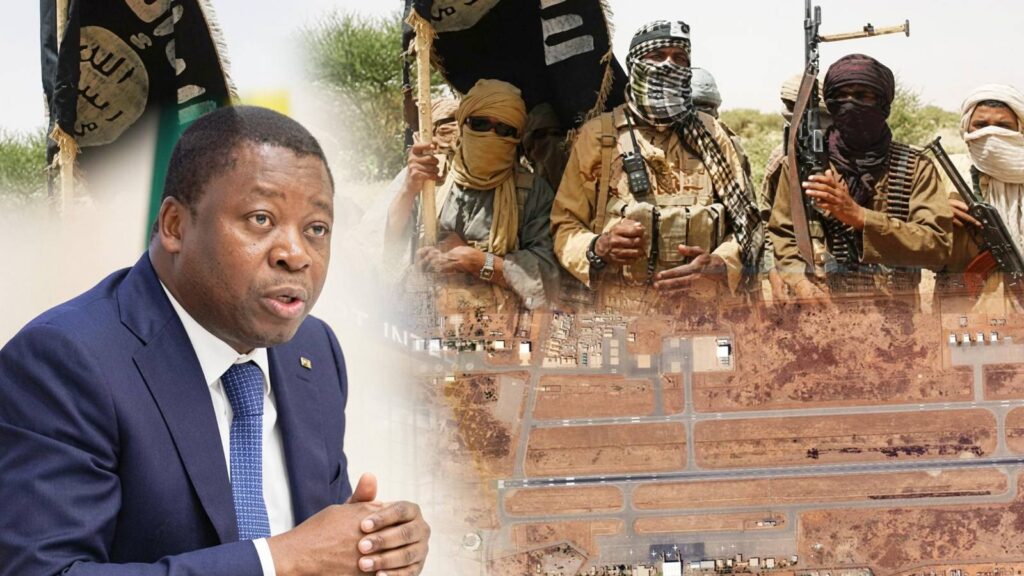
The violent assault on Niamey’s international airport on June 18, 2026 has sent shockwaves through West Africa, casting a long shadow over diplomatic efforts in the region. As negotiations between Bénin and Niger neared a critical juncture regarding border reopening, the sudden outbreak of violence has thrown a wrench into the proceedings, raising serious questions about hidden economic motives.
Suspicions of state-sponsored interference
While the Group for the Support of Islam and Muslims (JNIM) has been identified as the operational force behind the attack, analysts are scrutinizing the unusual precision and timing of the assault. Officials familiar with the investigation suggest the terrorist group may have acted as a proxy for external state actors with vested interests.
Among the names circulating in diplomatic circles, that of Togo’s President Faure Gnassingbé stands out prominently. Reports indicate he may have funded the operation with a single objective: to derail the imminent agreement between Cotonou and Niamey.
The port rivalry: the hidden driver of conflict
To unravel the true motivation behind this attack, it is essential to shift focus from security concerns to economic realities. The crisis stems from a fierce competition between regional ports, where commercial interests have escalated into geopolitical confrontation.
Since Bénin and Niger closed their borders, the Autonomous Port of Lomé (PAL) has become the primary lifeline for Niamey’s trade, absorbing a substantial share of its maritime traffic. This shift has generated unprecedented profits for Togo’s port economy.
However, any resumption of trade through Cotonou’s port—closer and more accessible to Niger—would immediately divert goods away from Lomé, resulting in significant revenue losses for the Togolese economy. The stakes are no longer just economic; they are existential.
Diplomatic fallout and regional instability
The timing of the attack was no coincidence. By striking on the very day progress was being made between Bénin and Niger, the orchestrators sought to reignite mistrust and sabotage the rapprochement. Should evidence confirm Togolese involvement, this would mark a dangerous escalation—one that transforms economic rivalry into a conflict waged not just in boardrooms, but in blood.