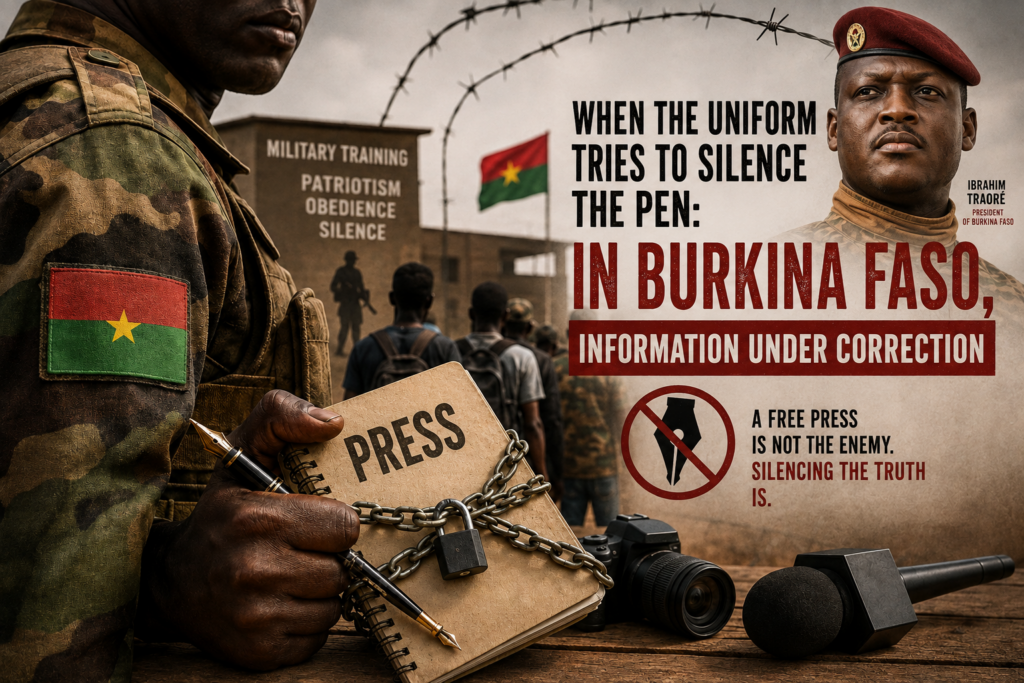
Military Drills Disguised as Civic Training
An unsettling scene has emerged near Ouagadougou, where more than forty journalists from Burkina Faso recently completed what was officially labeled a patriotism training session. Beneath the polished rhetoric of civic responsibility, however, lies a far more troubling agenda: an attempt to impose ideological conformity on independent journalism.
Silencing the Fourth Estate
The very notion of press freedom is under siege in Burkina Faso today. Investigative reporting that exposes security failures, civilian hardships, or institutional shortcomings is now met with accusations of treason or unpatriotic conduct. By compelling journalists to attend undisclosed military-style camps, authorities are not fostering civic awareness they are manufacturing compliant mouthpieces for state propaganda.
This coercive approach signals a dangerous shift. What we are witnessing is not merely a military administration navigating a complex security crisis; it is the consolidation of an absolute authority determined to monopolize public discourse. By stifling dissent and controlling the flow of information, the government seeks to position itself as the sole arbiter of national truth.
The Illusion of National Unity
Patriotism, however, cannot be manufactured through forced ideological conformity. Journalism that adheres to state-imposed narratives ceases to be journalism at all. When reporters are silenced or compelled to adopt a single, uncritical perspective, the consequences extend far beyond the newsroom. Citizens are left without reliable sources of information, leaving them vulnerable to misinformation, rumor, and arbitrary decision-making.
True patriotism does not require blind allegiance to those in power. It demands rigorous scrutiny of governance, especially in times of crisis. A journalist committed to Burkina Faso’s future must have the freedom to document civilian displacements, question official narratives, and highlight systemic weaknesses precisely because these are the issues that demand urgent attention.
Where National Security Ends and Political Control Begins
While it is reasonable for the state to request prudence in reporting sensitive military operations or protecting operational details, these legitimate concerns should never serve as a pretext to turn journalists into propaganda tools. National security and political survival are not the same thing.
The concept of patriotism itself warrants scrutiny. To love one’s country is not synonymous with endorsing the actions or inactions of its leaders. A journalist who exposes corruption, human rights abuses, or policy failures does not betray Burkina Faso; they uphold its democratic foundations.
The Danger of a Controlled Narrative
When official and private media refrain from publishing certain truths, the resulting information vacuum is quickly filled by unverified claims, social media speculation, and clandestine sources. Far from restoring stability, such censorship erodes public trust in institutions and fuels disillusionment.
Trust is not decreed by decree it is earned through transparency, accountability, and the freedom to challenge official accounts. A society that knows its press operates independently is better equipped to distinguish fact from fiction. Conversely, when certain truths become too dangerous to report, doubt permeates every corner of public life.
The Contradiction in Forced Patriotism
Journalism, by its very nature, relies on asking uncomfortable questions. A reporter who cannot investigate public decisions, hold authorities accountable, or contrast official statements with lived realities ceases to function as a watchdog. In a nation grappling with armed violence, mass displacements, and economic strain, the need for independent, fact-based reporting is more critical than ever.
Can a journalist, trained to obey military discipline, still fulfill the role of a critical observer? The two functions one rooted in command and secrecy, the other in verification and public responsibility are fundamentally incompatible. Blurring these lines risks reducing journalism to a mere extension of state authority.
A Slippery Slope of Ideological Enforcement
Today, it is journalists who are pressured to prove their patriotism. Tomorrow, who might be next? Academics, judges, artists, activists, researchers could any of these groups be labeled insufficiently patriotic for criticizing government policy? A robust democracy is measured not by its ability to suppress criticism but by its capacity to withstand dissent without branding it as sedition.
The Unstoppable Force of Truth
History demonstrates that regimes attempting to monopolize information rarely succeed in suppressing reality. While they may control state media, impose official narratives, and intimidate dissenters, they cannot erase facts. Information flows through testimonies, diaspora networks, international outlets, and social platforms. The real challenge, therefore, is not how to enforce a single narrative but how to create an environment where reliable information can thrive.
In a country at war with armed factions, the responsibilities of journalists are immense. But so too are the responsibilities of those in power. Protecting citizens does not justify the perpetual curtailment of freedoms. The true test of leadership lies in safeguarding the public without transforming security imperatives into a justification for censorship.
Patriotism as a Tool of Censorship or Empowerment?
Patriotism should never be a license to censor. Nor should it be used to divide citizens into the loyal and the suspect. A journalist who exposes a state weakness is not betraying Burkina Faso; they are helping prevent that weakness from becoming a catastrophe. The question facing the nation today is not whether patriotism is desirable but what kind of patriotism we choose to uphold.
Do we want a society where information is filtered through the lens of state approval? Or do we want a society where the truth however inconvenient remains accessible to all?