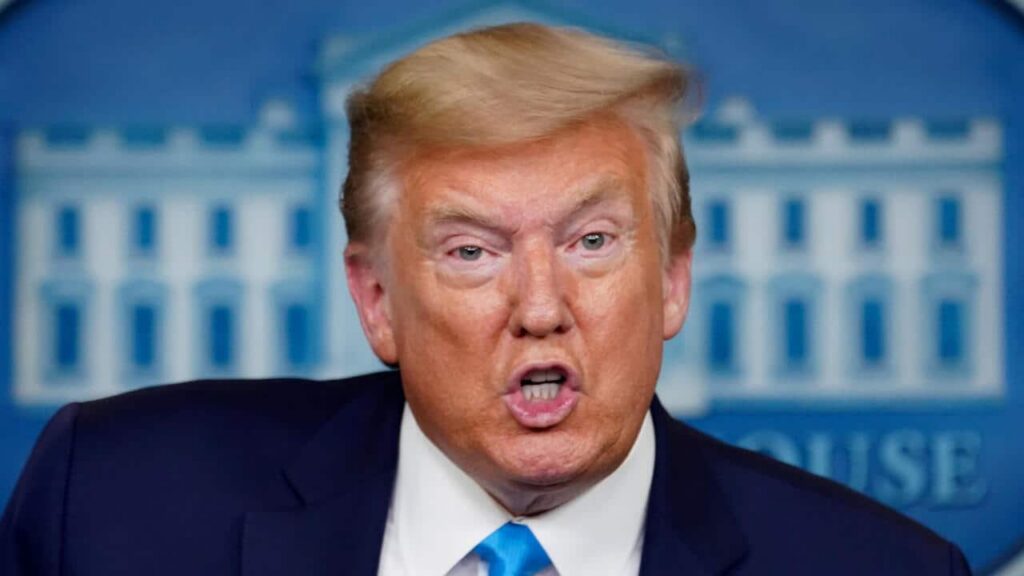
Since his first term, Donald Trump has structurally redefined United States policy to counter China, which he sees as America’s primary rival for global dominance.
Washington’s Trump administration has made breaking free from dependence on Chinese rare earths an absolute strategic priority. To lead this push, it is relying on GreenMet.
Founded by CEO Drew Horn, the firm saw its leader visit Yaoundé a few months ago in a meeting that attracted little public attention. Horn is a former national security official under Trump, having served as senior advisor to the Director of National Intelligence. He represents the visible face of an American program whose associates include former close Trump aides and trusted figures, notably George Sorial (former legal counsel to Donald Trump) and Keith Schiller (former director of security at the Trump Organization).
At the heart of the U.S. strategy, driven by Horn and GreenMet, a delegation of senior American officials came to Cameroon to sign a Memorandum of Understanding whose exact content was never disclosed by the American group. However, it is known that American Renaissance Minerals (ARM), directly linked to GreenMet, is now in pole position for the nickel and cobalt project at Nkamouna. And that is not all: Washington also has its sights set on rare earths.
Donald Trump is so committed to his ambitions in Cameroon that he bypassed a U.S. congressional restriction that had excluded Cameroon from AGOA. The American president is now leveraging the American Chamber of Commerce in Cameroon (AmCham) to handle trade agreements.
Unlike China, which focuses on strategic minerals in the DRC, the United States — aiming to invest in processing to reduce the carbon footprint in the U.S. — has conditioned its support for the government on transparency in extractive and legal sectors. U.S. intelligence reportedly stepped in after EITI revelations about illicit gold trafficking; Washington is now working with Yaoundé to expose those behind this plunder.
And the U.S. does not plan to stop there. American diplomacy has cut by more than half the number of African countries allowed to issue U.S. visas. Among the 20 countries selected out of 50 in Africa, Cameroon is included. On the security front, within eight months, President Paul Biya successively received in Yaoundé: General Dagvin Anderson, then commander of AFRICOM, in September 2025, and Lieutenant-General John William Brennan Jr., deputy commander of AFRICOM, in May 2026.
Improving the business climate is a priority for Washington: “I would sincerely like to see more American companies invest in Cameroon, develop trade relations, and create partnerships, including joint ventures between U.S. and Cameroonian firms. This benefits both countries: it creates jobs in the United States, supports American industry — a priority of President Trump — and also boosts Cameroon’s economy,” said Christopher Lamora earlier this year after a one-on-one meeting with President Paul Biya.
Washington aims to take up the challenge posed by China, which has invested over $700 billion across 49 African nations. Some observers of Trump’s policy see in his strategy a desire to transform target countries — Cameroon, Nigeria, and Kenya — in the image of what were once the “Asian dragons” (South Korea, Taiwan, Hong Kong, Singapore).