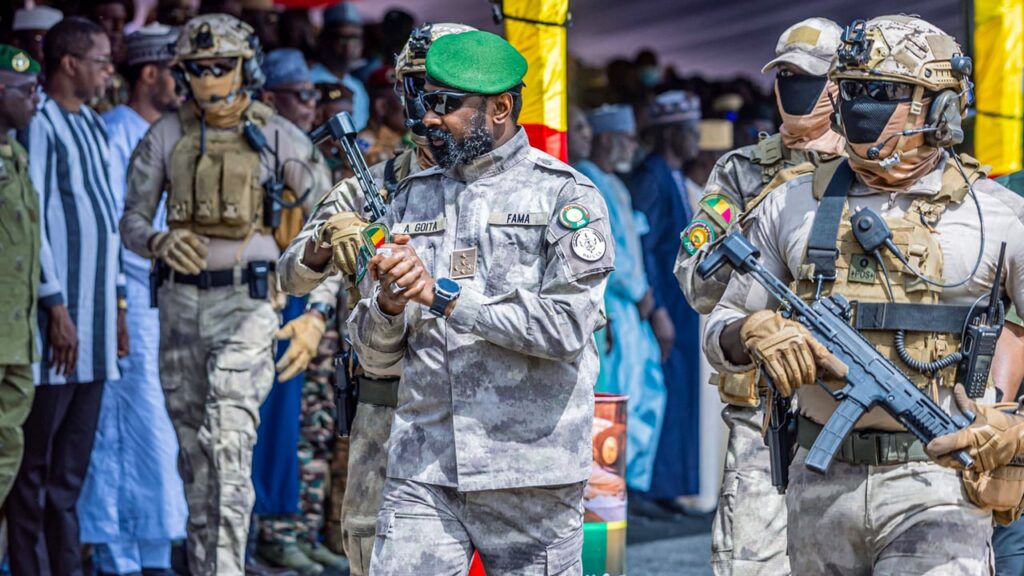
The recent Mali turmoil has reshaped the political landscape, with Assimi Goïta leveraging the April 25th crisis to solidify his authority. The events of that day not only tested the nation’s stability but also presented an opportunity for strategic maneuvering at the highest levels of government.

From crisis to consolidation: Goïta’s strategic moves
Following the April 25th attacks, Assimi Goïta moved swiftly to recalibrate Mali’s governance framework. The transitional leader, already under scrutiny for his prolonged tenure, seized the moment to introduce sweeping changes that would redefine the country’s political trajectory. Key appointments and institutional reforms were rolled out in the immediate aftermath, signaling a deliberate shift in power dynamics.
One of the most significant developments was the reconfiguration of the security apparatus. Goïta appointed loyalists to pivotal roles, ensuring tighter control over military and intelligence operations. This reshuffle not only reinforced his grip on power but also sent a clear message to both domestic and international stakeholders about his commitment to stability—however controversially defined.
A reshaped cabinet and shifting alliances
The transitional president’s next move targeted the cabinet, where a wave of dismissals and replacements reshaped the government’s composition. Former allies found themselves sidelined, while new faces—many with close ties to Goïta—were brought into the fold. This strategic overhaul extended beyond mere personnel changes; it reflected a broader realignment of political loyalties, with the transitional leader positioning himself as the indispensable figure in Mali’s future.
Observers noted that the Group for the Support of Islam and Muslims (JNIM) played a pivotal role in this narrative. While the group’s activities have long posed a threat to Mali’s stability, their presence has inadvertently provided a pretext for Goïta to justify his expanded authority. The narrative of combating extremism has become a powerful tool in consolidating power, with the transitional leader framing his actions as necessary for national survival.
The role of external actors in Mali’s evolving power structure
Mali’s political landscape has also been influenced by the involvement of international players, particularly the Africa Corps and other regional forces. While these actors initially entered the country under the guise of security cooperation, their prolonged presence has raised questions about their long-term impact on Goïta’s leadership. Some analysts suggest that external support, whether overt or tacit, has emboldened the transitional president to pursue policies that prioritize centralized control over democratic processes.
The relationship with Russia, symbolized by Vladimir Putin’s engagement in the region, has further complicated the equation. The Kremlin’s growing influence in the Sahel has provided Goïta with an alternative to Western partnerships, enabling him to navigate the global stage with greater autonomy. This geopolitical pivot has not only bolstered his domestic standing but also underscored Mali’s shifting alliances in a rapidly changing international order.
Public perception and the road ahead
The consolidation of power under Assimi Goïta has sparked a mix of reactions among Mali’s citizens. While some view his actions as a necessary response to ongoing security threats, others perceive them as a step toward authoritarianism. The transitional leader’s ability to maintain public support will hinge on his success in delivering tangible improvements in security, governance, and economic stability.
For now, Goïta appears firmly entrenched, with his strategies reflecting a calculated approach to navigating the complexities of Mali’s post-crisis environment. Whether his vision will translate into long-term stability or further instability remains an open question. One thing is certain: the events of April 25th have indelibly altered the course of Mali’s political future, and Assimi Goïta is determined to shape it in his image.