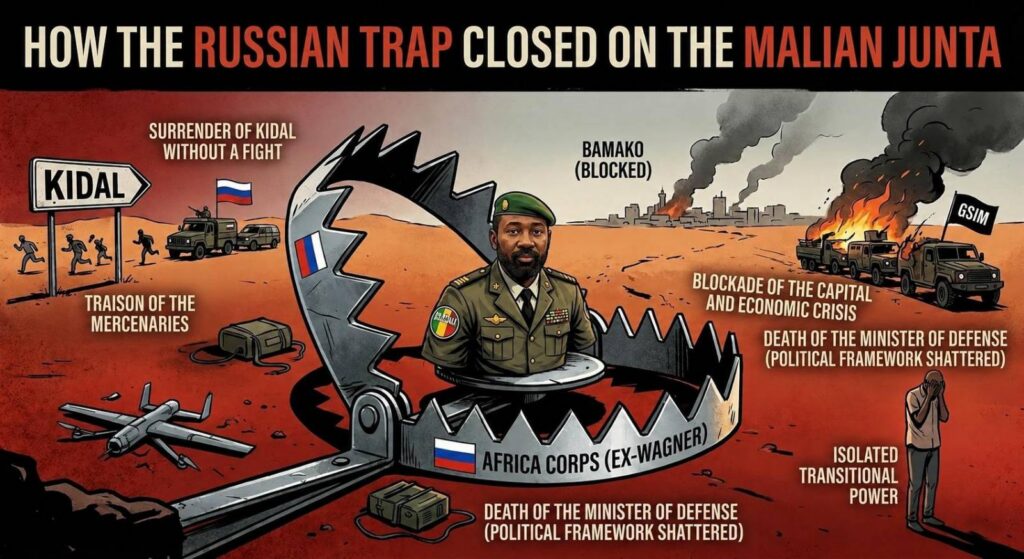
The swift unraveling of a political strategy often reveals itself in the speed at which its backers abandon ship. In Mali, recent battlefield setbacks against coordinated offensives by rebel factions from the Front de Libération de l’Azawad (FLA) and jihadist militants from the Groupe de Soutien à l’Islam et aux Musulmans (GSIM) have exposed systemic flaws within the ruling junta’s approach. By entrusting the nation’s security to foreign paramilitary forces, Bamako’s leadership has only highlighted its own fragility.
From Kidal to Bamako: the collapse of a flawed security model
April 2026 marked a turning point in Mali’s downward spiral when the northern city of Kidal—reclaimed in 2023 by Malian troops alongside Russian mercenaries—fell with surprising ease back into rebel hands. Rather than a heroic last stand, the retreat of Africa Corps (formerly Wagner) troops was negotiated, leaving behind heavy weaponry in exchange for safe passage. This pragmatic withdrawal underscored a harsh geopolitical truth: mercenary forces serve only their own interests, not the sovereignty of another nation.
« The Russians abandoned us in Kidal, » admitted a high-ranking Malian official, echoing the deep sense of betrayal permeating government corridors in Bamako. The incident became a symbol of the junta’s misplaced trust in foreign mercenaries, whose primary objective was never to defend Mali’s territorial integrity, but to extract profit from a failing state.
The domino effect of failed security partnerships
The consequences of this reckless gamble are no longer confined to the deserts of the North. In April, rebel offensives reached the outskirts of Kati and Bamako itself, culminating in the death of General Sadio Camara, Mali’s Defense Minister and the architect of the junta’s alliance with Moscow. The loss of such a central figure has left the military government decapitated at a time when the country faces total economic and humanitarian collapse.
For months, the GSIM has enforced a crippling blockade on fuel, food, and goods entering the capital. Schools have shuttered, power grids falter, and the economy lies in ruins. The Russian-backed « security shield » promised by Bamako has failed to prevent either the siege of the capital or the infiltration of hostile forces within the heart of government.
Drones, strikes, and the illusion of control
To justify expelling traditional international peacekeepers such as MINUSMA and Barkhane, the junta had touted a « surge » in Malian Armed Forces capabilities, bolstered by Russian technology and surveillance drones. While these tools were deployed extensively, they did little to stabilize the country—instead, they fueled local resentment. Civilian casualties from drone strikes deepened communal tensions without ever curbing rebel advances.
Analysts now believe Africa Corps is shifting its remaining resources to merely protecting the regime in Bamako, effectively abandoning any pretense of reclaiming or stabilizing the rest of the country. Moscow’s claims of « foiling a coup » ring hollow against this backdrop of retreat and retreat.
The endgame for Bamako’s military rulers
The Alliance of Sahel States (AES), once hailed as a regional bulwark against instability, has remained conspicuously silent in the face of Mali’s crisis. Abandoned by its Russian partner, ostracized by regional blocs like ECOWAS, and rejected by a population suffocating under blockades, the junta in Bamako appears to be running on borrowed time.
Its gamble on imported security from Moscow has proven to be the most catastrophic strategic misstep in modern Malian history. By sacrificing diplomacy, internal dialogue, and regional alliances in favor of a private security contract, the military regime has trapped itself in an inescapable dead end. In Bamako today, the question isn’t whether the government will fall—but how long it can stave off collapse before the security vacuum it created consumes it entirely.