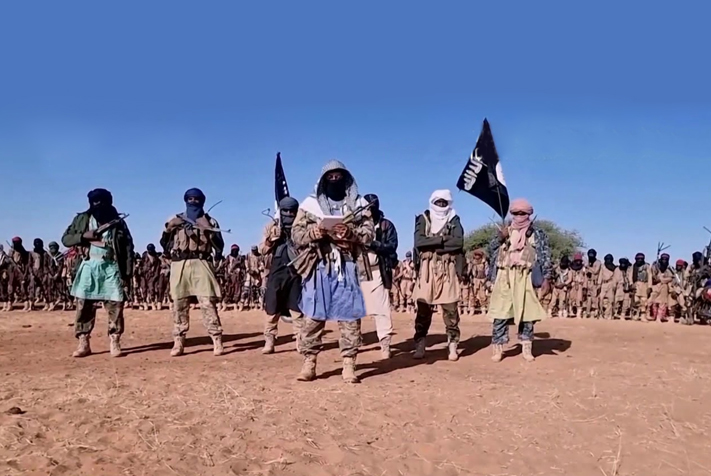
Despite JNIM’s prominence, the Islamic State’s Sahel branch remains entrenched in Mali’s northeast, adapting its tactics and expanding territorial control.
In the Gao and Ménaka regions of Mali, the Islamic State in the Greater Sahara (ISGS), now operating as the Sahel Province of the Islamic State (ISSP), continues to exert significant influence. Key areas under its sway include the “3 T” localities—Talataye, Tin-Hama, and Tessit—as well as Labbezanga, where the group maintains a strong operational presence. These zones serve as critical hubs for its activities, enabling it to assert control over local communities and vital transit routes.
Leadership and Strategy
The ISSP is currently led by Abou Al-Bara, who took charge after the death of Adnan Abu Al-Walid Sahraoui in 2021. While the group’s command structure remains partially obscure, it has shifted its approach since 2020. No longer relying solely on public executions and mass terror, the ISSP now focuses on subtler tactics—territorial dominance, localized governance, and community engagement—to embed itself within the region. This strategic pivot allows it to operate with less visibility while still advancing its objectives.
The Malian Armed Forces (FAMa) have intensified efforts to counter the ISSP’s presence. In a recent operation, military forces targeted and neutralized a mid-level commander in Bara, Ansongo cercle, during a nighttime airstrike. Several affiliated fighters were also eliminated in the raid, demonstrating the army’s sustained pressure on the group’s strongholds. Despite these setbacks, the ISSP has shown resilience, reconstituting its ranks and maintaining logistical networks in border areas.
Tactical Operations and Rivalries
The ISSP continues to target strategic locations along the Mali-Niger axis, including Talataye, Tin-Hama, Tessit, Labbezanga, and Ménaka. By controlling movement in these areas, the group reinforces its influence over local armed factions and asserts dominance over critical corridors. This approach not only strengthens its operational capacity but also undermines regional stability.
A notable aspect of the security landscape is the rivalry between the ISSP and the Jama’at Nusrat al-Islam wal Muslimin (JNIM). While JNIM has gained attention for its high-profile attacks, including coordinated strikes near Bamako in April 2026, the ISSP’s strategy remains distinct. JNIM’s operations often prioritize media attention through dramatic assaults, whereas the ISSP focuses on discreet territorial control, community pressure, and securing key transit points. Although past truces between the two groups limited direct confrontations, escalating military offensives by Malian forces have led to a temporary convergence of interests, though no formal peace agreement has been reached.
Ongoing Threats and Regional Impact
Data from early 2026 highlights the ISSP’s expanding threat. According to security assessments, 86% of Islamic State activities globally were concentrated in Africa during the first quarter of the year. The group has increasingly employed armed drones, motorized attacks, and economic pressure to assert its authority. Infrastructure in the Ménaka-Ansongo-Tessit-Labbezanga corridor remains particularly vulnerable, with recent incidents such as the February 2026 ambush on a civilian convoy near Gao—just 35 kilometers from the city—serving as stark examples of its capabilities.
International cooperation has yielded some successes, including the elimination of key figures like Abu-Bilal Al-Minuki in a joint operation involving Nigerian and U.S. forces in the Lake Chad basin. However, the ISSP’s presence in Mali’s northeast remains robust, particularly in the “3 T” areas and Labbezanga, where its territorial control and influence over local armed groups persist. By exploiting the media spotlight on JNIM and other factions, the ISSP has managed to consolidate its position, exert pressure on Malian forces, and deepen its roots within the region. Addressing this threat will require sustained military and strategic focus, especially along the Niger-Mali border.