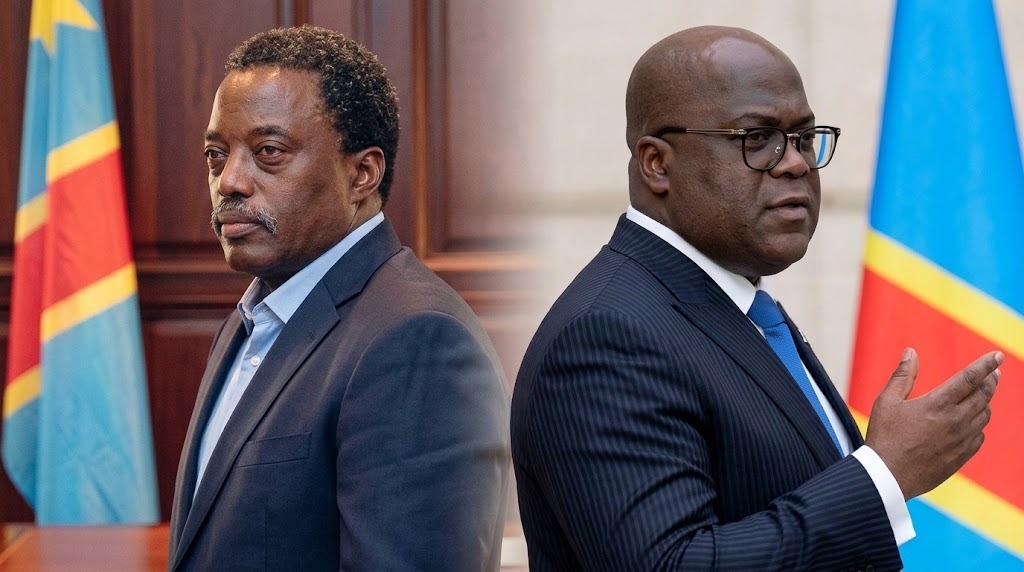
The political and military landscape of eastern Democratic Republic of Congo has reached a decisive breakthrough. Former president Joseph Kabila has taken charge of the Front for the Refoundation of the Nation (FRN), a new political-military platform unveiled in Goma that brings together senior figures from the AFC-M23. This restructuring could fundamentally alter the balance of power in the east, even as diplomatic efforts to end the conflict grind on.
A major shift in Goma as Kabila seizes the helm
GOMA, 13 October 2026 — The announcement, made on Monday 12 October in Goma, the North Kivu city controlled by the M23 since January 2025, marks a decisive turning point. The FRN gathers several key officials from the Alliance Fleuve Congo (AFC) and the March 23 Movement (M23), two components now at the heart of a sweeping political and military realignment.
Alongside Joseph Kabila stand Corneille Nangaa, Bertrand Bisimwa and Sultani Makenga, presented as leading figures of the new organisation. This configuration pairs a former occupant of the Congolese presidency with commanders directly tied to the rebellion fighting government forces in the east.
From AFC-M23 to FRN: a restructured rebel command
The creation of the FRN is not merely a change of name. It signals a declared intent to reorganise the political and military leadership of the movement opposed to Félix Tshisekedi’s government.
According to the declaration made public in Goma, the new front succeeds the Alliance Fleuve Congo. The document also outlines a strategy of confrontation with the central government, including the use of force. The exact institutional future of the M23, beyond its association with the new platform, remains to be clarified.
This development follows several signals observed since 2025. In its final report dated 11 June 2026, the United Nations Group of Experts on the DRC had already pointed to a possible restructuring of the AFC-M23 and a growing role for Joseph Kabila. The experts had also noted repeated contacts between the former head of state and leaders of the movement.
The FRN announcement thus gives official form to a rapprochement whose contours were already under scrutiny by international observers. It nevertheless raises a crucial question: will this new leadership consolidate the various components of the rebellion, or will it spark fresh internal rivalries?
Rwanda at the centre of a regional crisis
The regional dimension remains unavoidable. The M23 is considered by the United Nations and several international partners to be militarily supported by Rwanda. Kigali rejects the accusations against it and presents its security concerns in eastern DRC as a major issue in its relations with Kinshasa.
Joseph Kabila’s presence at the head of the FRN adds a political dimension to this equation. By bringing together a figure who led the DRC from 2001 to 2019 and rebel leaders, the new platform may seek to broaden its appeal beyond its military base. It could also complicate the reading of the conflict, more tightly intertwining national political opposition, territorial demands and regional alliances.
For Kinshasa, the challenge is no longer limited to containing an armed insurrection. It also involves responding to an organisation that intends to contest its authority under a broader political banner. For Kigali, the movement’s consolidation comes as its role in the conflict remains at the centre of diplomatic tensions with the DRC.
Extra pressure on peace negotiations
The birth of the FRN comes as diplomatic initiatives aimed at ending the fighting continue. Talks between Congolese parties and international mediators seek to reduce clashes, restore security and create conditions for a lasting settlement.
The emergence of a new political-military structure led by a former president could complicate these efforts. It raises questions about who is authorised to negotiate, the command chain of armed groups and the ability of leaders to enforce any commitments on the ground.
Joseph Kabila’s judicial record is also a source of tension. Sentenced to death in absentia in September 2025 for treason, the former president rejects the accusations against him and denounces a politically motivated procedure.
Eastern Congo still in uncertainty
Beyond announcements and power struggles, the populations of North Kivu and South Kivu remain the first to bear the consequences of the conflict: forced displacement, persistent insecurity and disruption of economic activities.
The creation of the FRN thus opens a new sequence whose effects will depend on its ability to unify its components, its relations with Rwanda and the reaction of Congolese authorities.
One certainty stands out: the crisis in eastern DRC can no longer be reduced to a confrontation between the Congolese army and the M23. With Joseph Kabila’s formal entry into this political-military architecture, the political, military and regional dimensions of the conflict are more deeply intertwined than ever. The question now is whether this realignment will lead to a new escalation or, eventually, open a wider space for negotiation.