
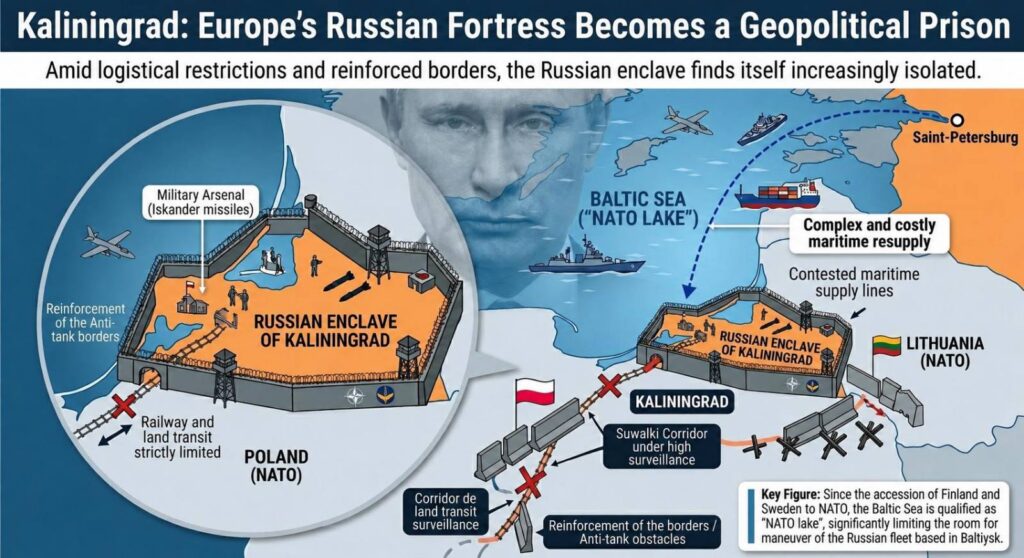
Once Moscow’s most formidable military bastion in Europe, the Russian exclave of Kaliningrad now faces an unprecedented tightening of controls by its NATO neighbors. Between strained logistics and fortified borders, the region is slipping into isolation, reshaping the geopolitical landscape of the Baltic.
From fortress to prison: a strategic reversal
Kaliningrad, a heavily militarized Russian territory wedged between Poland and Lithuania, is undergoing a historic shift. Long regarded by the Kremlin as a powerful projection tool—home to Iskander missiles capable of striking deep into Europe—the enclave now resembles a besieged outpost, severed from the continent.
The transformation is not sudden but the result of deliberate, incremental pressure from Warsaw, Vilnius, and Riga. What was once a perceived advantage—the exclave’s proximity to NATO’s eastern flank—has become a strategic liability, with the Baltic states and Poland leveraging its geographic vulnerability to reinforce deterrence.
Road and rail arteries choked by sanctions
The isolation of Kaliningrad is unfolding through a gradual, methodical asphyxiation of its supply routes. The transit corridors that once connected the exclave to the Russian mainland are now under siege:
- Rail networks: The Suwałki corridor, a narrow strip of land linking Belarus to Kaliningrad, is under heavy surveillance. Rail transit, largely reliant on Soviet-era infrastructure, has been slashed to the bare minimum permitted under European sanctions, crippling cargo flows.
- Energy transit: Overland fuel and power shipments have plummeted, forcing Moscow to reroute supplies via the Baltic Sea—a costly, logistically complex alternative that leaves the enclave exposed to maritime interdiction.
- Border fortifications: Physical barriers now seal off access. From anti-tank ditches to razor-wire barriers, Poland and Lithuania have transformed their frontiers with Kaliningrad into nearly impassable zones.
The Baltic Sea, once a contested maritime space, is now widely described as an « OTAN lake » following Finland and Sweden’s accession to the alliance. This shift has further narrowed Russia’s operational space, particularly for the Baltic Fleet stationed in Baltiysk.
Moscow’s dilemma: an enclave turned into a trap
For the Kremlin, Kaliningrad’s predicament is a strategic nightmare. While the region remains heavily armed, its resilience in a prolonged conflict is increasingly questioned by military analysts. Cut off from smooth overland supply lines to the Russian heartland, its forces now depend entirely on air and sea routes—both vulnerable to disruption.
Some observers argue that what Moscow once viewed as its « sharpest blade » against the West has backfired. In the event of open confrontation, the exclave could be swiftly encircled and isolated by a united, vigilant NATO.
Diplomatic stalemate deepens
Moscow has repeatedly condemned the de facto blockade, invoking violations of international treaties guaranteeing free transit to its peripheral regions. Yet, the Baltic states and Poland, backed by their Western allies, justify the measures as essential to national security amid Russia’s aggressive posture in Ukraine.
The question now is how far this logistical tug-of-war can escalate before igniting a military spark in one of the world’s most heavily militarized zones.


More Stories
Gabon’s economic management hindered by unreliable public data
Analyse du prêt du FMI et des ambitions d’Ousmane Sonko
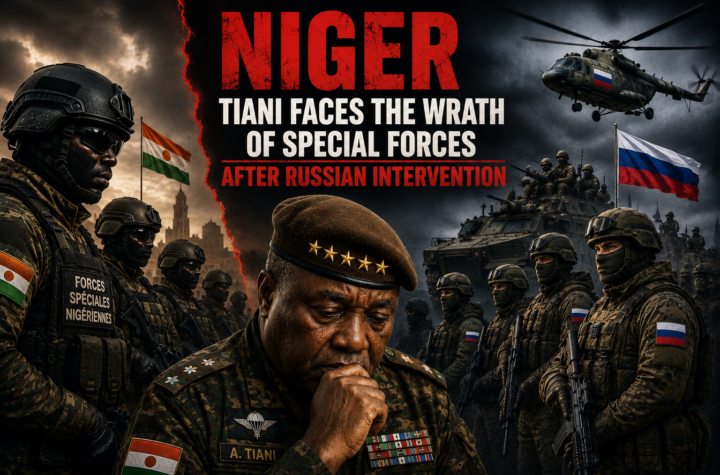
Niger: Tiani faces fallout from special forces anger after Russian intervention