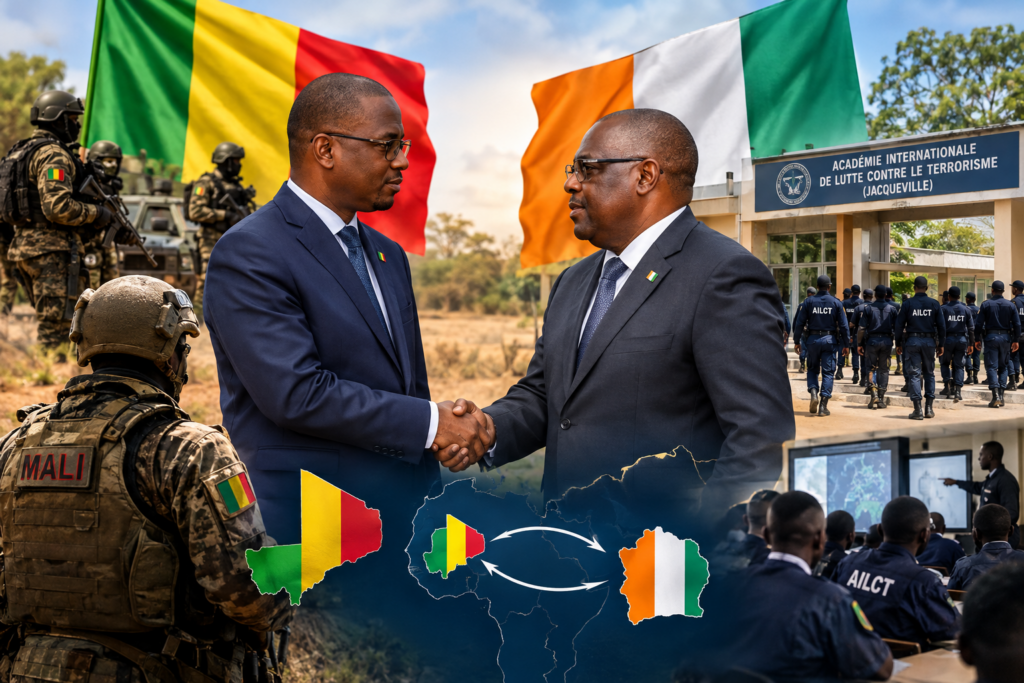
As Mali grapples with escalating terrorist threats, a high-level security meeting with Côte d’Ivoire is shaping up to be more than just diplomatic discourse it could have tangible consequences for the Malian economy. The upcoming visit of Côte d’Ivoire’s intelligence chief, Vassiriki Traoré, to Bamako is not merely symbolic; it highlights the growing recognition that regional instability is taking a severe economic toll on landlocked nations like Mali.
The timing of this meeting underscores a critical question: can Bamako leverage Abidjan’s counterterrorism strategies to mitigate the financial and social fallout of persistent insecurity in the Sahel? For a country already straining under the weight of conflict, the stakes are high unemployment, disrupted trade, and plummeting investor confidence are just some of the alarming outcomes Mali’s leaders must address.
Why Abidjan’s approach could be Mali’s silver bullet
Côte d’Ivoire’s counterterrorism model extends beyond military operations; it emphasizes intelligence-driven prevention, cross-agency coordination, and targeted training. One of its standout institutions is the International Academy for Counterterrorism (AILCT) in Jacqueville, operational since June 2021. Designed to strengthen both tactical and strategic capabilities, the academy serves as a blueprint for Mali’s forces, which face similar challenges in rural and urban hotspots.
For Mali, adopting even a fraction of Côte d’Ivoire’s methods could yield immediate dividends. Enhanced intelligence sharing, for instance, would allow Bamako to preempt attacks, reducing civilian casualties and economic disruptions. The AILCT’s success in training specialized units offers a low-cost route to upskilling Mali’s security personnel, thereby lowering long-term defense expenditures.
Economic fallout: the hidden cost of terrorism in Mali
Terrorist activities in Mali have already strained public finances, with defense budgets ballooning at the expense of social programs like healthcare and education. The Sahel region’s instability has also deterred foreign investment, particularly in mining and agriculture the backbone of Mali’s economy. A more effective counterterrorism strategy could reverse these trends, restoring investor confidence and unlocking growth.
Bamako’s challenge is to balance sovereignty with pragmatism. While no nation wants to cede control of its security apparatus, the reality is that Mali cannot afford to ignore proven regional models. The economic incentives are too significant to overlook.
From meetings to action: what Mali must demand from this partnership
For this security dialogue to yield tangible results, three key outcomes must emerge:
Operational training: Mali should negotiate access to AILCT’s programs for its officers, focusing on counterterrorism tactics that address local terrain and threats.
Intelligence integration: Establishing a joint task force with Ivorian intelligence could accelerate threat detection, reducing the likelihood of attacks that cripple markets and supply chains.
Economic countermeasures: A security partnership should include provisions for rebuilding economic zones post-conflict, ensuring that recovered areas attract trade and investment.
Sovereignty vs. survival: can Mali afford to ignore Abidjan’s model?
The Malian government’s recent shifts such as the reopening of dialogue with neighboring states signal a willingness to explore unconventional solutions. However, skepticism lingers. Some officials argue that Mali’s terrain and conflict dynamics differ too sharply from Côte d’Ivoire’s to justify wholesale adoption of its strategies.
Yet, the economic imperative is undeniable. Countries that fail to adapt to regional threats face prolonged instability, which, in turn, erodes national prosperity. The question for Bamako is no longer whether to cooperate, but how deeply and how quickly.
Measuring success: beyond rhetoric to real-world impact
This meeting will only matter if it leads to measurable improvements: fewer cross-border attacks, greater stability in trade hubs, and a visible reduction in defense spending tied to reactive measures. Mali’s leaders must resist the temptation to treat this as a photo opportunity. Instead, they should set clear benchmarks such as a 20% reduction in major attacks within 12 months to hold both Ivorian partners and domestic agencies accountable.
The cost of inaction is clear. For Mali, the choice is between incremental progress and economic stagnation a gamble no nation can afford to lose.
By Marguerite Ndongo — Journalist