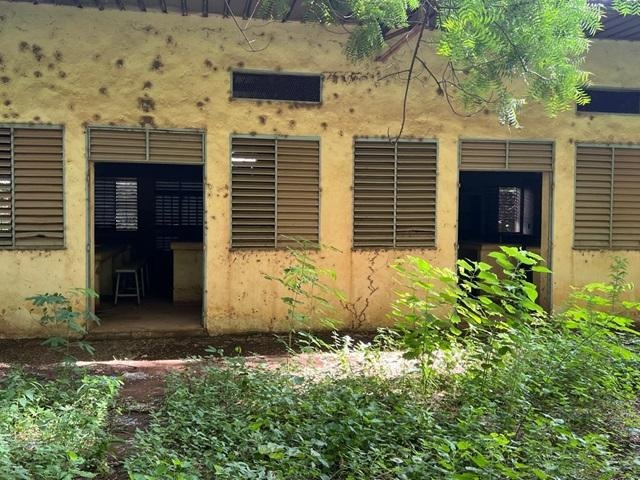
A school year that opens with 2,400 doors still shut
BAMAKO — The 2026-2027 school year was meant to be a showcase. Mali’s transitional president, General Assimi Goïta, had branded it the “Year of Education and Culture,” a slogan designed to project ambition and renewal. Instead, the first day of classes exposed a deepening rupture between official rhetoric and life on the ground. More than 2,400 schools across the country will not reopen. The figure, the highest yet recorded, leaves over 730,000 children without a classroom and has triggered a wave of anger, resignation and anxious debate about what comes next.
Anger and disbelief as families confront another lost year
In Bamako and in regional capitals, the reaction has been swift and raw. Parents who had hoped the new school year would bring a measure of normalcy now face the same impossible choice as last year: keep children at home, send them to overcrowded host schools, or watch them join the ranks of the idle. Teachers’ unions and civil society groups have described the closures as a national emergency, demanding that the authorities explain how a year dedicated to education can begin with one in five schools out of service. On social media and in marketplaces, the question repeats: if this is the Year of Education, whose education is it?
How the closures became a map of state retreat
The breakdown is not random. It follows the front lines of a conflict that has steadily consumed the country’s periphery. In the far north, Kidal region reports roughly 84 percent of its schools still closed. In neighbouring Ménaka, where Islamic State in the Greater Sahara (ISGS) dictates terms across vast desert tracts, 52 percent of schools in the academy are classified as non-functional. Gao, along with central districts such as Mopti and Bandiagara — and now parts of Ségou and Koulikoro — are increasingly exposed to the Group for the Support of Islam and Muslims (GSIM, Al-Qaeda’s local affiliate). School buildings have been looted, burned or repurposed as shelters for the displaced. Each shuttered classroom is a marker of territory the state no longer controls.
What the public debate is really about
The conversation in Mali has moved beyond statistics. Critics of the transitional government argue that the security-first strategy has failed to protect civilians and has instead pushed violence into new areas. The 2024 rout at Tinzaouatène, the attack on the Faladié gendarmerie school, and the strike on Bamako’s military airport have shattered the narrative of a swift reconquest. For many observers, the school closures are the most visible symptom of a broader strategic dead end. Supporters of the junta counter that Mali is fighting an existential war and that education cannot be secured before territory is. That argument, once accepted by many, is now meeting growing scepticism as the number of closed schools climbs year after year.
Beyond the blame: the humanitarian fallout
Whatever the political reading, the human cost is stacking up. A generation is being raised without schooling, and aid agencies warn that the longer children stay out of class, the harder it becomes to bring them back. Girls are especially at risk, with early marriage and domestic labour filling the vacuum left by closed schools. Displaced families, already struggling with food and shelter, see education slip further out of reach. In towns under blockade, such as Niono and Djenné, residents describe a slow suffocation in which fuel shortages and road closures make even daily survival a challenge, let alone schooling.
What comes next: pressure, adaptation and hard choices
The outlook is bleak but not entirely uniform. In some southern and western regions, including Koulikoro, Sikasso and Kayes, dormant GSIM cells are beginning to test the state’s reach through economic blockades and targeted attacks on supply routes. Authorities have responded by promising to fortify administrative centres and to expand community-led schooling, but these initiatives remain limited. International organisations continue to call for safe humanitarian access, though their room to operate has shrunk. For now, the debate in Mali revolves around a single, uncomfortable question: can a government that has staked its legitimacy on sovereignty deliver something as basic as a classroom? Until that question is answered, hundreds of thousands of children will keep waiting — and the Year of Education will look less like a turning point than another year lost.