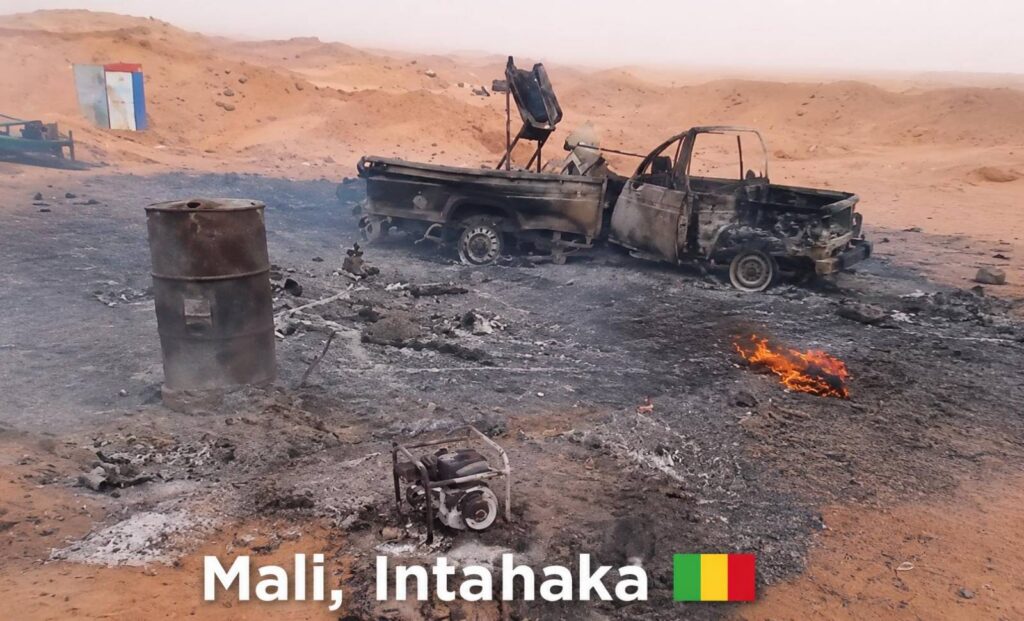
On the morning of May 18, a Malian military drone unleashed a deadly strike—not on insurgents as intended, but on an allied vehicle in the gold-rich mining hub of Intahaka, near Gao. The tragic error, which claimed lives and left others gravely wounded, underscores a widening rift between Bamako’s junta and the local forces it once counted on to restore stability.
When precision fails: the Intahaka misfire
The strike, reported at dawn, shattered a pickup belonging to the Imghad Tuareg Self-Defense Group and Allies (GATIA), a coalition long partnered with government forces against instability in northern Mali. Initial claims of a “terrorist neutralization” quickly dissolved into a grim acknowledgment of collateral damage—one that laid bare the military’s operational blind spots.
Investigations revealed a glaring lack of coordination among allied units, with drones operating without adequate oversight. The incident not only cost lives but also eroded the fragile trust between Bamako and its allies, particularly in regions where loyalty is as fragile as the terrain is contested.
High-tech illusions vs. brutal reality
Under the leadership of Colonel Assimi Goïta, Mali’s military has championed drone warfare as the cornerstone of its counterinsurgency strategy. Yet the Intahaka strike is just the latest in a string of failures, from civilian casualties in San to errant strikes on its own forces. While Bamako touts technological superiority, the reality is one of mounting casualties and a widening credibility gap.
Meanwhile, the opposition grows bolder. The Permanent Strategic Framework, now rebranded as the Azawad Liberation Front (FLA), has joined forces with the Group for the Support of Islam and Muslims (JNIM) to launch sweeping offensives. Equipped with advanced jamming and drone technologies, these groups have exposed the junta’s asymmetric tactics as woefully inadequate against a mobile, tech-savvy enemy.
Gold, blood, and the cost of chaos
Intahaka isn’t just a battleground—it’s the lifeblood of Gao’s economy. The region’s sprawling artisanal gold mines sustain thousands, but relentless violence and erratic military strikes have crippled operations. “We’re trapped. Roads are blocked by terrorists, food prices have tripled, and now even the sky is against us,” confided a local resident, speaking on condition of anonymity. For civilians, the presence of government forces has become synonymous with terror, not safety.
A spiral of self-sabotage
The Intahaka incident is more than a tactical blunder—it’s a symptom of a deeper crisis. By abandoning peace accords and embracing a purely military response, Bamako has alienated allies like GATIA, accelerating the unraveling of state control across northern and central Mali. The junta’s war rhetoric rings hollow as villages fall out of reach and sovereignty crumbles. If the military continues to confuse propaganda with strategy, the errors won’t just cost allies—they’ll cost an entire nation its future.