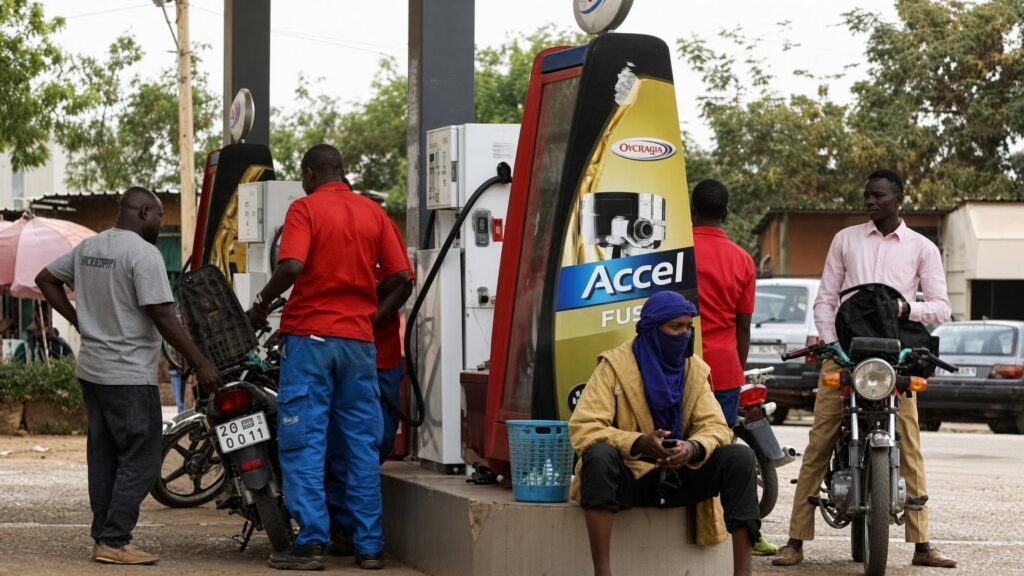
The human cost of fuel scarcity in Niamey: families and businesses paying the price
Life in Niamey has ground to a halt as the capital plunges deeper into an escalating fuel crisis. Citizens now wake up to another day of exhausting waits at service stations that rarely open their pumps. Desperation has turned these once-routine stops into battlegrounds, with motorists risking hours in sweltering queues that yield nothing more than shattered nerves and empty tanks.
For Niger’s hardworking families, this is more than an inconvenience—it’s a threat to livelihoods. The transportation sector, the lifeblood of the local economy, is seizing up. Public transit schedules are in chaos, small traders can’t get their goods to market, and taxi drivers are either abandoning routes or overcharging riders just to stay afloat. Meanwhile, informal sellers thrive in the shadows, peddling dangerous, watered-down petrol at triple the official price. It’s not supply—it’s exploitation.
Behind the shortage: a failure of leadership and infrastructure
The crisis gripping Niamey didn’t appear overnight. It’s the result of years of failed planning, weak infrastructure, and a fatal over-reliance on unstable external fuel sources. Despite boasting a domestic refinery in Zinder—Soraz, with a nominal capacity of 20,000 barrels per day—Niger has been unable to produce enough gasoline to meet even half its needs.
Official admissions in late 2026 revealed a gaping deficit: 196.62 million liters of gasoline and 52.60 million liters of diesel went unmet over the first eight months of the year. That admission came far too late. The collapse of smuggling routes from Nigeria, triggered by the end of fuel subsidies there, removed a crucial lifeline that had long disguised Niger’s inability to manage its own supply.
Soraz, designed primarily for diesel production, cannot pivot to meet gasoline demands. Left with no choice, the government has scrambled to import costly fuel from distant markets, a band-aid solution that only deepens the crisis by exposing weak logistics, corruption risks, and poor distribution networks.
Government’s response: panic measures, not solutions
When faced with public outrage, the response from authorities has been amateurish at best. Publishing a list of a handful of functioning gas stations didn’t ease the burden—it redirected the chaos, funneling desperate drivers into overcrowded zones and turning rationing into a daily lottery. There was no strategy, no transparency, only damage control dressed as leadership.
The Petroleum Ministry has remained silent on stock levels, delivery schedules, and import transparency. When pressed on corruption allegations or mismanagement, officials dismiss concerns with empty reassurances rather than concrete data. This culture of opacity fuels distrust and leaves citizens with no recourse but to accept whatever terms the black market imposes.
The ripple effect: inflation, debt, and economic paralysis
Every day this crisis persists, the burden shifts from the government to the people. Commuters waste precious hours in lines; motorcycle taxi operators sink into debt to buy smuggled fuel; small shop owners see their margins evaporate under rising transport costs. The informal black market, though a symptom of state failure, has become the de facto fuel provider—selling adulterated petrol that damages engines and lines the pockets of opportunistic middlemen.
The long-term consequences are dire. Soaring transport costs are already pushing up the prices of basic goods. If unchecked, this inflationary spiral will push thousands of vulnerable households into deeper poverty, eroding years of economic progress. And with no relief in sight, the question must be asked: how much longer can Niger’s citizens and businesses bear the weight of a leadership that seems incapable of solving even the most basic of crises?
In Niamey and across Niger, the fuel shortage is not just an energy crisis—it’s a governance crisis. And it’s one that the people are paying for in time, money, and trust.