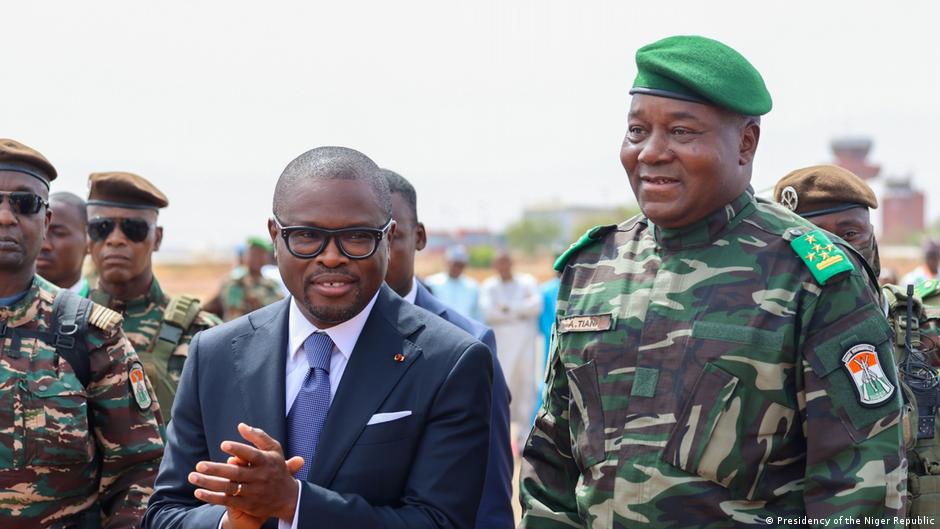
Niger and Benin edge closer to border reopening amid economic stakes
The joint expert committee tasked with reviewing the reopening of the Benin-Niger border has delivered its findings. While progress has been made on security, transit, and select legal and economic aspects, Niger has outlined three non-negotiable conditions that could delay political ratification of the agreement.
What does the future hold for this three-year crisis, which has imposed severe economic and human costs on both nations?
Three non-negotiable prerequisites
Nigerian authorities have set three uncompromising conditions for the sustainable reopening of the border with Benin, closed since 2023:
- Formal defense and security agreement: Niamey demands a binding accord with Benin, explicitly prohibiting mutual aggression and pledging to refrain from hosting or supporting destabilization efforts against either country. Analyst Régis Hounkpè, executive director of InterGlobe Conseils, describes this as a fundamental expectation: “Of course, Benin will not attack Niger, and Niger will not attack Benin. This is standard practice, but given the three-year tension between the two nations, it feels extraordinary. The real challenge lies in practical implementation—ensuring both sides adhere to this principle without imposing rigid constraints.”
- Real-time intelligence sharing: The second condition centers on enhanced security cooperation through a joint intelligence cell. This mechanism would facilitate immediate information exchange on terrorism threats and cross-border trafficking. Hounkpè emphasizes the reciprocal benefits: “A shared intelligence hub ensures neither country harbors destabilization efforts. It’s a step toward mutual trust.”
- Transparency on foreign military presence: Niger’s final demand addresses sovereignty concerns by requiring full disclosure of any foreign military forces or equipment stationed near the Beninese side of the border. “This touches on sovereignty,” Hounkpè notes. “President Wadagni has repeatedly affirmed Benin’s freedom to forge external partnerships—whether with France, Western nations, or others—as long as these alliances aren’t used to destabilize Niger.”
Hounkpè adds a pragmatic perspective: “Instability anywhere in the region ultimately harms everyone. There’s no strategic advantage in igniting conflict beyond one’s borders.”
These conditions reflect deep-rooted political distrust stemming from the 2023 military takeovers in both countries, which have since fueled mutual suspicion.
The toll of a closed border on Niger
The border’s closure—pending Benin’s response to Niger’s conditions—has crippled a vital trade corridor for both nations. As a landlocked country, Niger relies on Benin for over 70% of its imports, including fuel, construction materials, and food staples like rice. Alternative routes via neighboring countries are longer, riskier, and up to 50% more expensive.
The economic strain is particularly acute for Niger’s oil sector. The 2,000 km pipeline connecting Agadem’s oilfields to Benin’s Sèmè-Kpodji port has seen suspended flows, depriving Niger of critical revenue. Each delayed shipment costs millions, a burden no Sahelian budget can sustain.
How Benin’s economy suffers
Benin, too, faces severe repercussions. Transit fees form a key revenue stream, but blocked containers have clogged the port of Cotonou and surrounding logistics networks. Revenue losses in customs, road transport, and wholesale trade have plunged by up to 60% in some sectors.
Merchandise rerouted to Togo and Nigeria has eroded Benin’s status as a regional trade hub. Meanwhile, communities on both sides of the border—such as Malanville in Benin and Gaya in Niger—have seen markets shrink by nearly half, with local businesses shuttering and unemployment rising.
Households have been cut off from vital supplies, with basic goods becoming scarce and prices skyrocketing. Families separated by the closure face precarious conditions, and the lack of legal trade routes has fueled smuggling and extortion networks.
A shared economic imperative
Régis Hounkpè underscores the macroeconomic urgency of reopening the border: “The return of trade flows would revitalize Benin’s port, which has struggled for three years despite its diversified economy. Nigerians—transporters, logisticians, traders—would regain access to Benin’s coastal trade routes, restoring lost profits and stabilizing local markets.”
For Hounkè, the path forward is clear: “The two presidents are now engaging in pure geopolitics—prioritizing geography over ideology. They have no choice but to collaborate; survival depends on it.”
Path to resolution
The dialogue gained momentum after Beninese President Romuald Wadagni’s election. Days after his inauguration, he visited Niamey on June 2, 2026, kickstarting the joint expert committee. Progress has been steady, though Niger’s conditions remain a hurdle.
Hounkpè predicts a gradual reopening, starting with high-priority goods under reinforced controls. “If these early June negotiations succeed, they could set a precedent for the Sahel and ECOWAS, much like the recent Mali-Ivory Coast rapprochement driven by economic pragmatism.”
The stakes couldn’t be higher: economic survival, logistical stability, and security cooperation against terrorism. The question now is whether political will can overcome lingering distrust.