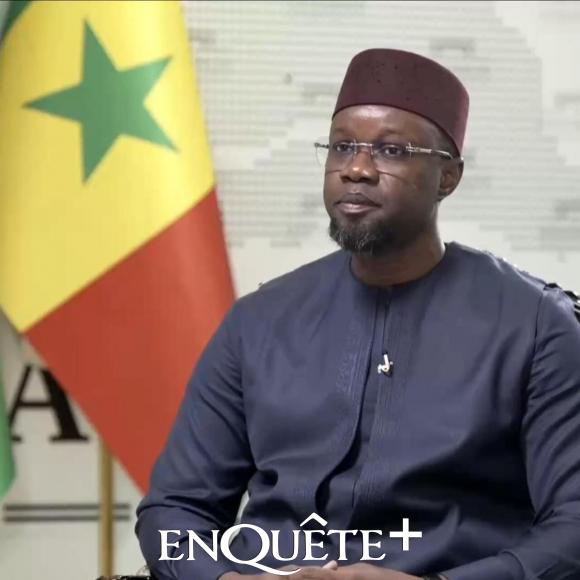
Since departing from the Prime Minister’s office, Ousmane Sonko has fundamentally altered his public communication approach. The leader of Pastef has adopted a more measured, nuanced, and conciliatory tone, deliberately moving away from his previous confrontational rhetoric to project an image of a statesman committed to peace.
The transformation was most evident during his recent address at the Diamniadio congress, where he urged party members to abandon aggressive behavior in public spaces. « Pastef has evolved into a mature party, » he declared, emphasizing the need for respectful discourse. « Our words carry weight—observed by religious leaders, families, and the wider public. Insults and provocations only diminish our stature. »
From confrontation to diplomacy
Once known for fiery speeches, Sonko’s recent interviews, including one with international media outlets, have showcased a more diplomatic demeanor. Observers note that while he defended his tenure as Prime Minister and addressed his break with President Bassirou Diomaye Faye, he primarily presented himself as a pragmatic leader seeking to wield influence from his new role as Speaker of the National Assembly.
Analysts question whether this shift reflects genuine political maturation or a calculated strategy ahead of the 2029 elections. Some ask: Is the former firebrand becoming a consensus-builder? Is the agitator transforming into a mediator? The answers remain speculative, but the change is undeniable.
Contradictions in his evolving narrative
Despite his newfound restraint, Sonko’s discourse remains fluid, with statements often tailored to the audience. In a recent interview, he adopted a cautious approach on debt restructuring, a topic he previously opposed vehemently. When pressed on the possibility of sovereign debt restructuring, he replied: « We do not hold fixed positions. Every situation requires careful assessment. »
On the issue of odious debt, he initially backtracked before reiterating his stance. « A portion of Senegal’s debt is indeed odious. Political courage is needed to address this, and I’ve stated this repeatedly. I hope the current administration will take responsibility to discuss partial debt cancellation… » When challenged about his inaction during his time as Prime Minister, his response was vague: « It was proposed—it was proposed. »
His shifting positions on homosexuality further illustrate this evolution. While previously advocating for harsh measures, he now acknowledges the legal framework’s historical roots, citing arguments that contrast with his earlier rhetoric. He justified arrests linked to HIV transmission concerns, a stance critics argue contradicts his past hardline positions.
Projecting a new image: the apostle of peace
Sonko has also toned down his criticism of President Bassirou Diomaye Faye, rejecting terms like « betrayal » as subjective. Instead, he frames their differences as political divergences, not personal conflicts. His call for Pastef to embody intellectual rigor and civic responsibility reflects a deliberate effort to distance the party from its earlier confrontational image.
At Diamniadio, he warned supporters against falling into traps set by opponents seeking to portray Pastef as a belligerent force. « The only strategy left for them is to provoke you into repeating the mistakes of 2021–2024, » he cautioned. « Do not take the bait. »
The question lingers: Is this a genuine transformation or a tactical pivot? One thing is certain—Senegal’s political landscape is watching closely as Ousmane Sonko redefines his role on the national stage.