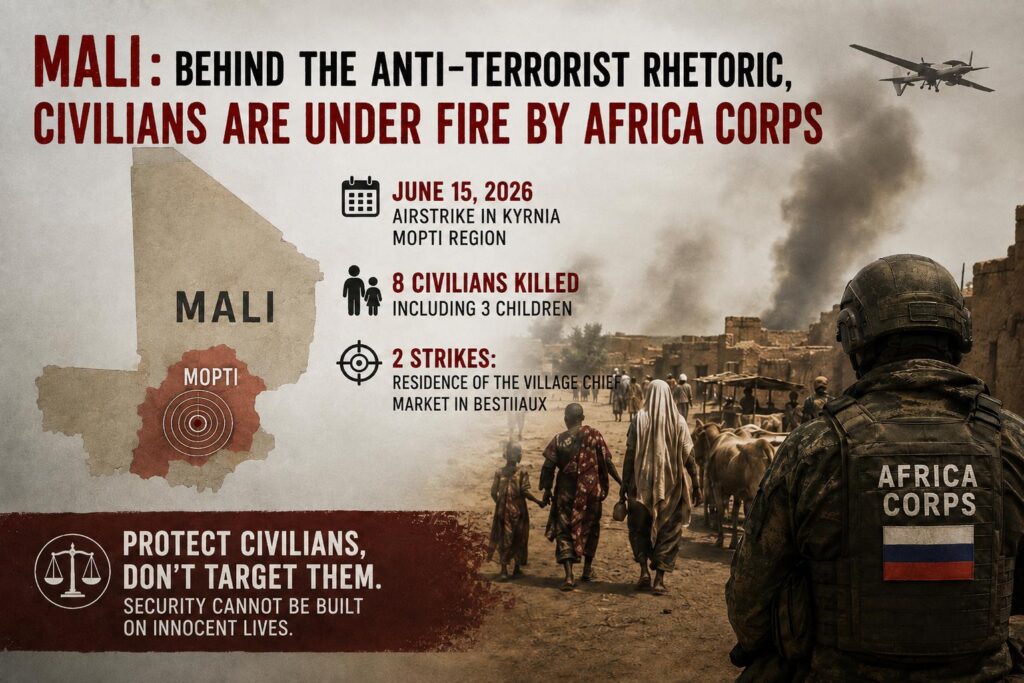
Civilian Tragedy in Kyrnia Highlights Concerns Over Military Tactics
A recent incident in the central Malian village of Kyrnia has intensified scrutiny over the conduct of Africa Corps operations in the region. According to Human Rights Watch, an airstrike conducted on June 15, 2026, resulted in the deaths of eight civilians, including three children. The attack, which struck near the village chief’s residence and a livestock market, is alleged to have violated international humanitarian law, as no armed combatants were among the casualties.
Investigations into the strike involved interviews with 19 witnesses, satellite imagery analysis, and verification of footage released by Africa Corps. The findings underscore the devastating human cost of operations conducted in areas where civilian populations coexist with armed groups.
Security Strategy Under Scrutiny
The strike in Kyrnia raises critical questions about the military doctrine employed by Malian authorities under the leadership of Assimi Goïta. The collaboration with Africa Corps—successor to the Wagner Group—has been framed as a strategic move to combat terrorism. However, the incident in Kyrnia forces a reevaluation of whether such operations prioritize civilian protection alongside military objectives.
Systematic Blurring of Civilian and Combatant Lines
In rural regions like Mopti, the proximity between civilians and armed groups complicates counterinsurgency efforts. Human Rights Watch has documented instances where entire communities, particularly those of Fulani ethnicity, have been stigmatized as supporters of Islamist factions. This has led to abuses during military operations, further alienating populations already vulnerable to recruitment by extremist groups.
Failures in Target Identification and Proportionality
The Kyrnia strike occurred despite reports of a drone surveilling the area the day prior and the confirmed presence of JNIM fighters in the vicinity. International law requires forces to distinguish between military targets and civilians, yet the attack resulted in civilian casualties, including the village chief’s residence and a livestock market. This disproportionate outcome challenges the legitimacy of the operation.
Discrepancies in Military Communications
Africa Corps initially described the strike as a successful operation against a “terrorist gathering,” claiming the elimination of several commanders. However, Human Rights Watch’s investigation confirmed the victims were civilians. Such discrepancies between official narratives and ground realities demand independent verification to restore credibility.
Beyond Military Metrics: The Human Cost of Counterterrorism
A reliance on airstrikes and firepower alone cannot constitute a sustainable security strategy. Effective counterterrorism must also address the root causes of violence, including the protection of communities, prevention of extremist recruitment, and restoration of public trust. In Mopti, civilians face threats not only from armed groups but also from the very forces tasked with safeguarding them.
Human Rights Watch has documented abuses by both Islamist militants and government-aligned forces. Yet the latter’s involvement in civilian casualties represents a fundamental breach of trust, as those sworn to protect populations must adhere to the strictest standards of accountability.
Impunity and the Erosion of Justice
The absence of credible investigations and accountability mechanisms exacerbates the crisis. Human Rights Watch has highlighted a pattern of unaddressed violations, where victims struggle to obtain justice, reparations, or even acknowledgment of wrongdoing. This climate of impunity risks deepening societal fractures, allowing extremist narratives to gain traction among disillusioned communities.
Sovereignty cannot be invoked to evade responsibility. The Malian government’s partnership with foreign forces does not absolve it of its duty to protect civilians or investigate violations on its territory. Without accountability, the very legitimacy of the state’s security apparatus is undermined.
Reevaluating the Path to Peace in Mali
The Kyrnia incident serves as a stark reminder that military operations must be conducted with precision, restraint, and respect for human life. The loss of eight civilians—including children—demands a reevaluation of the strategies employed in the fight against terrorism. Sustainable security cannot be achieved through force alone; it requires robust intelligence, meticulous target identification, and unwavering commitment to civilian protection.
For the people of Mopti, the question is no longer how many operations are conducted, but whether these operations can restore peace without further endangering the lives of those they claim to defend. The true measure of success lies not in statistics, but in the preservation of human dignity.