
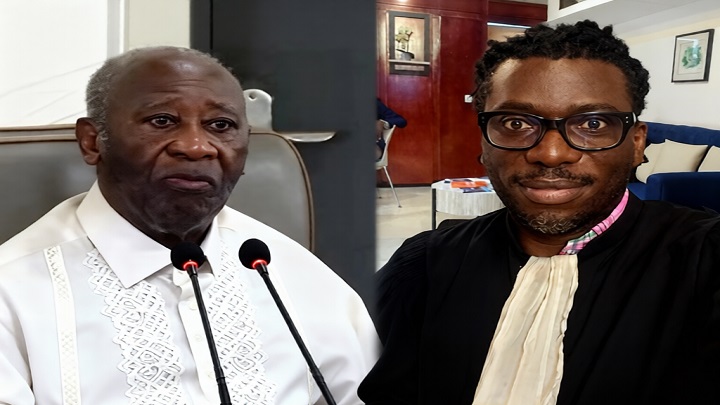
Ivorian political circles are abuzz after the surprise announcement that Laurent Gbagbo will remain at the helm of the Parti des Peuples Africains – Côte d’Ivoire (PPA-CI). The decision, made during the party’s first ordinary congress held in Abidjan, has reignited discussions about the inevitability of political retirement for long-serving leaders.
« We can no longer fault President Ouattara for choosing to stay in politics, especially after he had publicly discussed retiring », declared lawyer Ange Rodrigue Dadjé in a statement that has sparked widespread reactions across political platforms.
Gbagbo’s unexpected reversal and its ripple effect
Just months ago, Laurent Gbagbo had signaled his intention to step back from active politics. In an October 2025 interview with journalist Alain Foka on AFO Media, the former Ivorian president stated his clear intent to avoid seeking political office after the December 2025 legislative elections. « There is no retirement in politics, but I will refrain from holding political roles, whether within my party or the state. I’ve given enough », he asserted at the time.
However, the political landscape shifted dramatically during the PPA-CI’s congress on May 14–15, 2026. Under thunderous applause from delegates, Gbagbo declared, « I remain for the fight », effectively ending months of speculation about his exit from the political stage. At 81 years old and cleared by the International Criminal Court (ICC) in 2021, the former leader seemed prepared to pass the torch to a younger generation. Yet, the party’s decision to reaffirm his leadership has altered the calculus entirely.
Ouattara’s contested legacy of staying in power
The timing of Gbagbo’s reversal raises fresh questions about the sustainability of political retirements in Côte d’Ivoire. In 2020, President Alassane Ouattara faced sharp criticism when he announced his candidacy for a third term, despite earlier indications that he would step aside. The opposition, including Gbagbo’s PPA-CI, condemned the move as a betrayal of his earlier pledge. Dadjé argues that Gbagbo’s recent decision underscores how political realities often override initial commitments.
Ouattara’s own political future came under scrutiny again in July 2025 when he formally declared his candidacy for the October 2025 presidential election, seeking a fourth term at 83 years old. The president framed his decision as a « carefully considered duty » to safeguard the nation amid regional security and economic challenges. « This choice serves the higher interest of the Nation », he stated.
A new chapter for Ivorian politics?
The PPA-CI’s decision to retain Gbagbo has intensified debates about the role of historical figures in Ivorian politics. Observers point to a recurring pattern: when influential leaders announce retirement, party dynamics and public pressure often pull them back into the fray. The congress’s outcome suggests that as long as their supporters demand their leadership, these figures may struggle to disengage completely.
While the political terrain remains fluid, one thing is clear: Côte d’Ivoire’s leadership debates are far from settled. The interplay between personal commitments and collective expectations continues to shape the nation’s political narrative.
More Stories
Ousmane Sonko’s firm stance on Senegal’s FMI agreement demands full transparency
Senegal’s institutional crossroads: the unfolding dynamic between Ousmane Sonko and Bassirou Diomaye Faye
Minister abdourahmane diouf reignites feud with ousmane sonko over special credits reform