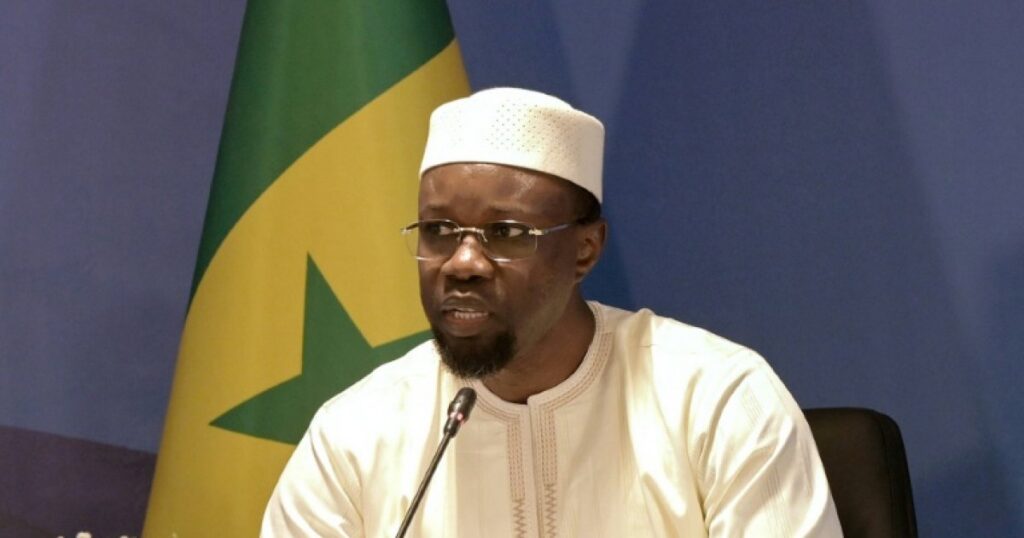
Senegal’s president dismisses prime minister Ousmane Sonko amid rising tensions
President Bassirou Diomaye Faye of Senegal has relieved Prime Minister Ousmane Sonko of his duties, marking the end of a turbulent partnership that once inspired widespread public hope. The decision, announced Friday evening through a televised statement delivered by the presidential secretary-general Oumar Samba Ba, stated that Sonko’s dismissal extended to all members of his cabinet.
“The outgoing government will manage current affairs until further notice,” the statement concluded, without specifying a timeline for the appointment of a successor.
Tensions between the two leaders had escalated since their electoral victory in April 2024, fueled by growing differences in governance and political strategy. Sonko, once a key ally and mentor to Faye, had wielded significant influence, particularly among the country’s youth, who rallied behind his panafricanist rhetoric.
From allies to adversaries: the unraveling of a political alliance
Ousmane Sonko, a prominent opposition figure under former President Macky Sall, had been barred from running in the 2024 presidential election due to a defamation conviction that stripped him of civil rights. In a strategic move, he endorsed Bassirou Diomaye Faye, who campaigned under the slogan “Diomaye Moy Sonko”—”Diomaye is Sonko” in Wolof—garnering massive support.
Both men were released from prison in early 2024 under an amnesty law aimed at easing political tensions, and their electoral triumph was seen as a turning point for Senegal. However, their collaboration quickly soured, with public disagreements over governance priorities and international alliances coming to the fore.
Public outcry and political maneuvering
Within hours of the announcement, Sonko’s supporters gathered outside his residence in the Keur Gorgui district of Dakar, celebrating his removal as a victory. Earlier that day, Sonko had criticized Western influence in a parliamentary address, condemning what he described as attempts to impose “LGBTQ+ agendas” on Senegal, a predominantly Muslim nation. This followed the recent passage of a controversial law increasing penalties for same-sex relations.
The president had publicly warned Sonko about the “excessive personalization” of power within their party, the Pastef, which dominates the National Assembly after sweeping the 2024 legislative elections. Faye’s remarks suggested his patience had worn thin: “As long as he remains Prime Minister, it’s because I trust him. When that trust fades, there will be a new Prime Minister.”
Legal battles and future ambitions
Sonko’s political future had been a subject of debate after the Supreme Court upheld his 2023 defamation conviction in July 2025, raising questions about his eligibility for the 2029 presidential race. However, his party argued that his election as a deputy in the 2024 legislative elections—before he resigned to stay on as Prime Minister—proved his eligibility. Local elections are slated for 2027, followed by the presidential poll in 2029.
Meanwhile, President Faye, though lacking the same grassroots enthusiasm as Sonko, has cultivated support through the “Diomaye President” movement, fueling speculation about his own potential 2029 candidacy.
Economic challenges overshadow political shifts
The government faces daunting economic hurdles, inheriting a staggering debt equivalent to 132% of GDP—one of the highest in sub-Saharan Africa, according to the International Monetary Fund (IMF). The previous administration under Macky Sall was accused of concealing the true extent of the fiscal crisis, leading to the suspension of a $1.8 billion IMF aid program in 2024.
As Senegal grapples with these financial constraints, the political shake-up adds another layer of uncertainty to an already complex governance landscape.