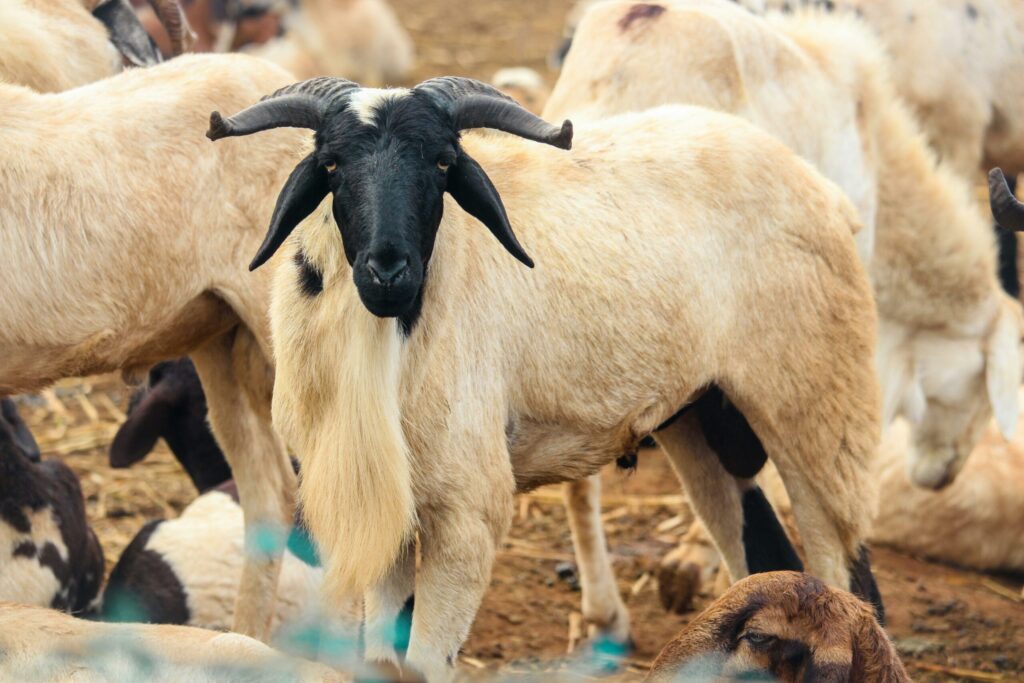
Tabaski costs push Senegalese families into debt traps
Each year, millions of Senegalese plunge into debt to purchase a sheep for Tabaski. From rotating savings clubs to microfinance institutions and informal lenders, an entire ecosystem of borrowing has emerged around a religious celebration now burdened by social pressures. While Morocco implemented a solution decades ago, Senegal continues to grapple with this annual financial crisis.
Two weeks before Tabaski, a wave of anxiety sweeps through Dakar’s neighborhoods—from the bustling streets of Almadies to the quiet corners of Sacré-Cœur. The price of sheep has skyrocketed once again. What cost 120,000 CFA francs yesterday now demands 150,000, and some animals fetch as much as 200,000 or even 300,000 CFA francs. The so-called “prestige sheep”—those photographed and shared on WhatsApp—often exceed 300,000 CFA francs.
The question haunts fathers across the city: How will I ever afford this? For many, it’s a recurring nightmare, a tradition hijacked by financial strain. Tabaski, once a purely religious observance, has morphed into a test of social standing, where the ability to slaughter a sheep signals respectability and success.
Tabaski’s sheep: from ritual to financial burden
Mamadou Sall, a resident of Sacré-Cœur earning roughly 60,000 CFA francs monthly, begins stressing as early as May. By July, he must somehow scrape together 150,000 CFA francs—two and a half months’ salary—not for nourishment, but for tradition. To preserve his family’s dignity. To silence the whispers of neighbors. To post the obligatory social media photo.
Banks won’t lend him money for a sheep, so Mamadou turns to his local tontine. He borrows 150,000 CFA francs, but the cost is steep. Interest rates during Tabaski surge to 30% or even 50% annually. On a 150,000 CFA loan, that means upfront fees of 3,750 to 6,250 francs, followed by a grueling 12-month repayment schedule.
Mamadou’s story isn’t unique. Between 35% and 45% of all microfinance loans in Senegal during Tabaski season go toward sheep purchases. Nearly one in two credit applications in some weeks is for an animal that will be consumed within days.
The steep climb: sheep prices since 2010
In 2010, a decent sheep cost 60,000 to 80,000 CFA francs. Today, prices range from 150,000 to 250,000 CFA francs—a surge of 87% to 275% in just 15 years. This inflation isn’t tied to general price increases but to concentrated demand over two months. During Tabaski, demand becomes inelastic: families will borrow, sacrifice, or go without to fulfill the obligation. Breeders and middlemen exploit this desperation, driving prices ever higher.
Senegal’s minimum wage (SMIG) stands at 60,239 CFA francs monthly. To buy a sheep priced at 150,000 CFA francs, a wage earner must allocate two and a half months of full salary. And this doesn’t include other Tabaski expenses: new clothes, food, gifts. For the 60% of Senegalese living below the poverty line, this is an impossible feat without debt.
Who borrows—and why?
In 2024, microfinance institutions recorded a 62% spike in loan applications compared to non-Tabaski periods, with average requests ranging from 120,000 to 200,000 CFA francs. A concentrated flood of credit demand descends upon Senegal every August.
The hidden architecture of debt
With traditional banks inaccessible for such purchases, an elaborate web of informal lending thrives during Tabaski. Tontines, microfinance lenders, and private loan sharks all prosper in this seasonal frenzy.
| Lending Source | Regular Period | Tabaski Period |
|---|---|---|
| Local tontines | 15-30% annually | 30-50% annually |
| Formal microfinance | 24-36% annually | 36-48% for short-term loans |
| Private informal lenders | 30-40% annually | 50-60%+ annually |
| Commercial banks | Nearly inaccessible | Nearly inaccessible |
Local tontines accelerate their lending cycles during Tabaski, with interest rates jumping to 30-50% annually. A 150,000 CFA loan could balloon to 172,500 to 225,000 CFA francs over 12 months. Microfinance institutions offer slightly better terms—24-36% nominal rates—but their effective annual rates can reach 48% for short-term loans. Families borrowing in July for August’s Tabaski face immediate finance charges of 3,000 to 6,000 CFA francs on a 150,000 CFA loan.
Social media fuels the crisis
A decade ago, Tabaski’s pressures were confined to the neighborhood. Today, they’re broadcast globally. WhatsApp groups and Instagram timelines amplify the competition. Fifty friends might admire your sheep—or critique its size, color, and breed.
A 2023 study by Cheikh Anta Diop University found that 67% of young Dakarois feel social pressure to buy a sheep for Tabaski. Of those, 48% cite social media as the primary source of that pressure. Influencers showcase extravagant Tabaski feasts; viral videos highlight families gifting lavish sheep. The message is clear: a sheep not photographed is a sheep not celebrated.
For men, the stakes are highest. In Senegalese culture, purchasing the sheep is a man’s responsibility. Failure to do so risks judgment—whispers of inadequacy, of inability to provide for one’s family. The shame drives borrowing, even when it’s unsustainable.
The hidden price: reduced household spending
Households that borrow for Tabaski reduce food and healthcare spending by 18-25% in the three months following the holiday. School fees go unpaid; essential medicines go unfilled. The true cost of Tabaski isn’t just the sheep’s price—it’s the deferred expenses, the sacrifices made to keep up appearances.
Worse still, some farmers divert agricultural loans—meant for seeds and fertilizer—into sheep purchases. Between 8% and 12% of Senegalese agricultural loans are misused for Tabaski consumption. A farmer who might have boosted his harvest by 30% instead invests in social prestige, only to face barren fields the following season.
Morocco’s solution: dignity over debt
In 1999, Morocco’s monarch made a bold decision. He declared that every poor Moroccan should receive a sheep for Tabaski—not as charity, but as a right. A recognition that a religious observance shouldn’t be held hostage to market forces.
Since then, Morocco has distributed millions of sheep through the Zakat Al-Fitr fund. In 2023 alone, over 2.8 million sheep were provided, at a cost of roughly 450 million Moroccan dirhams (43 billion CFA francs). Relative to Morocco’s national budget, this amounts to less than 0.1% annually. A small price for dignity—a price Senegal could afford to pay.
Morocco recognized a simple truth: a religious celebration that excludes the poor isn’t truly a celebration of faith. It’s a mechanism of social distinction disguised as tradition. By treating Tabaski as a public good, Morocco elevated the observance above the pressures of commerce. Senegal could follow this example.
Senegal’s inaction: a cycle of debt and despair
Senegal offers no such solution. There’s no national program, no government-backed initiative. A handful of municipalities and religious organizations provide minimal assistance, but the vast majority of Senegalese are left to navigate a treacherous landscape of usurious loans and crippling social expectations.
Debt collectors report a troubling pattern: household over-indebtedness peaks three months after Tabaski. Families scramble to repay loans while struggling to survive. Meals are skipped. Medical care is delayed. Children are pulled from school.
The psychological toll is equally severe. A 2022 study by the Dakar Mental Health Research Center revealed a sharp rise in calls to helplines in the three weeks before Tabaski. Among men aged 30 to 55, call volumes double. The dread of not affording a sheep, the fear of social judgment, the weight of failure—it’s a toxic brew that lingers long after the holiday ends.
How did we reach this breaking point?
The crisis stems from two intertwined forces. First, the rise of conspicuous consumption. Tabaski is no longer a quiet religious observance but a public display of wealth and respectability. Social media has turbocharged this shift, turning the holiday into a year-round competition for status.
Second, Senegal’s policymakers have ignored the issue entirely. There’s no national debate, no coordinated effort to address Tabaski’s social and economic burdens. Politicians remain silent; media coverage is sparse. Meanwhile, millions of households drown in debt every year.
Mamadou’s phone rings again. Tabaski 2025 looms. Sheep prices climb. Interest rates surge. The cycle repeats.