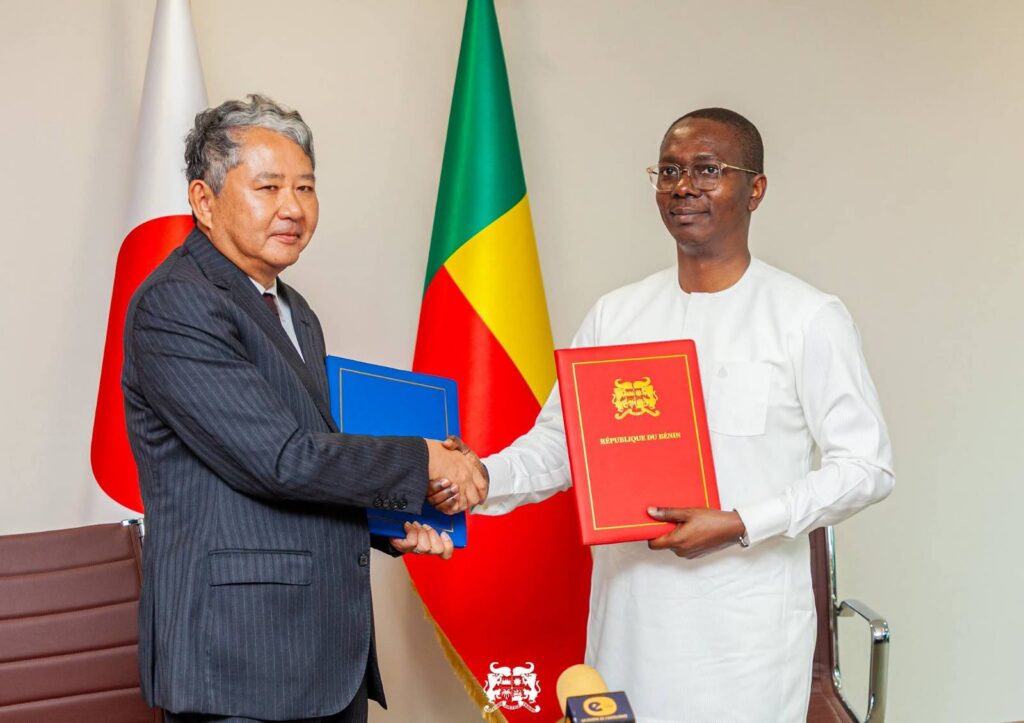
Something shifted in Cotonou on Friday, October 9, 2026. Benin and Japan signed a fresh grant agreement worth 10.8 billion FCFA to bankroll the second phase of the Vêdoko interchange — a move that pushes total announced financing to 26.228 billion FCFA and injects decisive momentum into a project already under construction. This is not a project launch. It is a breakthrough moment that keeps the work moving toward its ultimate goal: easing traffic in one of the economic capital’s most strategic corridors and improving daily travel for thousands of road users.
A major boost for work already in motion
The Vêdoko crossroads interchange project has crossed a critical threshold with the signing of a 10.8 billion FCFA grant between Benin and Japan. The official ceremony took place in Cotonou on Friday, October 9, 2026, covering the second phase of construction.
This new envelope brings the total announced funding for the structure to 26.228 billion FCFA. It reinforces the resources mobilized to continue a worksite that was officially launched on October 28, 2025, at a ceremony attended by Japan’s ambassador to Benin.
What matters now is not whether the project exists — it is about sustaining the pace. The additional financing is designed to keep construction on track so the infrastructure can eventually deliver the traffic relief that Cotonou needs.
Under the terms announced with this new agreement, the funding will specifically support the construction of an east-west oriented overpass, along with related development and drainage works required to complete the structure.
Why Vêdoko is a strategic pressure point
For road users in Cotonou, Vêdoko is an area where traffic density can make movement difficult, especially during peak hours. The convergence of vehicles, motorcycles, taxis and other transport modes creates slowdowns that disrupt the reliability of journeys.
In a city where mobility is essential to economic activity, these difficulties have consequences far beyond time spent on the road. Workers must anticipate delays, traders and delivery riders can see their operations disrupted, while public transport drivers must cope with travel times that are sometimes hard to predict.
The interchange is intended to better organize traffic movements at this crossroads. Through the overpass and planned improvements, the goal is to facilitate vehicle flow and reduce conflicts between different streams of traffic.
The project’s scope therefore matters greatly for urban mobility. However, its effectiveness will depend on how well the structure integrates into the existing road network and how nearby intersections and roads are managed.
Fewer jams, more time for residents
The main expectation among local populations concerns the concrete impact of the interchange on their daily lives. Once construction is finished and the infrastructure is operational, users hope to cross the Vêdoko area under better conditions.
For employees, smoother traffic could cut the time spent commuting between home and work. For pupils and students, it could help make journeys more consistent. As for traders, transporters and delivery riders, they could benefit from better predictability and more efficient organization of their activities.
Reducing prolonged stops and frequent restarts could also lower fuel consumption linked to congestion, while helping to cut certain noise nuisances and polluting emissions.
These benefits remain expected outcomes, not results already achieved. The signing of the new financing agreement does not mean traffic jams will end immediately. The gains will depend on construction progress, the quality of the work and how traffic evolves.
The ambition is to durably reduce traffic difficulties at Vêdoko — not to present the interchange as an automatic fix for all of Cotonou’s mobility problems.
A worksite that also demands patience
Since construction has already begun, the building period is a significant phase for nearby residents and road users. As with any road project of this scale, interventions may require traffic adjustments, diversions or temporary restrictions depending on the areas concerned and the execution phases.
These possible constraints must be weighed against the long-term benefits being pursued. They also highlight the importance of keeping users well informed, with visible signage and efficient organization of temporary routes.
To limit inconvenience, traffic management during construction must remain a major concern. Drivers, motorcyclists, pedestrians and local residents need to know about traffic changes and have sufficiently clear directions to adapt their journeys.
The project’s success will therefore be measured as much by the quality of the final structure as by the ability of those running the worksite to limit disruptions during construction.
Benin-Japan partnership serving urban mobility
Financing for the second phase confirms Japan’s role in supporting infrastructure development in Benin. The additional 10.8 billion FCFA grant strengthens a bilateral cooperation aimed, in this specific case, at improving traffic conditions in the economic capital.
The project also envisages collaboration between Japanese and Beninese companies, with a prospect of skills and know-how transfer, according to the Japanese embassy’s statement released when works were launched in October 2025.
Beyond building a civil engineering structure, the stakes are economic and social. More efficient mobility facilitates trade, improves access to professional activities and supports the functioning of urban services.
Mobilizing significant financing, however, is only part of the equation. The infrastructure’s durability will also depend on the quality of its execution, its maintenance and its integration into a broader policy for managing travel.
A promise of fluidity still to be confirmed on the ground
With total announced financing of 26.228 billion FCFA, the Vêdoko interchange ranks among projects designed to improve urban mobility in Cotonou. The new agreement signed with Japan on October 9, 2026, brings additional resources to continue a worksite already underway.
For local populations, the expectation is simple: spend less time in traffic jams, move more easily and regain greater consistency in daily journeys. But these expectations can only be considered met once the structure is completed, operational and its effects genuinely assessed.
Reducing congestion will notably need to be evaluated using data on travel times, queue lengths and traffic conditions before and after commissioning.
Ultimately, the Vêdoko challenge is no longer just about financing and building infrastructure. It is about turning that investment into tangible improvement for users. Only then can the interchange keep its promise: contributing to smoother traffic and urban mobility better suited to the daily needs of Cotonou’s residents.