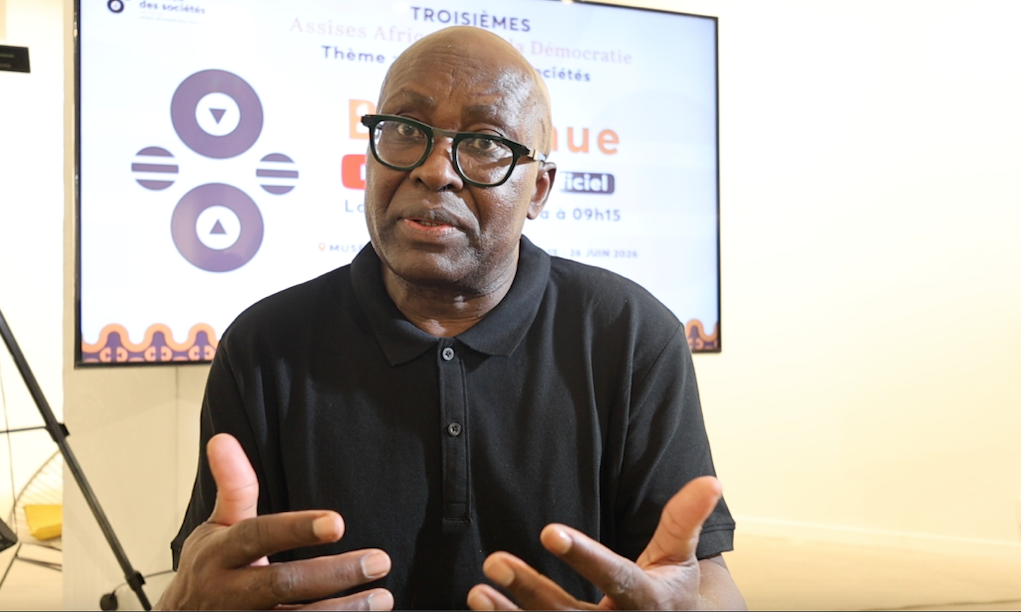
The Cameroonian philosopher challenges long-held assumptions about governance on the continent. In a candid conversation, he dissects the failures of democracy in Africa, critiques the CFA franc, and examines the legacy of colonialism.
During the third edition of the African Democracy Forum held at the Théodore Monod Museum in Dakar, Professor Achille Mbembe, renowned historian and philosopher, shared his unfiltered insights on Africa’s political landscape. As founder of the Innovation Foundation for Democracy, he argued that the continent has never truly experienced democracy—not in the Western sense, nor in any adapted form.
Democracy in Africa: a nonexistent concept?
Mbembe dismisses the idea of an “African democracy crisis.” For him, such a claim is misguided. «There can be no crisis of democracy where democracy has never existed», he asserts. Instead, he describes the political systems in place as administrative multiparty regimes—a facade of elections and political pluralism with no real substance. These systems, he explains, are designed to maintain power through contested processes rather than genuine representation.
Rejecting the “tropicalized” democracy
The philosopher rejects the notion of a “tropical democracy,” calling it a colonial construct intended to marginalize African political thought. «Tropicalizing democracy makes no sense. It’s a concept rooted in geography and climate, invented to stigmatize anything not originating from the West», he states. Instead, Mbembe advocates for an endogenous African democracy, one rooted in the continent’s own social, political, and cultural realities.
Monetary sovereignty: beyond the CFA franc debate
On monetary sovereignty, Mbembe goes beyond the CFA franc controversy. He insists that Africa needs a true African currency, free from external control. He also draws a stark contrast between West and Central Africa: the former, he argues, benefits from dynamic civil societies and influential diasporas, while the latter remains trapped in political stagnation—citing regimes in Cameroon, Chad, Equatorial Guinea, and the Central African Republic as prime examples of postcolonial authoritarianism.
Reparations: justice for irreparable losses
Speaking on reparations for the transatlantic and trans-Saharan slave trades, Mbembe acknowledges the irreparable nature of the crimes committed. Yet, he insists that this only strengthens the moral and historical justification for reparations. «Some losses are beyond measure. They cannot be replaced. But that doesn’t mean reparations shouldn’t be demanded. In fact, the more irreparable the loss, the more urgent the demand for justice becomes».
He also cautions that the reparations debate must address Africa’s own complicity. «We cannot ignore Africa’s role in these historical crimes. The transatlantic and trans-Saharan slave trades involved Africans as much as Europeans. African elites bear responsibility, and this must be part of any conversation on justice».
A call for deep reflection
Through his sharp analysis, Achille Mbembe urges Africa to rethink its democratic trajectories, monetary independence, and historical accountability. His words challenge both African leaders and citizens to confront uncomfortable truths and envision a future built on genuine sovereignty, justice, and reconciliation.