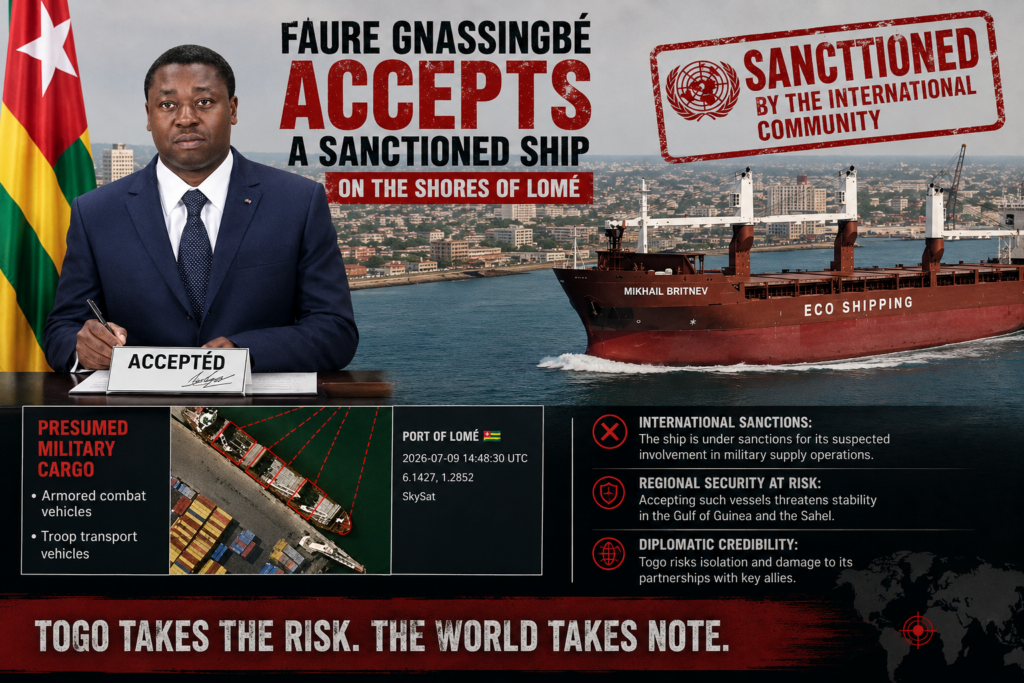
The arrival of the Russian cargo vessel « Mikhail-Britnev » in Lomé port, a ship subject to international sanctions, coupled with reports of several hundred Africa Corps personnel deploying on Togolese territory, is fueling an intense discussion regarding Togo’s diplomatic and security trajectory. Many observers interpret these developments as an accelerated alignment with Moscow, a strategic choice that could commit the nation to a path with potentially uncontrollable consequences.
While official statements frame this cooperation as a necessary response to the escalating security threat posed by armed groups in the country’s northern regions, critics of President Faure Gnassingbé contend that this partnership extends far beyond counter-terrorism efforts. They express apprehension that the head of state may gradually transform Togo into a pivotal logistical and strategic platform for Russian interests across West Africa, with implications transcending national borders.
Regional scrutiny intensifies over Faure Gnassingbé’s strategic maneuvers
Analysts and leaders throughout the sub-region perceive this shift as part of a broader pattern. Faure Gnassingbé faces direct criticism for his inclination to leverage Togolese diplomacy as a tool for influence, even at the risk of destabilizing neighboring states. Critics recall that such tactics are not unprecedented for the Lomé administration, which has previously been accused of serving as a rear base, logistical facilitator, or financial hub in various regional conflicts to monetize its geopolitical sway.
Presently, Faure Gnassingbé’s unilateral decision to welcome Russian paramilitary forces and grant port access to vessels under sanctions has generated considerable alarm among adjacent nations. His regional counterparts suspect the Togolese president of aiming to act as a disruptive force within ECOWAS, positioning himself as an independent actor capable of forging alliances with the military regimes of the Sahel (AES), thereby undermining the collective cohesion and stability of West Africa.
This unfolding situation is particularly concerning given the sensitive political climate. For opponents of the current administration, the intensified military cooperation with Moscow, orchestrated by Faure Gnassingbé, appears primarily driven by a desire to consolidate his own regime rather than a comprehensive strategy for national stabilization. According to this perspective, the head of state is utilizing the jihadist threat to justify a foreign military presence that not only bolsters the regime’s security capabilities but also reinforces a power structure that has endured for decades.
The limitations of a purely military approach
Experiences from other Sahelian nations further amplify these concerns. Despite the involvement of Russian military partners, Mali, Burkina Faso, and Niger continue to grapple with persistent insecurity, marked by ongoing deadly attacks. Numerous analysts argue that these examples demonstrate the inadequacy of an exclusively military response in curbing terrorism when fundamental issues such as economic hardship, institutional fragilities, communal tensions, and governance deficits remain unaddressed.
Beyond the security dimension, this presidential-led rapprochement could incur significant diplomatic costs. By forging closer ties with a power facing international sanctions and widespread global opposition, Faure Gnassingbé risks isolating Togo from some of its long-standing traditional partners, whether European, American, or African. Such a trajectory could adversely impact foreign investment, economic cooperation, and the country’s international standing.
Finally, this strategic direction raises critical questions of governance. A commitment of such magnitude warrants transparent public discourse and genuine national consultation. The head of state’s imposed choices regarding defense policy, military alliances, and national sovereignty hold profound implications for future generations. These decisions should not be perceived as the prerogative of a small circle around the president but rather as orientations openly deliberated within a democratic framework.
The imperative to combat terrorism is undeniable. However, it cannot, by itself, legitimize every diplomatic or military orientation. Enduring security is also predicated upon economic development, the strengthening of institutions, fostering trust between the state and its citizens, and upholding democratic principles. It is against this comprehensive balance that Faure Gnassingbé’s governance will ultimately be evaluated in the years ahead.