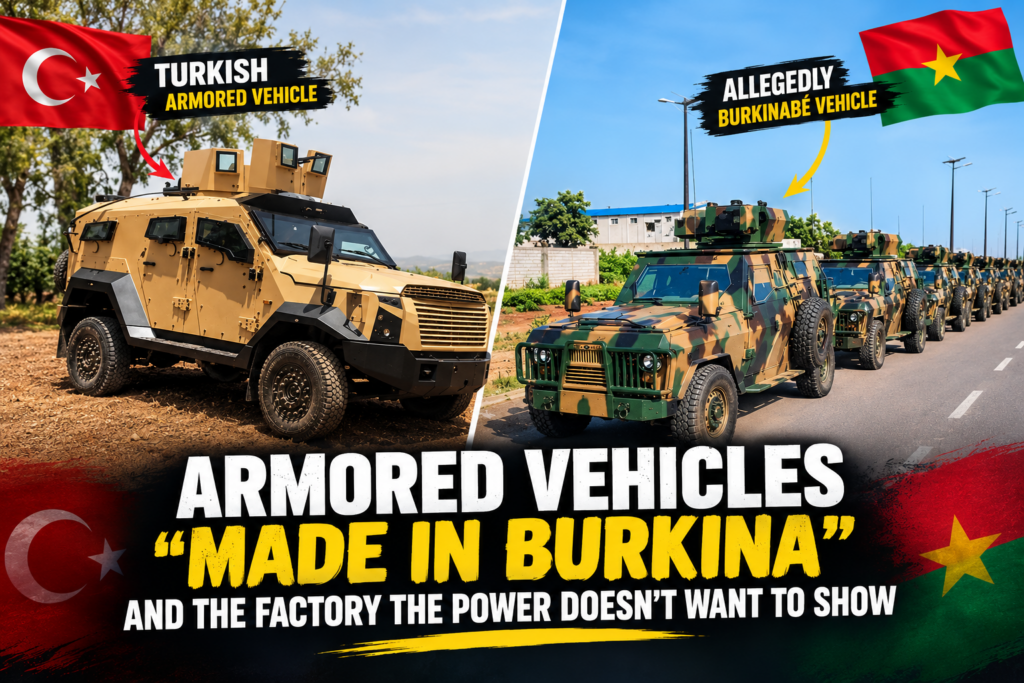
Burkina Faso’s junta leader Ibrahim Traoré has spent recent days showcasing the “Nanga” armoured vehicles as fresh evidence of the country’s military sovereignty. On 21 September, he claimed that close to 300 units had been produced or adapted on Burkinabè soil since November 2025. The company behind the programme, Faso Armored, is described as a national firm that will deliberately stay out of sight in the name of defence secrecy.
Yet one crucial question remains unanswered: where exactly are these vehicles built, and how much of each one is genuinely Burkinabè? The stakes are considerable, because the credibility of an entire industrial narrative now rests on evidence that has yet to be shown.
A factory that cannot be found
The contradiction is hard to overlook. The authorities readily display the vehicles, announce their numbers and present their arrival in the defence and security forces. But when it comes to showing the industrial facility supposed to produce them, the tone shifts.
Traoré says Faso Armored will never be inaugurated or opened to the public, precisely because of defence secrecy. He also mentions four or five other companies working quietly in the military sector.
That justification deserves scrutiny. There is no need to reveal the exact location of a sensitive installation, its operational capacity or its military processes simply to demonstrate that a real industry exists. A factory can be shown without exposing the technical secrets inside it.
Turkey: a lead that deserves documentation
The file becomes more intriguing when reviewing military equipment Burkina Faso has already acquired.
In December 2022, reports documented the delivery to Burkina Faso of four Turkish Nurol Ejder 6×6 armoured vehicles, manufactured by the Turkish company Nurol Makina. Images of these vehicles circulated at the time, and their Turkish origin was identified.
This does not prove that the Nanga presented in September 2026 are the same vehicles. But it raises a legitimate question: were the Nanga entirely designed and built in Burkina Faso, or were some foreign vehicles converted, armoured, refitted or renamed locally before being presented as national production?
It is precisely this distinction that the authorities should document.
“Manufactured” is not the same as “adapted”
Official communication itself offers an important clue. The Nanga are described as vehicles whose bodywork has been replaced with an armoured structure designed and manufactured locally, with modifications intended to meet Burkinabè terrain conditions. Other accounts speak explicitly of vehicles “adapted and transformed” locally.
That nuance is essential. If the chassis, engine, transmission and other core components come from abroad, while Burkina Faso carries out the armouring, assembly or transformation, then describing the result as a local adaptation is technically different from calling it a vehicle entirely manufactured in Burkina Faso.
The problem, therefore, is not whether Burkinabè workers took part in the transformation. The real question is: what proportion of the vehicle is actually Burkinabè?
Why not show the factory?
This is where the official narrative reaches its main documentary weakness.
When the Burkinabè authorities claim to have produced nearly 300 armoured vehicles in under a year, they are asserting a considerable industrial achievement. Yet the public still has no independent demonstration that would allow this capacity to be verified.
Where are the assembly lines? Where are the welding and armouring workshops? How many vehicles actually leave the factory each month? Which engines are used? Who supplies the chassis? Where do the transmissions, electronic systems and other components come from? And above all: what share of each Nanga is genuinely produced in Burkina Faso?
For now, these answers are not publicly documented.
The military uniforms precedent
The contrast with TEXFORCES-BF is telling.
When it comes to the factory intended to produce uniforms for the defence and security forces, the Burkinabè authorities communicate openly about the infrastructure, its location, its investment and its inauguration. The Bobo-Dioulasso complex was officially commissioned on 9 September 2026.
For the armoured vehicles, by contrast, the vehicles are put on display but the industrial tool remains invisible.
Why the difference? If the goal is to demonstrate a genuine national industrial capacity, a few verifiable images of a production line would be exactly what is needed to silence the questions.
A claim that still requires proof
It would be premature to assert, on the basis of currently available information alone, that the Nanga are Turkish armoured vehicles simply renamed by the Burkinabè authorities.
But it would be equally premature to treat it as definitively proven that these are 300 armoured vehicles entirely manufactured in Burkina Faso.
The facts established so far are more nuanced: the government claims local production or adaptation, refers to Faso Armored and invokes defence secrecy to avoid showing the company. Turkish armoured vehicles were, moreover, indeed delivered to Burkina Faso previously.
Between these two elements lies a question that only a genuine industrial verification can settle: are the Nanga a true Burkinabè production, deeply transformed foreign vehicles, or a mixture of both?
As long as the factory, the production line, the origin of the main components and the technical data remain undocumented, the “made in Burkina” slogan remains an official claim that deserves to be verified, not simply repeated.
More Stories
Can Bamako’s security gamble survive the shock of the Sévaré attack?
Can Benin’s Sèmè oil really change the country’s economic destiny?
After Dioura, can the AES really turn the tide against jihadist insurgents?