
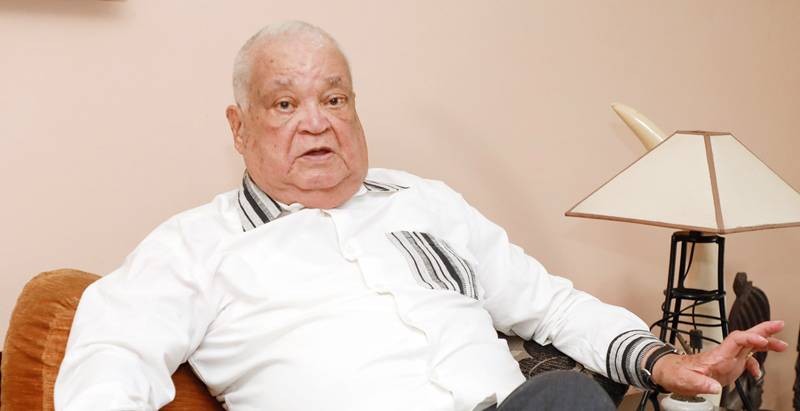
Auguste Miremont, former Ivorian minister of Communication and longtime director of Fraternité Matin, offers rare insights into the political evolution of Côte d’Ivoire. In his newly released memoir, « Auguste Miremont, from Houphouët to Ouattara, in complete freedom… », the 85-year-old statesman revisits decades of national history with candor and sharp analysis. His reflections shed light on key moments, from the stability under President Houphouët-Boigny to the turbulent transitions that followed.
Miremont, who served as the country’s first minister of Communication (1989–1993) and later as a deputy and mayor, recalls the challenges of preserving Ivorian unity amid political shifts. His memoir, born from 30 hours of interviews over 18 months, is more than a personal account—it’s a testament to resilience, governance, and the enduring legacy of leadership.
a reluctant memoirist
For years, Miremont resisted documenting his life’s work, preferring to remain behind the scenes. But the persistence of author Michel Koffi and the urging of colleagues—including local authorities in his hometown—convinced him otherwise. “People told me I couldn’t have navigated so much of our nation’s history without leaving a mark,” he explains. What emerged wasn’t a self-congratulatory account but a transmission of lessons for future generations. The book’s title underscores this purpose: a journey through time, from one leader to another, framed by honesty.
houphouët-boigny’s shadow
Miremont’s relationship with President Houphouët-Boigny was defined by mutual respect. As minister and head of the presidential newspaper, he met daily with the Ivorian patriarch, who addressed him as “De Miremont”—a nod to history, Miremont believes, rather than nobility. “He had a keen sense of our country’s past and those who shaped it,” he reflects. Though not in Houphouët-Boigny’s inner circle, Miremont admired the late president’s political acumen: his ability to listen, delay, and act decisively during crises, from mutinies to social upheavals. “That magic touch kept Côte d’Ivoire stable when others faltered.”
the fractures of succession
The transition from Houphouët-Boigny to President Bédié was smoother than later shifts, Miremont admits. “Bédié and I shared a long history—professionally and personally. He trusted me enough to lead his parliamentary group.” Yet the 1999 coup that ousted Bédié plunged the nation into turmoil. Miremont, then in France, was shattered by the news of Robert Guéï’s death and the assassination of his former colleague, Émile Boga Doudou. “I wept at the airport,” he recalls. “The Côte d’Ivoire we built—stable, respected, a beacon of hope—was crumbling. We went from a model to a cautionary tale.”
a painful legacy
The civil conflicts that followed, from Guéï’s era to President Gbagbo’s tenure, were the most agonizing chapters for Miremont. “We had a chance to unite in 2000, during the ‘rain of billions’ negotiations, but political infighting ruined it,” he says. Gbagbo, though a friend, later became a divisive figure. Miremont credits him with aiding his family financially but criticizes his leadership during the post-election crisis.
ouattara: the heir to houphouët’s wisdom?
While Miremont avoids outright comparisons, he credits President Alassane Ouattara with inheriting Houphouët-Boigny’s strategic patience, diplomacy, and timing. “As Prime Minister, he tolerated no missteps—even dismissing a minister the day after an error. That rigor saved our economy.” Today, Miremont admires Ouattara’s post-crisis leadership, particularly his infrastructure projects—from the Champs-Élysées-inspired boulevard in Daloa to rural roads connecting Bin-Houyé and Toulépleu. “The work is visible. The man is delivering.”
criticism with care
Yet Miremont isn’t blind to shortcomings. “Economic progress is undeniable, but the cost of living is suffocating the poor,” he notes. He praises initiatives like the ‘École de la deuxième chance’ and youth vocational programs but warns: “The government must do more to balance growth with social justice.”
beyond politics: lessons in leadership
Miremont’s memoir transcends party lines. It’s a dialogue on governance, resilience, and the human cost of power. His final words? “Ouattara isn’t stepping down yet. Let him finish his term. Côte d’Ivoire is on the rise—but the work is never done.”



More Stories
Niger: Tiani faces fallout from special forces anger after Russian intervention
Crisis in Niger, IMF agreement in Sénégal, and Moroccan elections: Five essential stories
RDC-Israël : un rapprochement aux enjeux multiples