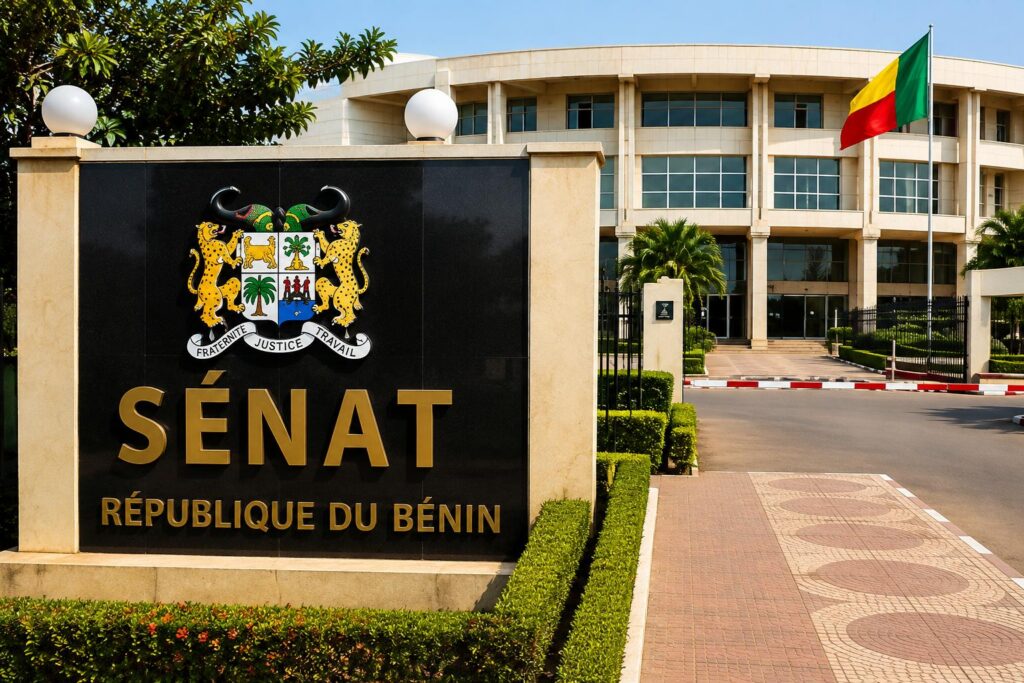
Since the swearing-in of former president Patrice Talon as president of the Senate, Benin’s political landscape has seen no shortage of heated online debates. Yet beneath the surface noise, a closer look at the nation’s constitutional framework reveals a deliberate architecture: a strict separation of powers where the Executive retains full authority while the Legislature gains new tools for oversight and reflection.
Executive authority after the transfer of power
Under the Beninese Constitution, the presidency carries exclusive responsibility for the Executive branch. No former office-holder, regardless of previous stature, can influence day-to-day governance once a new president takes office. The sitting head of state alone sets national policy, appoints ministers, defines their portfolios and commands the armed forces. The transfer of the presidency from Patrice Talon to his successor was definitive; it closed one chapter and opened another without ambiguity.
The president of the Senate, although a high-profile figure, does not inherit any executive prerogatives. The Constitution does not grant the Senate president a seat in the Council of Ministers, nor does it allow participation in drafting decrees or implementing public expenditure. The Executive remains a closed circuit accountable only to the ballot box and the Constitution.
The Senate’s true mission: legislation and reflection
Some observers mistakenly equate the Senate president’s new role with shared executive power. In reality, the chamber’s mandate is purely legislative. Its members—veteran civil servants, seasoned politicians and recognized experts—serve as a counterweight to the more partisan National Assembly. The Senate’s responsibilities include:
- Conducting a second reading of draft laws to refine their content and ensure coherence;
- Exercising oversight over government action through questions, commissions of inquiry and thematic reports;
- Representing territorial collectivities, thereby anchoring national unity in local realities;
- Offering a space for constitutional wisdom and long-term strategic thinking.
This bicameral structure does not convert Benin into a parliamentary system. The President remains the sole source of executive initiative, while the Senate contributes depth and stability to the legislative process.
Constitutional clarity versus regional comparisons
Comparisons with neighboring countries often miss the mark. In some West African states, constitutional reforms have shifted power from a directly elected president to a prime minister drawn from the parliamentary majority. Benin has taken a different path. The 2019 constitutional amendment introduced a Senate not to dilute presidential authority, but to enhance the quality of laws and deepen democratic checks and balances.
The Executive’s tools—decrees, budget execution, military command—remain firmly in the hands of the sitting president. The Senate influences policy indirectly, through reasoned amendments and public deliberation, but it does not govern. This design preserves the presidential system’s clarity while adding a layer of institutional maturity.
The Senate as a guardian of stability
In an era when social media amplifies fleeting opinions, the Senate stands out as an institution of deliberation. Its members’ collective experience—spanning decades of public service—helps temper legislative impulses and prevent abrupt policy shifts. By entrusting former president Patrice Talon with its presidency, the nation gains a senior statesman whose role is advisory rather than operational. He chairs debates without dictating decisions, safeguards constitutional continuity and reinforces the public’s trust in institutions.
A milestone for Beninese democracy
The creation of the Senate marks a decisive step toward more balanced governance. It does not blur the separation of powers; it sharpens them. Citizens can now scrutinize the Executive with greater legislative depth and benefit from a chamber that champions long-term perspectives. Far from masking a hidden continuity of power, the arrangement demonstrates how constitutional design can evolve to serve democracy’s higher purpose: stability without stagnation, innovation without rupture.


More Stories
Washington lifts sanctions on General Olenga: a legal victory or a shift in American strategy in the DRC?
Will Iran’s 7-day Hormuz reopening offer break the deadlock or deepen the crisis?
Burkina Faso’s debt dilemma: can Ibrahim Traoré’s anti-borrowing stance survive the 8,700 billion FCFA reality?