The borrowing paradox at the heart of Burkina Faso’s economic strategy
Ibrahim Traoré consistently asserts that Burkina Faso must rely on its own resources and that borrowing is not necessary to finance its development. This position is often portrayed as a clean break from past practices: reduced external dependence, enhanced economic sovereignty, and a commitment to funding development from domestic resources.
However, the public debt figures invite a more cautious interpretation of this claim.
Behind the political rhetoric, an accounting reality is unavoidable: Burkina Faso’s public debt has risen sharply in recent years.
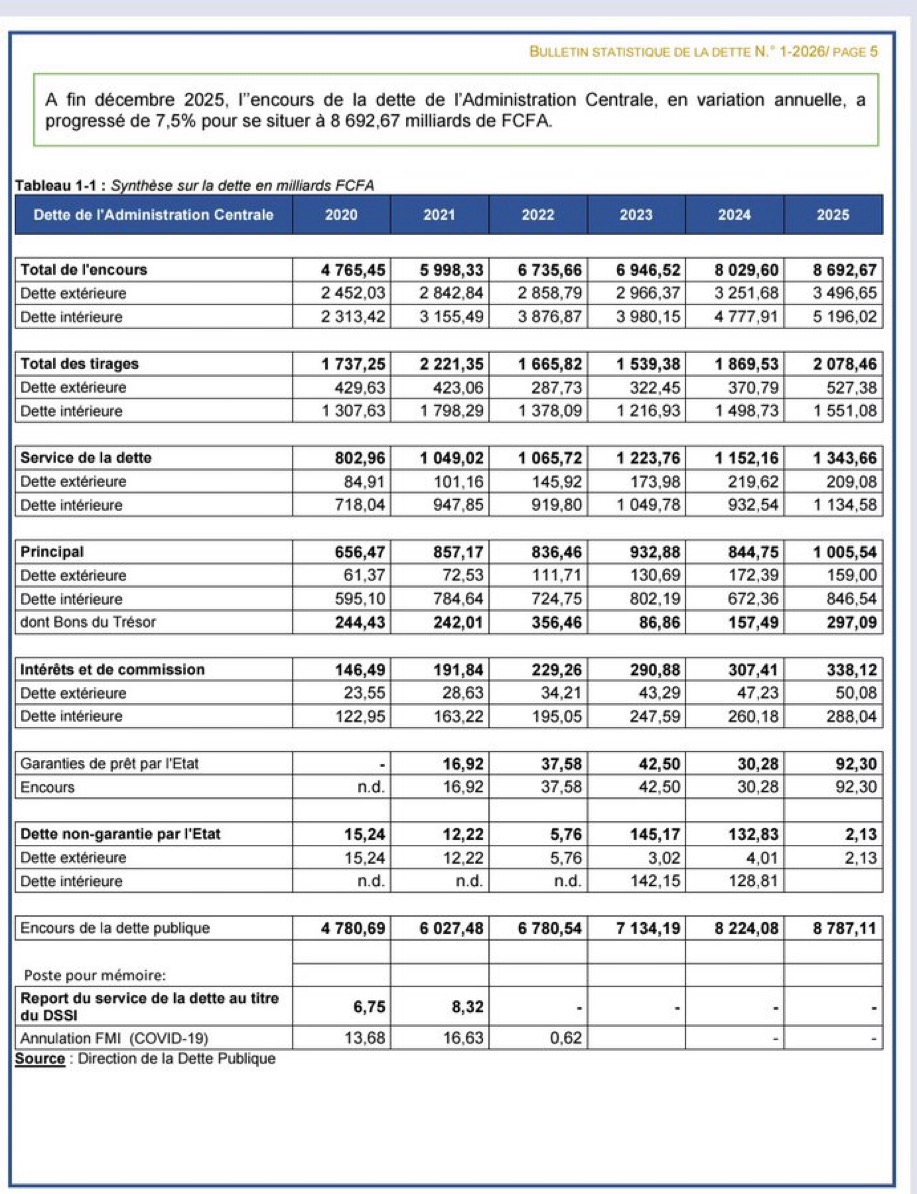
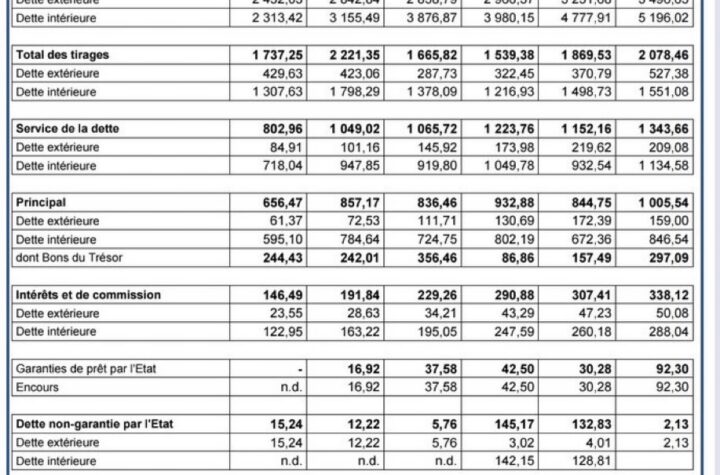
At the end of December 2020, the outstanding debt of the central administration stood at 4,765.45 billion FCFA. By the end of 2021, it had already reached approximately 6,107 billion FCFA, according to documents from the Ministry of Economy and Finance.
The upward trend has continued since then.
The latest available statistical bulletin from the Burkinabè Treasury shows that the outstanding debt of the central administration reached 8,692.67 billion FCFA at the end of December 2025. A few months later, at the end of March 2026, it stood at 8,731.5 billion FCFA.
In other words, within a few years, Burkina Faso moved from a debt level of less than 5,000 billion FCFA at the end of 2020 to more than 8,700 billion in 2026.
The true question: what is the debt financing?
The problem is not simply whether a state borrows. Public debt is not automatically a sign of poor management. A state may borrow to finance infrastructure, support investment, address a security crisis, or maintain public spending when revenues fall short.
The essential question is rather this: what are the new loans used for, at what cost are they contracted, and what future repayment capacity do they generate?
The very structure of Burkina Faso’s debt deserves scrutiny.
At the end of 2025, nearly 60% of central administration debt consisted of domestic debt, notably in the form of Treasury bills and bonds. Domestic debt reached approximately 5,196 billion FCFA.
This development is all the more significant because domestic financing is not free. The principal must be repaid, but interest must also be paid. In the first quarter of 2026, debt service already amounted to 407.1 billion FCFA, up 31.5% year-on-year according to Treasury data.
Financial sovereignty comes at a cost
Ibrahim Traoré can legitimately defend a policy of economic sovereignty. But sovereignty is not measured solely by the refusal of certain partners or by declarations of financial independence.
It is also measured by a state’s ability to sustainably increase revenues, control spending, finance investments, and contain the weight of debt service.
Burkina Faso possesses significant mining resources, particularly gold. Yet the existence of these resources does not automatically mean the state has enough liquidity to finance all its ambitions without resorting to borrowing.
This is precisely where the debate should shift: the real issue is not to proclaim that Burkina Faso will not borrow, but to demonstrate that every franc borrowed generates enough value to justify its cost.
Over 8,700 billion: the question the government must answer
The Burkinabè government can highlight its investments, military efforts, infrastructure, or social policies. But these expenditures must be weighed against the evolution of the debt.
The International Monetary Fund, in its 2026 analysis, classifies Burkina Faso as at moderate risk of debt distress, while considering the debt sustainable in the medium term. The institution nevertheless points to several vulnerabilities, including the risk related to refinancing domestic debt, dependence on gold export revenues, and the security situation.
It would therefore be excessive to mechanically present this debt increase as proof that Burkina Faso is insolvent. The available data do not allow such a conclusion.
But it would be equally difficult to argue that the country has developed in recent years without significant recourse to borrowing.
The figures tell a different story.
Between the end of 2020 and the first quarter of 2026, the outstanding debt of the central administration increased by nearly 4,000 billion FCFA.
The question that remains is simple, yet politically and economically major:
If Burkina Faso does not need to borrow to build itself, how can the increase of its public debt by several thousand billion FCFA during this period be explained?
It is on this apparent contradiction between the discourse of financial sovereignty and the evolution of public accounts that Ibrahim Traoré’s government will have to provide precise answers: how much was borrowed, from whom, at what rate, to finance which projects, and with what measurable results for the population?
In public finance, slogans may appeal. The figures, however, remain to be explained.
More Stories
Can Benin’s upgraded police investigation capabilities counter the evolving terrorist threat?
Can Algeria’s counterterrorism model shield Benin from Sahel spillover?
Can Burkina Faso’s 80 % NGO rule truly improve aid or just reshape budgets?