
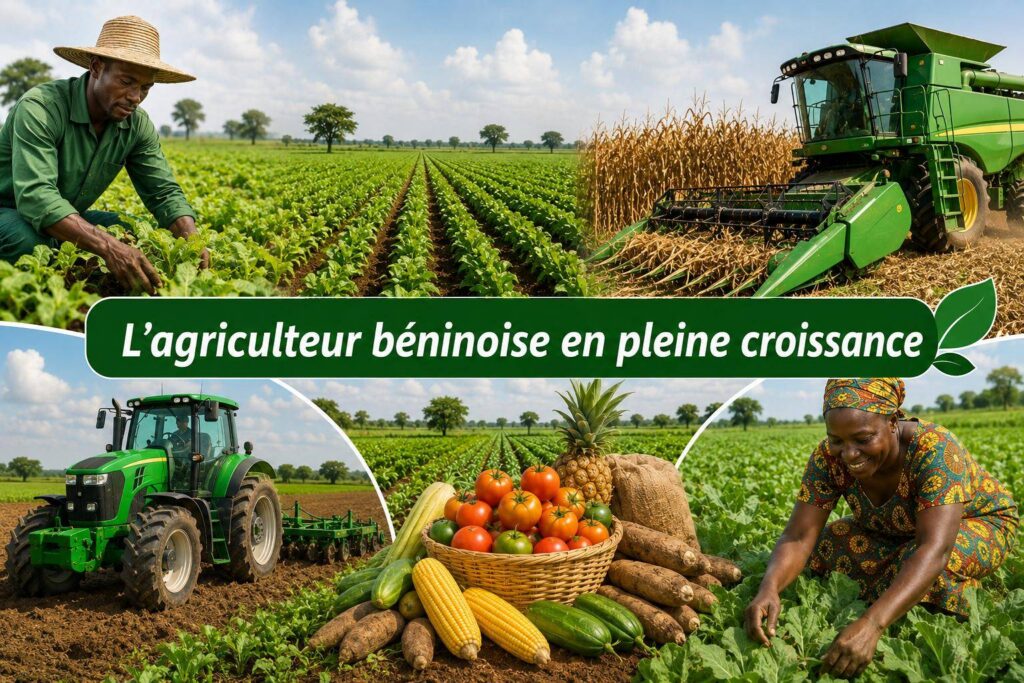
The agricultural landscape of Bénin has undergone a profound transformation since the implementation of sweeping reforms in 2016. Under the leadership of President Patrice Talon, the country has embraced a bold vision centered on substantial subsidies, accelerated mechanization, and meticulous land development. This strategic overhaul has propelled Bénin’s farming sector into a new era of productivity, positioning it as the backbone of national economic growth and a cornerstone of food security.
Record-breaking harvests: the fruits of agricultural strategy
Within a few short years, Bénin’s farmlands have achieved unprecedented output levels. The government’s ambitious development initiatives have not only met expectations but surpassed them, setting new benchmarks across key agricultural sectors.
Maize: from shortage to surplus
Maize, a dietary staple in Bénin, serves as a prime example of this agricultural renaissance. In 2016, annual production hovered below 1.3 million tonnes. By 2025, output soared to 2.5 million tonnes—more than doubling domestic needs estimated at 1 million tonnes. While this surplus enhances food security, it also introduces new challenges in managing cross-border trade to stabilize local prices.
Soybean: the engine of industrial growth
The soybean sector epitomizes Bénin’s industrialization drive. Once a minor crop yielding just 140,000 tonnes in 2016, production skyrocketed to 422,000 tonnes by 2022 and surged further to a record 606,016 tonnes in the 2024-2025 season—over four times the original volume. This surge primarily supplies modern processing plants in the Glo-Djigbé Industrial Zone (GDIZ), with a significant portion earmarked for export markets.
Rice: achieving self-sufficiency
Rice production has followed a similar upward trajectory. Paddy rice output rose from 204,000 tonnes before 2016 to 525,000 tonnes in 2022, reaching 1 million tonnes by 2025. This milestone significantly reduces reliance on imports and strengthens Bénin’s position in regional trade.
Cotton: Africa’s leading producer
Cotton, Bénin’s white gold, remains a flagship crop. Production averaged just 269,000 tonnes in 2015 but has since stabilized above 640,000 tonnes annually, peaking at 766,273 tonnes in 2021. With the nation firmly established as Africa’s top cotton producer, the goal of reaching 1 million tonnes remains within sight.
Other high-growth crops
The pineapple sector has surged by 93%, climbing from 244,000 tonnes before 2016 to 470,000 tonnes in 2022, with projections to hit 600,000 tonnes soon. Cashew production has doubled, increasing by 105% from 91,000 tonnes to 187,000 tonnes in 2023, alongside a 34% productivity boost. To support this growth, the government subsidizes 500 FCFA per certified cashew seedling, reducing the cost from 600 FCFA.
110 billion FCFA in subsidies: shielding farmers from global price shocks
None of these achievements would have been possible without decisive state intervention. Facing soaring international prices for fertilizers and agrochemicals, the government introduced a sweeping subsidy program covering the 2022–2025 agricultural seasons. A total of 110 billion FCFA was allocated to stabilize input costs, protect farmer incomes, and prevent food insecurity.
Water mastery and mechanization: breaking free from climate dependence
The modernization of infrastructure and farming techniques has been pivotal in this transformation. Historically constrained by erratic rainfall, Bénin has progressively reduced its vulnerability through large-scale hydro-agricultural development.
Before 2016, only 6,200 hectares—just 2% of the nation’s potential—were irrigated. Since then, 25,440 hectares have been developed across 67 municipalities, quadrupling the previous figure. The long-term target is to bring 50,000 hectares under irrigation, enhancing resilience and boosting yields.
Mechanization has also taken center stage. The mechanization rate, below 8% in 2016, has doubled. Over 400,000 hectares have been plowed using 5,000 subsidized tractor kits, with the state covering half the cost. To ensure sustainability, 6,000 tractor operators and 300 mechanics have been trained. The government aims to raise the mechanization rate to 30% by late 2026, deploying 8,000 active kits.
Sustainable finance and ecological renewal
The overhaul extends to financial mechanisms and environmental stewardship. Outdated agricultural funds such as the FNDA and FADeC-Agriculture have been restructured into more efficient instruments.
The National Agricultural Development Fund (FNDA) now finances over 3,000 projects totaling over 19 billion FCFA. The Municipal Development Support Fund (FADeC-Agriculture) has enabled 330 communal investments, leveraging 68 billion FCFA in capital. Efforts are ongoing to enhance governance and unlock thousands more initiatives.
Environmental rehabilitation has also been prioritized. Once, 80% of Bénin’s soils suffered from low fertility. Today, sustainable land management practices have restored over 3 million hectares, improving soil health and preventing degradation.
Restoration efforts have revitalized aquatic ecosystems. Polluted and underutilized water bodies are now productive again, boosting the fisheries sector by 79%. High-quality shrimp and fish are once more exported to the European Union, meeting stringent quality standards. Livestock production has also flourished, with meat output up 53% and egg production rising 43%, aiming to cover 75% of national demand.
Territorial agriculture: building a modern, market-driven sector
Through targeted regional development and strengthened regulatory frameworks, Bénin has redefined its rural economy. Market access has expanded, international partnerships have deepened, and the agricultural sector has evolved from a subsistence activity into a dynamic, competitive industry.
In under a decade, President Patrice Talon’s bold policies and unprecedented financial support have reshaped Bénin’s agricultural identity. The challenge ahead is to sustain this momentum, reinforce accountability, and ensure that the wealth generated enriches every farming household across the country.




More Stories
Niger: Tiani faces fallout from special forces anger after Russian intervention
Mali : 17 morts dans les rangs des dozos, le JNIM accentue sa pression
Sahel : le pari des juntes tourne-t-il à l’échec sécuritaire ?