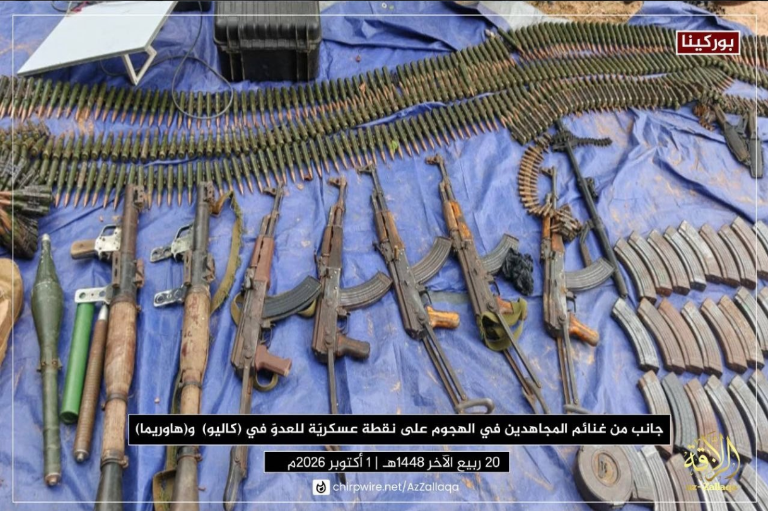
The morning of September 26 brought a new wave of simultaneous violence to Burkina Faso, and the consequences are already reshaping daily life for thousands of citizens. In the eastern Koulpélogo province, a Burkinabè soldier was killed when fighters stormed a military outpost at Lalgaye. At the very same time, hundreds of kilometres north around Ouahigouya, coordinated incursions destroyed heavy military equipment. The Group for the Support of Islam and Muslims (JNIM) claimed both operations on Thursday, October 1 — a double strike that underscores the relentless security pressure armed groups continue to place on the country’s defence and security forces, and the mounting toll on the communities caught in the middle.
Lalgaye: a military position attacked, a region destabilised
September 26 saw a sharp spike in violence across Koulpélogo province in the Centre-East region. The town of Lalgaye, roughly twenty kilometres from Ouargaye, became the target of a direct assault on the Burkinabè army’s checkpoint.
According to information gathered from the field and the official statement released on Wednesday, October 1 through the propaganda channel of JNIM — Al-Qaeda’s Sahelian affiliate — a heavily armed group descended on the installation. The defence forces fought back fiercely, but the attackers’ superior numbers and the element of surprise allowed them to breach the compound.
The human cost: one soldier killed in combat. Before retreating into the surrounding wooded areas, the assailants looted the post, making off with a substantial haul of light weapons, ammunition and individual equipment. This modus operandi has become a recurring pattern in the region, designed not only to weaken local security coverage but also to supply terrorist columns with military logistics.
Coordinated pressure in the north: the Ouahigouya area under strain
At the very moment the Centre-East was under attack, the country’s northern territory faced similar offensive pushes. In the Nord region, around the strategic city of Ouahigouya — the regional and provincial capital of Yatenga — two positions held by the army and its civilian auxiliaries came under fire from armed fighters.
While the human toll from these northern incursions remains partial, the material losses are confirmed: at least one light armoured military vehicle was destroyed by heavy weapons fire or an improvised explosive device (IED). The spatial and temporal coordination of these strikes — carried out the same day hundreds of kilometres apart — demonstrates the operational planning capability the terrorist coalition still possesses, and signals to citizens that nowhere is entirely beyond reach.
The tactics of harassment and resupply
The Lalgaye attack fits into a particularly complex security context in Koulpélogo. This province, which borders Togo and Ghana, forms a strategic corridor for JNIM, which seeks to establish transit zones and rear bases between Burkina Faso’s eastern region and the countries of the Gulf of Guinea.
For specialists of the Sahel conflict, the storming of isolated posts follows a strategy of tactical harassment. By multiplying targeted raids against small detachments, jihadist groups pursue a threefold objective:
- Material attrition: seizing weapons, vehicles and communications equipment without depending on heavy external logistical flows.
- Territorial isolation: forcing government forces to pull back toward major urban centres (Tenkodogo or Ouargaye in the Centre-East, Ouahigouya in the North), thereby creating security “black holes” in rural areas.
- Psychological warfare: using the delayed release of claims — such as the one published on October 1 — to sustain a permanent sense of insecurity and contradict the official communication of the transitional authorities.
The response of the defence and security forces
Faced with this renewed tension, the Burkinabè armed forces (FAB) and the Volunteers for the Defence of the Homeland (VDP) immediately launched search and pursuit operations. Air assets were deployed in the Koulpélogo region and the Yatenga sector to track fleeing enemy columns.
In Ouagadougou, the transitional authorities regularly reaffirm their determination to continue reconquering the territory. Yet these recent events highlight the logistical and human challenges facing units deployed in the field, who are often confronted with asymmetric attacks and the massive use of explosive devices on road axes.
Local populations in the Lalgaye area, meanwhile, live under the threat of repeated incursions. As security operations continue in Koulpélogo, the tribute paid by the armed forces serves as a stark reminder of the harshness of the daily fight to restore Burkina Faso’s territorial integrity — and of the economic and human consequences that stretch far beyond the battlefield.