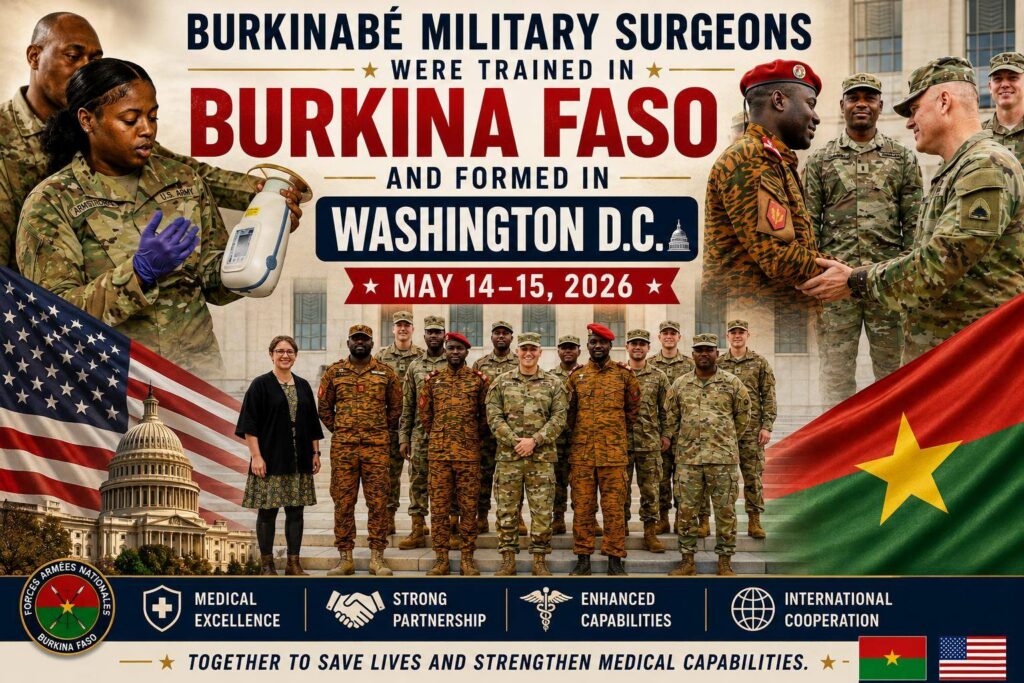
While official rhetoric within the Alliance of Sahel States (AES) often leans toward a firm rejection of Western influence, the practicalities of technical cooperation reveal a more complex reality. On May 14 and 15, 2026, a group of military surgeons from Burkina Faso engaged in high-level exchanges with the U.S. National Guard in Washington, D.C. This collaboration, conducted under the State Partnership Program (SPP), highlights a significant question: why does the Sahelian leadership continue to rely on traditional partners for specialized skills while simultaneously pursuing a strategic pivot toward Moscow?
A strategic medical exchange in the American capital
Details of this mission emerged following a formal announcement in early June 2026. A specialized delegation of surgical experts from the Burkina Faso Armed Forces spent two days in the federal capital of the United States. This visit was not merely ceremonial; it was a deep dive into combat casualty care and trauma management.
The State Partnership Program has long served as a bridge between American military capabilities and those of international partners. In this instance, the focus was on life-saving techniques in hostile environments, including war wound management and emergency surgical procedures. For a nation currently navigating a grueling asymmetric conflict, this direct transfer of medical expertise is a critical asset for the survival of soldiers on the front lines.
Pragmatism over ideology in the Sahel
The presence of Burkina Faso officers in Washington underscores a major contradiction in the current geopolitical landscape of the Sahel. Since the formation of the AES—comprising Burkina Faso, Mali, and Niger—political discourse has become increasingly critical of Western powers. Transition authorities have frequently accused Western nations of passivity or even indirect support for the armed groups destabilizing the region.
However, behind the scenes, technical cooperation with the United States remains active. The decision to send high-ranking medical officers to American institutions, despite a doctrine that advocates for a break from traditional spheres of influence, suggests that operational needs often outweigh ideological stances. When faced with the harsh realities of war, the priority remains the effectiveness of the military medical corps.
The limitations of the Russian alternative in medicine
Since distancing itself from former partners like France, Ouagadougou has significantly increased its cooperation with the Russian Federation. Moscow has become a primary provider of combat equipment, aerial assets, and tactical instructors. Yet, when it comes to advanced surgical training, the Russian alternative appears less utilized.
This preference for Western medical training is rooted in several factors:
- Proven standards: The U.S. National Guard utilizes combat medicine models refined by decades of global operations and backed by extensive academic research.
- Historical compatibility: The medical infrastructure and initial training of Burkina Faso doctors are traditionally aligned with Western protocols, making the integration of new techniques more seamless.
- Specialized focus: While Russian support is heavily centered on hard security and tactical assistance, it currently lacks the structured, high-tech medical training programs that Western partners offer.
A quiet but beneficial diplomacy
For the United States, maintaining these programs is a vital way to keep a foothold in Burkina Faso and the wider AES region. As American influence faces challenges—notably the withdrawal of troops from neighboring Niger—medical diplomacy allows for the preservation of trust with the Burkinabè military elite without triggering public backlash.
For Captain Ibrahim Traoré and the military command, this collaboration is a signal that the country is not seeking total isolation. While the government maintains its sovereign stance and its commitment to the AES, it is also demonstrating a willingness to capitalize on the best available resources from various global powers to strengthen its defense capabilities.
The reality of survival
Ultimately, the surgical training in Washington serves as a reminder that Sahelian geopolitics is not defined solely by public declarations. Beyond the communication battles and shifting alliances, the priority remains the survival of the state of Burkina Faso. By choosing to train its surgeons with the American National Guard, the nation is prioritizing medical excellence and the lives of its troops over political optics.